
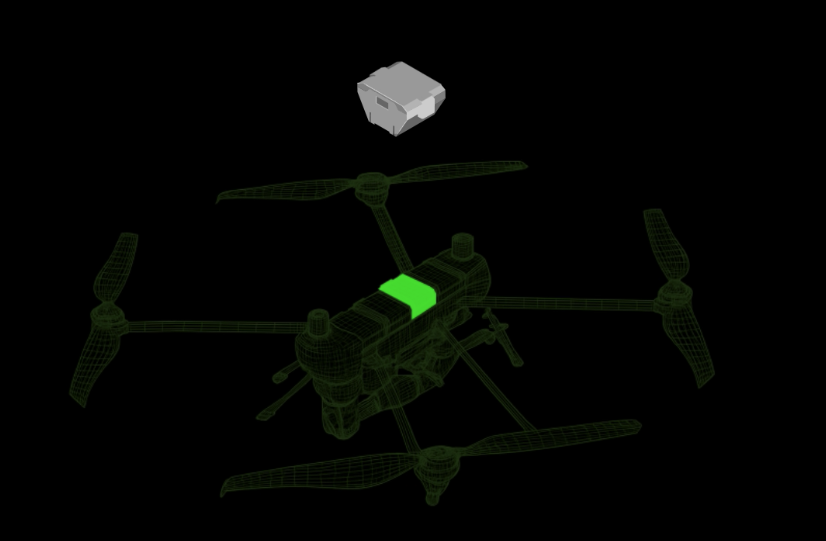
Whatever image you have of what batteries look like, forget it.
On Tuesday, Miami-based 3D-printed battery startup Material announced it had raised a $7.1M seed round co-led by Outlander VC and Harpoon Ventures. The company is taking aim at a surprisingly persistent problem: Batteries power nearly everything we write about, yet they’re rarely designed for the platforms they actually serve—like drones.
With 3D printing, Material argues it can move beyond the one-size-fits-all battery model—and make the autonomous systems we know and love more efficient, to boot.
“Every electrified device on planet Earth is fundamentally compromised by the size and shape of the batteries used—your cell phone, car, smart watch, smart glasses, the drone that a soldier is flying,” Material CEO and co-founder Gabe Elias told Tectonic. “All these things are compromised by the shape of electrical storage, which, right now, is cylindrical or prismatic cells. That’s just how electrical energy is stored.”
Power problems: Those clunky cylindrical or boxy prismatic cell batteries create a lot of dead space and require the products they’re housed in to be built around them, which is a pretty big problem for all those teeny, zoomy, drone-y things that are all the rage these days.
Material has a different take: 3D-print the batteries to make them conform to the things they go in. And they have a powerhouse founding team working to make that a reality.
- Gabe Elias: A former seven-time world champion design engineer on the Mercedes Formula 1 team and engineer at Rivian.
- Miles Dotson: A serial entrepreneur and engineer.
- Dr. Christopher Reyes: The guy who pretty much published the core research that laid the groundwork for the 3D-printed battery field a decade ago.
Since launching the company in 2023, Material has developed a proprietary manufacturing platform that produces the full-stack battery, called HYBRID3D. Put simply, the platform prints energy directly into a component of any shape or size, making it form-fitted to the things it’s powering and reducing dead or inefficient space.
On the drone front, that means the batteries could be printed directly into the airframe, reducing weight, boosting aerodynamics, and maximizing available power and payload capacity.
Charging ahead: Naturally, that’s gotten the attention of a drone-obsessed US military.
- Material won an SBIR Phase I contract with the Air Force Research Lab and AFWERX last February, and a follow-up $1.25M Phase II last August, focused on developing lightweight, high-energy-density batteries for drones and autonomous aerial platforms.
- Under that contract, they’re working with Alabama-based PDW and Teledyne FLIR, and are expected to deliver 3D-printed batteries for “multiple drone applications, probably in the next 10 months,” Elias said.
With PDW, Material has simulated that they can add “55 percent more energy density [to PDW’s C-100 quadcopter] with no mass penalty,” according to Elias. “That means you can either fly 55 percent longer with the same payload, or decrease the size of the battery pack literally in half and increase the potential payload with the same runtime.”
It’s not just small UAV companies that see the technology’s potential. “The inbound that we get is from really the widest breadth of applications you can think of,” Elias said. “We’re talking laser scopes for rifles, hypersonics, submersibles and semi-submersibles, drones, aircraft. I mean, the applications are really boundless.”
Material money: With the Air Force and companies actively exploring what Material can bring to the table, the company has caught the attention of investors, raising a $7.1M seed round led by Outlander VC and Harpoon Ventures.
“The US wants faster innovation, stronger industrial capacity, and technologies that deliver not just capability, but high-performance capability,” Outlander’s AJ Smith told Tectonic. “Material is, in my humble opinion, a very big piece, potentially, that could fit right in line with those priorities.”
Harpoon, which co-led the round, is equally fired up.
“The drone market’s getting a little bit crowded,” Harpoon investor Riley Loftus told Tectonic. “If you can find something that enables all those companies, even if only one drone company ends up being the winner here, these guys are going to be around to supply them.”