In case you haven’t been paying attention, electronic warfare is kind of a big thing right now.
Few are more aware of that than CX2, the El Segundo-based defense tech startup that says it’s “securing spectrum dominance for the United States and its allies.”
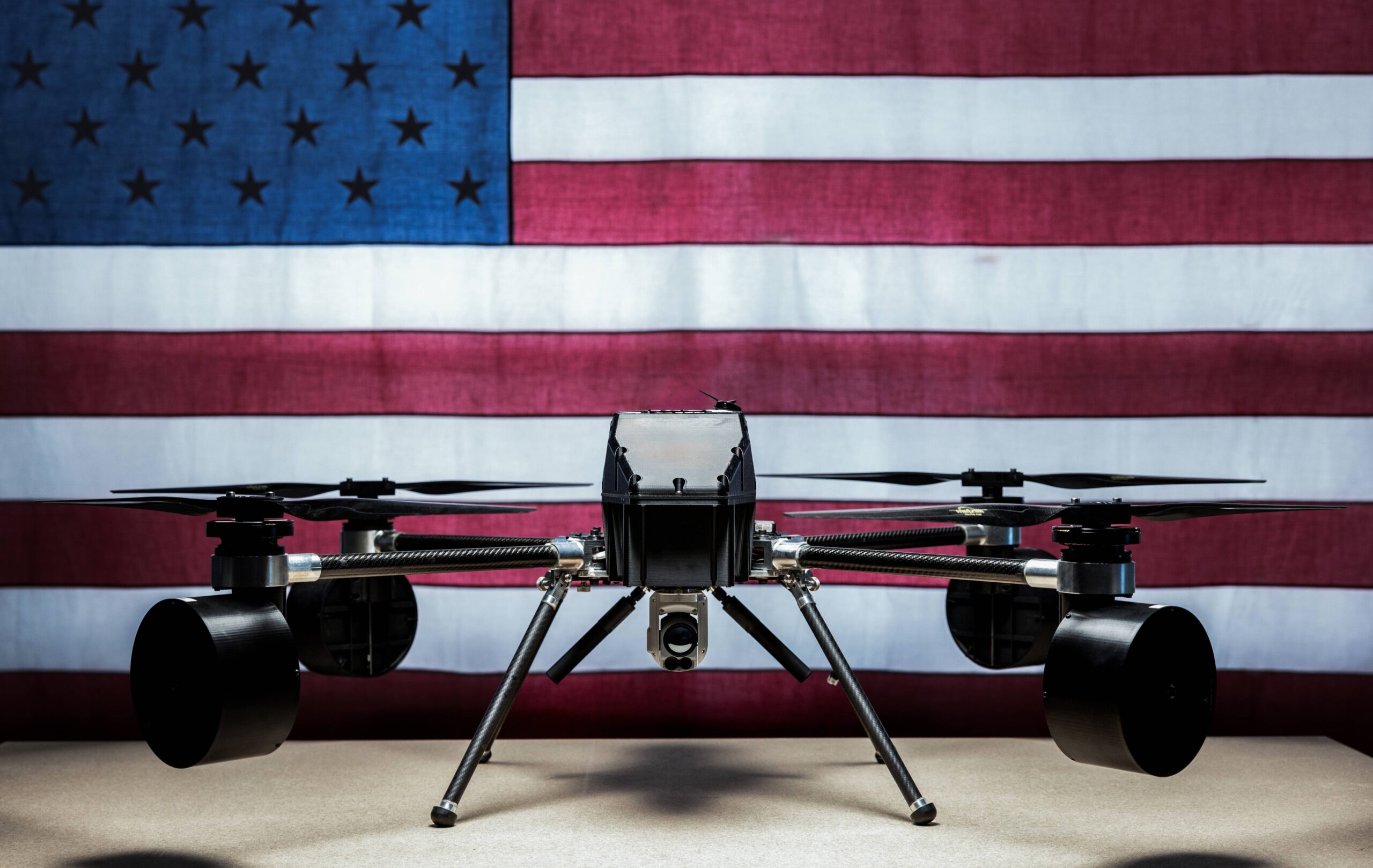
This morning, in an exclusive release to Tectonic, the company unveiled its latest means of achieving that—an “airborne electronic intelligence (ELINT)” system called Wraith, which is “designed to detect and geolocate hostile emitters… [giving] operators immediate, attributable data when traditional systems go blind.”
In layman’s terms, it’s essentially a drone equipped with sensors that can pick up everything from GPS jammers to enemy control links, giving operators a picture of where EW is coming from on the battlefield. Wraith also integrates with CX2’s other tools, like Vadris, which can then help find and target those emitters (or drone pilots).
“Wraith is an airborne EW platform that was tailor-made for where we think the drone wars are going, which is the need for ground forces to be able to organically find, fix, and ultimately finish anything on the modern battlefield that emits, which is pretty much everything,” CX2 Head of Warfare Porter Smith told Tectonic.
Sounds like someone’s taken those lessons from the battlefield in Ukraine to heart.
Invisible war: We covered CX2 a few weeks back when they launched Vadris, but let’s do a quick refresh. The company was founded in 2024 by a pretty legendary team, including:
- Nathan Mintz (CEO), an ex‐EW/radar engineer at Raytheon & Boeing and an Epirus co-founder
- Mark Trefgarne (President), a tech entrepreneur behind behemoths like LiveRail and Meta
- Smith (Head of Warfare), a former a16z investor and DIU fellow
- Lee Thompson (Head of Hardware), the former head of RF engineering at SpaceX
The company’s quest for “spectrum dominance” follows a three-step approach:
- Find: Tech that can detect and track emitters, equipped with edge-capable AI for denied environments. That’s where Wraith fits in.
- Fix: tools that can locate and classify emitters even in jammed environments. That’s Vadris.
- Finish: The boom-boom and jamming side of things—targeting and disruption tech that enable a kinetic or EW response to whatever is giving off those signals.
This approach (and team, we’re willing to guess) has been a hit with investors: Earlier this year, CX2 raised a $31M Series A led by Point72 Ventures with participation from Andreessen Horowitz, 8VC, 201 Ventures, and Pax Ventures.
That’s my jam: As warfare shifts toward a “jam or be jammed” reality (looking at you, Ukraine and Russia), Wraith is a pretty sweet setup. Here’s how it works:
- The drone itself looks a lot like a quadcopter RF with sensors on board.
- The “hardened airborne sensor” (CX2’s classification) has onboard processing and a “wideband RF front end” that can basically fly over the battlefield and pick up where RF emissions are coming from.
- Wraith plugs into the company’s EW Operating System, creating a neat operating picture for users. Smith compared it to “a spectral heat map that shows where everything is…a map of [the] invisible battlefield.” This mapping is designed to plug into pretty much any C2 platform, from Lattice to Maven.
- Once they’ve got locations, operators can then decide how to respond—with targeting, jamming, etc. FWIW, Wraith plays quite nicely with Vadris.
“It is a hunter-killer pairing,” Smith said. “Wraith goes up as the hunter and maps everything out…Vadris is then used as the killer. This creates a closed kill chain between two systems for organic ground force elements.”
On the frontline: Wraith was developed largely in response to what Smith saw on the battlefield in Ukraine—he told Tectonic he’s been going to the country since 2023. “The key takeaway on the modern battlefield that we see over there is that now drones have kind of flooded the zone,” he said. “There’s this invisible war going on in the RF spectrum.”
The system was actually inspired by what Smith saw Russians using against Ukrainian forces. Basically, they would use an ISR drone to find Ukrainian emitters and operators, then use a loitering munition to take them out. “I think [this combo is] probably the most lethal thing they have out there on the battlefield,” he said.
Wraith took the concept and scaled it down—the idea was to build something that could have a similarly lethal effect but for a much, much lower cost. (In case you didn’t know, EW platforms tend to be very large and very expensive.)
“[This is a] platform that democratizes access to these capabilities to the lowest level, which is something the US military hasn’t ever had before,” Smith added.
Testing, testing: And so far, it’s been a hit. While CX2 couldn’t tell us exactly who has tried out Wraith, Smith said that it had flown at a “variety of US military exercises that have had live jamming” and “successfully [flew] against and geo-located a 300-watt GPS jammer at a major US military exercise last spring.” He added that several units are “actively interested” in purchasing the system.
Wraith isn’t in full production yet, but Smith said the company expects to start churning them out for purchase in January 2026. He noted that the drone and sensors are made entirely of “US and allied components” and are being built at their factory in El Segundo.