If anyone thinks M&A isn’t the road to success, someone better tell the defense tech world—and fast.
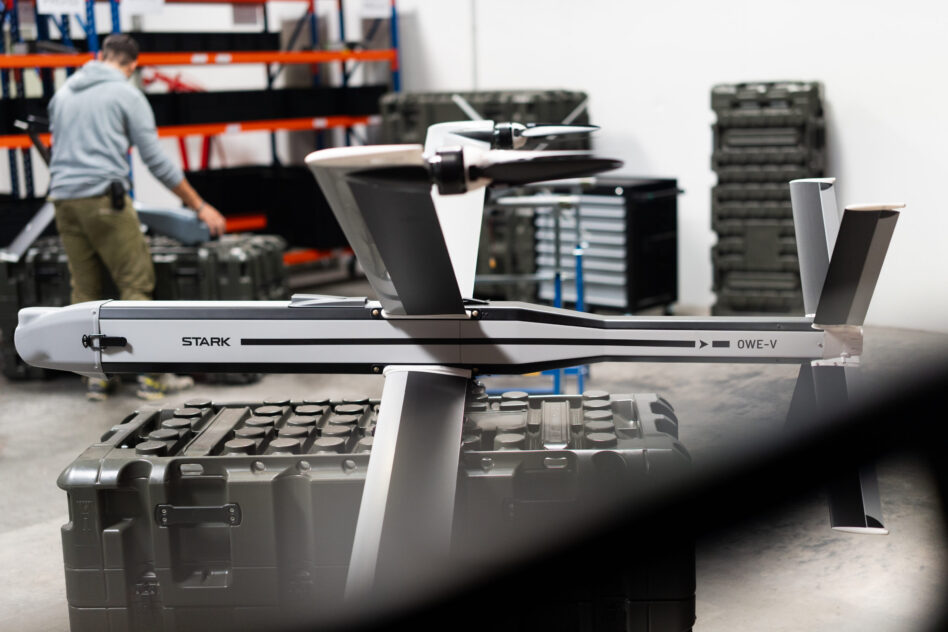
Earlier this week, European defense tech darling STARK announced that it has acquired AeroMass Technologies, a “distributed manufacturing company” that says it builds “scalable, attritable systems for the modern battlefield.”
The move comes just a few months after STARK raised $62M at a $500M valuation led by Sequoia, and after it dipped its toes into maritime with a new USV in September.
But it sounds like that was just the tip of the iceberg. James Earl, STARK programme manager and co-founder of AMT, told Tectonic that the company’s “portfolio of products is significantly broader than we have publicly released.”
“AMT’s manufacturing process is already in use in a number of these projects,” he said. “It’s not about speeding up production; it’s about achieving scale rapidly.”
Earl added that this comes down to breaking manufacturing into its composite parts. “By focusing on how you design systems, components, and sub-assemblies for existing manufacturing capability, you free up the supply chain by diversifying it—and by not relying on constant government buying to keep that workforce busy,” he said.
Speed networking: STARK’s old hat around here, so let’s kick things off with AMT. The company was founded back in 2023 and helps companies scale production using an “extensive production network which makes use of traditional and non-traditional manufacturers based in Europe,” according to a STARK statement.
“AMT doesn’t own factories; it is a design-for-manufacturing process that utilises non-defence-aligned manufacturing to generate capability at a moment’s notice,” Earl said.
In real terms, that means that—basically—the company has brought together a whole load of manufacturers (some that make commercial products) and can leverage their production capacity to build things like drones and other weapons systems on demand.
- The thesis underpinning the whole thing is that building out factories is really freaking expensive.
- Rather than using investment there, AMT—now STARK—uses existing production lines to build the parts and systems they need, and fast.
- Earl said that for now, the approach is being used for STARK’s aerial tech, “but the application can easily be expanded as needed.”
“In acquiring AMT, we are leveraging not only their dynamic approach to production, but also their impressive manufacturing network, which will help to keep NATO safe,” STARK CTO Johannes Schaback said in a statement.
STARK did not disclose the financials of the deal, but Earl said that all of AMT’s contracts (they say they’re already working with the UK MoD and “other allied militaries”) will be passed on to STARK as part of the acquisition. They’re also already “applying this process in the UK and Europe today,” he added.
Making a splash: This is STARK’s second acquisition of the year—back in July, the company snapped up Pleno, a Berlin-based startup that specializes in comms-denied navigation for low-cost drones.
The M&A expansion method is one that STARK’s step-sibling-once-removed Quantum Systems has also leaned in on—this year alone, QS has bought up AirRobot, Nordic Unmanned, and Spleenlab, and says it will use the €180M ($210M) to carry out “strategic acquisitions specifically aimed at strengthening and expanding [its] multi-domain offerings.”
What’s that? Are those the rumblings of the great defense tech roll-up kicking off across the pond?