In case you hadn’t noticed, two things have really defined the modern battlespace: Cameras are pretty much everywhere, and GPS navigation could be going the way of the sextant.
On Tuesday, Vantor and Niantic Spatial announced they’re teaming up to build a unified visual positioning system (VPS) that combines Vantor’s aerial intelligence with Niantic’s ground-based localization. The goal is to enable air and ground platforms—and all their cameras and sensors—to determine their location and navigate in GPS-denied environments.
If that sounds complicated, it is. But bear with us, ‘cuz this is pretty cool.
Dream team: Niantic and Vantor aren’t reinventing the wheel here.
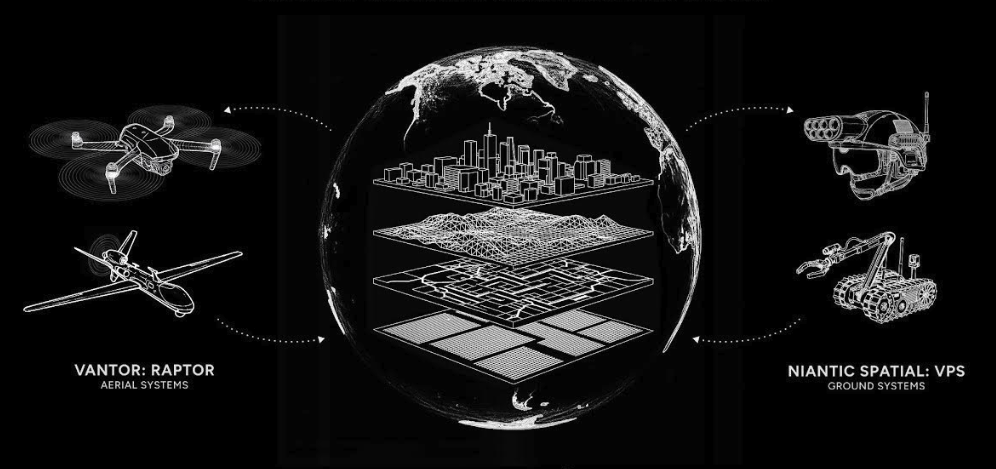
The companies have been working on air (in Vantor’s case) and ground (in Niantic’s) positioning and building 3D representations of the real world for a while. This new VPS integrates two of their proven systems: Niantic’s localization system and Vantor’s Raptor system.
- Raptor: A platform-agnostic, vision-based software that allows autonomous drone platforms to navigate sans GPS and pinpoint ground coordinates by cross-referencing camera feeds and sensors with Vantor’s big ‘ol repository of global 3D terrain data.
- Niantic VPS: A localization system that uses a platform’s camera—whether that’s on an AR goggle or an unmanned ground vehicle—to determine its location and orientation in the real world. It uses Niantic’s Large Geospatial Model (a high-fidelity geospatial model of the Earth), built on posed images, user scans, and mapping data.
Combo deal: Put simply, Niantic and Vantor respectively have the ground and aerial visual localization stuff covered, and this integrated capability aims to create a unified GPS-free operating system fusing the intel collected through camera feeds—matched against their respective 3D representations of the real world—to make sure all of the autonomous systems and soldier-borne tech are on the same page.
The power duo is moving fast on this, aiming to kick off field demos in early 2026. Team chemistry has helped on that front.
“A lot of people on our team have worked with [Niantic] for 15-20 years in various capacities, so there’s a lot of shared DNA, and we’ve explored what it would look like to connect the systems,” Vantor’s Chief Product Officer, Peter Wilczynski, told Tectonic. “We’ve been holding joint meetings with end-users and seeing what a fully software-enabled air-to-ground positioning system would look like.”
“The modern battle space is going to be complete with different systems, and you’re going to want to upgrade those systems quickly—bringing new hardware online faster than new software,” Wilczynski added. “Rather than waiting for this glorious future when some new system gets developed, this basically baselines everyone and starts allowing the systems to work together today.”
On the same page: That includes everything from ATAK and the Army’s Soldier Borne Mission Command (SBMC) mixed-reality display to aerial drones and UGVs. Sounds handy.
“We’re thinking thousands of these devices all operating on the same unified coordinate system in the increasingly electronic warfare-heavy operating environment,” Niantic’s Go-to-Market lead Hugh Hayden told Tectonic. “GPS-challenged or denied is one of the planned assumptions, and there’s a need to solve this problem for both airborne and ground-based platforms.”
They haven’t completed full field testing of the integrated VPS yet, but the Vantor-Niantic team is feeling pretty good about where their partnership is headed.
“I think we’re on to something here that’s so fundamental and so foundational to the future, that in five years, everyone’s gonna say, ‘Well, yeah, of course that’s how it is,’” Hayden added. “That’s something that Vantor and Niantic Spatial are pushing the ball forward on.”