We love a cheeky raise to kick off the new year.
This morning, space-based radar company Array Labs announced in an exclusive release to Tectonic that it’s raised a $20M Series A led by Catapult Ventures, with participation from Washington Harbour Partners, Kompas VC, and others, including Y Combinator.
The startup—which builds powerful, more affordable radar satellites designed to 3D-map the Earth—says it will use the new cash money to build out its team and gear up for a four-satellite commercial launch planned for later this year. They plan to get another 16 into orbit in 2027.
“We’re building radars that are much higher power and much lower cost than traditional systems,” co-founder and CEO Andrew Peterson told Tectonic. “They have the ability to operate as a mesh or as a swarm to image locations and capture them in 3D, which is a really neat trick.”
Well, at least someone is starting out 2026 quite literally shooting for the stars. (Bada-bing!)
The Valley: Palo Alto-based Array has made good use of its Silicon Valley roots. The company completed the YC accelerator program in 2022, and scored a $5M seed that same year. Peterson told Tectonic that they also raised a $10M pre-Series A in 2024, bringing total funding to a cool $35M.
The team—made up of Apple and Google alums working alongside aerospace and defense veterans—initially focused on selling the data and imagery produced by the satellites (similar to companies like the artist formerly known as Maxar). Then, they realized that everyone from power companies to the DoD had an interest in buying the satellite-mounted radars themselves.
Now, Array says it’s a “radar-first platform business.”
Here’s how the whole setup works:
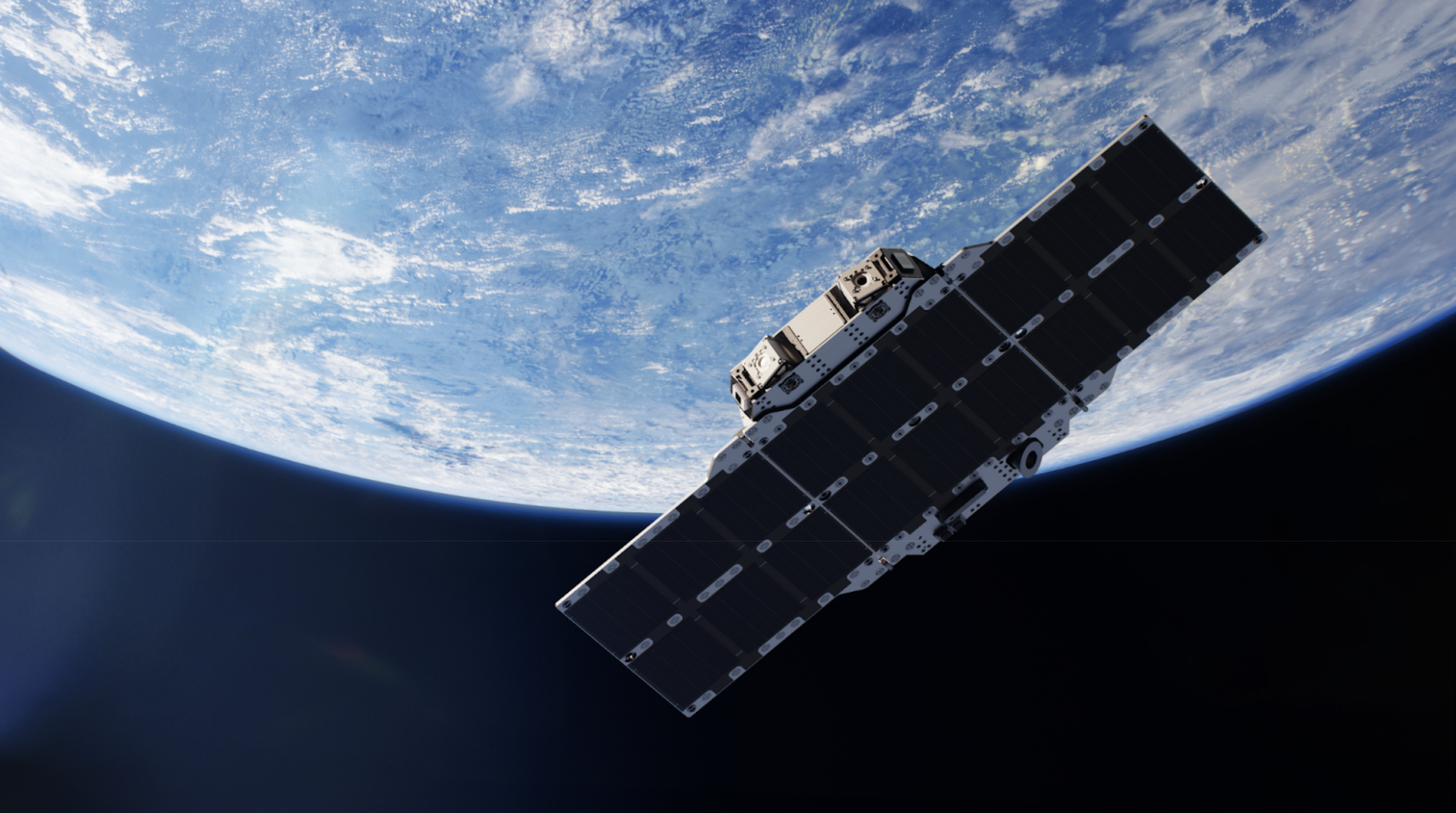
- Array’s satellite is roughly suitcase-sized, with a radar on one side and a fold-out solar array on the other (get it?), designed to work in low earth orbit (LEO).
- The whole thing weighs about 60kg (132 lbs) and produces four kilowatts of power, according to Peterson. He said that’s about a ten times higher power-to-weight ratio than anything else on the market.
- The radar-satellites work as a cluster to produce 3D imagery. Each unit can capture imagery from different angles, which when mashed together (by the company’s in-house software Earthside) creates that oh-so-desirable 3D map.
- They go up in constellations of four or more, which (basically) amps up the radars’ capability without having to make them bigger. A four-satellite cluster will have 16 kW of power; the 16 satellite constellation will a combined 64 kW. Think of it as a mesh network, but make it radar.
- Right now, the system has a latency of about 30 minutes, but Peterson said they’re working to get that down to “minutes.”
Peterson said that each satellite currently costs in the “single digit millions”—similar to other commercial satellites on the market, but with a more powerful punch. “[Those other systems] are in the couple 100 watts of power, not the multiple kilowatts of power that we’re talking about here,” he said.
Down to earth: You might be sitting there thinking—wait, so what does all this space talk mean for us defense tech nerds? Well, it’s two-fold.
First, the 3D imagery and mapping Array’s clusters will produce can help with fun things like navigation and simulation. Basically, it can tell you what you’re going to encounter when you head into a new or unfamiliar area—super useful for things like UGVs.
But then there’s the whole situational awareness side of things. As we’ve seen in places like Ukraine, real-time data and imagery is increasingly critical to modern warfare, and radars are a pretty handy way of getting that.
“You want to know where all the ships are? Check the radar. Where are all the aircraft flying around? Check the radar,” Peterson said. “Today, we have ground-based radar or ship-based radar or air-based radar systems all around the world that try to understand what’s going on in these different places.”
The problem is, these big, expensive, buzzy systems are far from stealthy—things like the E-7 Wedgetail (shout out to a real one) are a pretty easy target. Moving radars into space makes them much more resilient, Peterson said.
“[With space-based systems] you have a radar that can see where all the ships are, [have] a radar that can see where all the aircraft are, but is far enough away that it can’t be easily shot down by a missile,” he added. That’s pretty nifty for something like, say, the Golden Dome.
Bottom line: And the DoD is, like, very interested.
Peterson said that the company has been awarded about $15M in government contracts from the Air Force, Space Force, Navy, Army, SOCOM, and DARPA to “advance the state of the art across high-power antenna architectures, high-bandwidth communications links, 3D reconstruction algorithms, and more.”
- They’ve also inked commercial agreements for that first four-unit cluster with “global leaders in mining, infrastructure, and embodied AI.”
This new pile of cash will allow Array to double its team (from 30 to 60) and scale production to meet this demand, all while gearing up for those 2026 and 2027 launches.
Speaking of—Peterson said that the company is working with SpaceX to launch its satellites and Maverick Space Systems as its launch integrator. Friends in high places, indeed.