
Well, it’s certainly been a busy start to the week for the Pentagon press office.
Yesterday, between a rabble-rousing speech by Pete Hegseth at Lockheed’s factory in Fort Worth, the release of a plan to fully overhaul the DoD’s innovation ecosystem, another plan to accelerate AI development for the military, and the official announcement of new DIU and CDAO heads, one thing was pretty clear—the administration seems pretty serious about the whole “we want to build and buy weapons differently” thing.
It was a lot to take in—even for rugged defense reporters like us—so we thought we’d treat you to a little breakdown. After all, if all of this pans out, the people slated to benefit most are, well, all of you defense tech nerds.
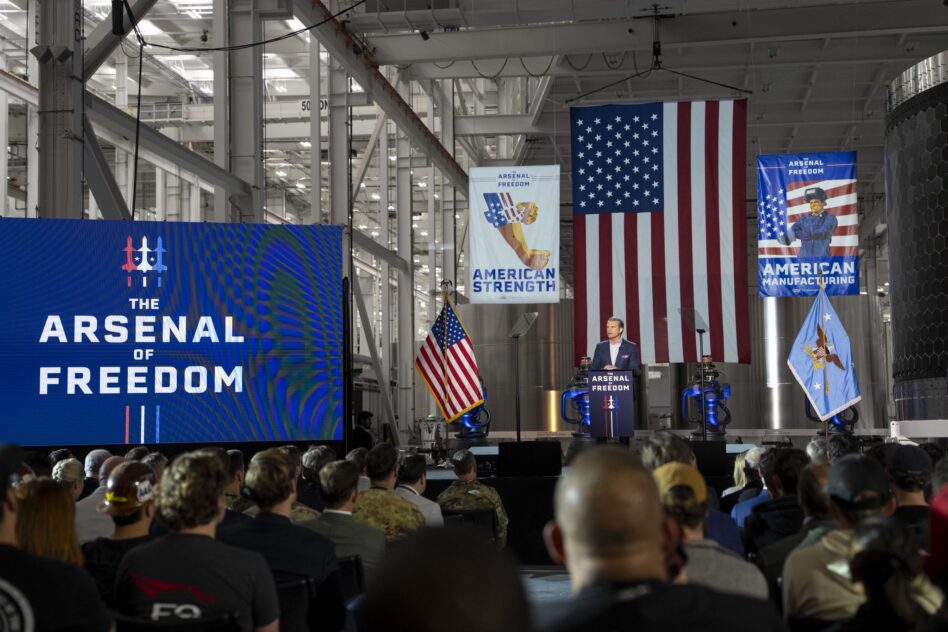
The Lockheed ultimatum: In case you missed the many photo ops, SecDefWar Pete Hegseth is currently on his “Arsenal of Freedom” tour, visiting key sites and factories for defense production around the country.
- He kicked things off with shipbuilders in Newport News, VA, then visited a few of our friends in the Gundo, and spoke yesterday at Lockheed’s production hub in Fort Worth, TX.
- He also stopped in Brownsville to visit SpaceX with founder and on-again-off-again Trump favorite Elon Musk. There, he slammed woke AI and said the DoD plans to use Grok despite concerns over its, well, spicy proclivities.
- The idea is to “rally the [defense industrial] base”—to “see the work being done by the military and our partners in American manufacturing, to usher in a new golden age of peace through strength,” according to Hegseth’s speech in Virginia.
The Lockheed speech dug majorly into the whole “primes need to get their act together” thing the president kicked into gear last week.
- The Fort Worth factory is where Lockheed builds the F-35 and F-16. The $2T F-35 program is pretty much the poster child for the whole “primes suck at this” thing.
- Hegseth told workers that the Pentagon is “changing the game to incentivize speed, to incentivize efficiency, competition, open architecture at cost—ensuring that big companies like this one, and small ones, can compete.”
- However, he wasn’t as harsh on Lockheed as the president was on, say, RTX. He said he expected Lockheed to “step up” and “win a lot” under Trump (that PAC-3 contract was certainly a good start.)
The race to innovate: As Hegseth rallied Lockheed’s workers, the Pentagon also unveiled what it called a “transformative realignment of the DoW’s innovation ecosystem.”
At its most basic level, the order basically reorganizes the military’s whole innovation arm under a single person, or CTO—former Uber executive and current USW(R&E) Emil Michael.
- According to Hegseth’s memo outlining the changes, Michael (as Pentagon CTO) will be “tasked to modernize the Department and align innovation organizations around outcomes that matter for the warfighter.”
- The “Defense Innovation Steering Group, the Defense Innovation Working Group, and the CTO Council are disestablished,” and Michael will set up a CTO Action Group (CAG) that will “assist him in making decisions, clear bureaucratic blockers, hold leaders accountable…[and] quickly deliver new innovations to our warfighters.” Under Michael, this is basically the top dog organization for innovation now.
- The Defense Innovation Unit (DIU) and the Strategic Capabilities Office (SCO) will be designated as “Field Activities,” and their directors will still report to the Secretary and Deputy Secretary and “execute authorities provided to them by law.” (Remember—it was set into stone that DIU reports to the Secretary when it was set up.)
So—in addition to DIU and SCO—here are the innovation organizations left standing, which will all report to Michael, the Pentagon CTO.
- The Defense Advanced Research Projects Agency (DARPA)
- The Chief Digital and Artificial Intelligence Office (CDAO)
- The Test Resource Management Center (TRMC)
- The Office of Strategic Capital
The whole shebang will also be expected to (drumroll please) actually engage with industry and “present…clear demand signals through two complementary channels.”
- In terms of how that will work: “The Mission Engineering and Integration Activity (MEIA) will execute problem-driven engagement organized around the Joint Force ‘s top Operational Problems – telling industry what we are trying to do.”
- DIU will also work with PAEs to help them better understand how to actually adopt what industry has built.
New blood: Plus—it wouldn’t be an overhaul without some fresh faces.
- DIU will be led by Owen West—a former Marine Corps officer and Wall Street energy trader who served as Assistant Secretary of Defense for Special Operations and Low-Intensity Conflict during the first Trump Administration.
- CDAO will be led by Cameron Stanley—the National Security Transformation Lead for AWS, who served as the Chief Data Officer of the Undersecretary of Defense for Intelligence and Security from 2022-2024. He also headed up Project Maven from 2021 to 2022.
Big brain: Finally, let’s get to the AI of it all. Yesterday, the Pentagon also unveiled the “Artificial Intelligence Acceleration Strategy that will extend [the US’] lead in military AI deployment and establish the United States as the world’s undisputed AI-enabled fighting force.”
- Hegseth said the US would become an “AI-first warfighting force across all domains.”
- The Department’s AI development effort will be based around three pillars: warfighting, intelligence, and enterprise operations.
To accomplish that, the Pentagon is setting up seven “Pace-Setting Projects (PSPs)”—basically ambitious AI development projects that each report to a single leader.
- Swarm Forge: Basically, a project to better learn how to fight with and against AI.
- Agent Network: A project to build up AI capabilities for “battle management and decision support.”
- Ender’s Foundry: For AI simulation capabilities.
- Open Arsenal: For intelligence, to turn “intel into weapons in hours, not years.”
- Project Grant: Basically, it sounds like AI-powered influence and pressure campaigns (non-kinetic, as they say).
- GenAI.mil: Department-wide access to AI models like Gemini and Grok. (No woke AI!)
- Enterprise Agents: Exactly what it sounds like. Agents to “transform enterprise workflows” across the department.
The strategy says that the Pentagon will bring in top talent through things like the “Tech Force” initiative and work with private industry to make sure the projects match the very best out there in the commercial realm.
Dare we say….the Pentagon might actually be putting its money where its mouth is in terms of this whole acquisition and innovation overhaul thing?
If only this morning’s bajillion-dollar SRM investment hadn’t gone to one of the big boys…