Looks like at least one RACER has crossed the finish line.
On Wednesday, DARPA announced that the Robotic Autonomy in Complex Environments with Resiliency (RACER) program, launched in 2021 to develop new vehicle autonomy algorithm technologies, has officially wrapped up.
Now, it’s up to the autonomy companies that spun out of it—including Overland AI—to keep the dream of vehicle autonomy going.
Speed RACER: RACER (RIP) had a straightforward goal: Develop and test software that, at a minimum, can operate autonomous vehicles off-road and in challenging terrain at speeds on par with a human driver.
- It was launched because earlier US military autonomy programs were, in DARPA’s words, “slow to adapt “ and “lagged due to the challenging complexity of off-road terrain.”
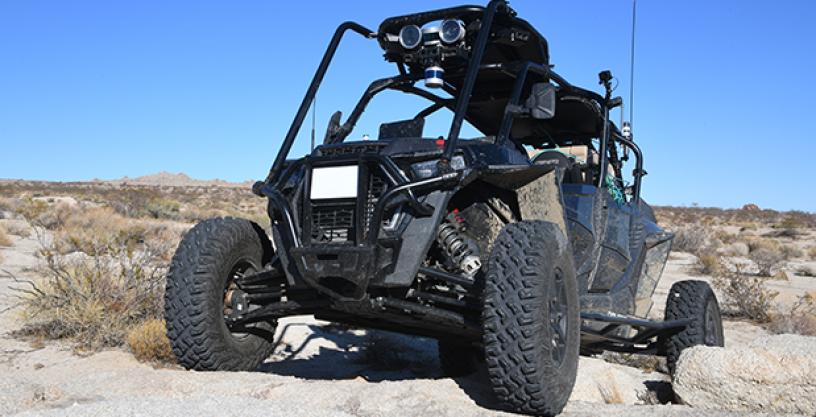
- RACER featured a series of eight DARPA-hosted field experiments in varying terrains across the country. DARPA provided different unmanned ground vehicle (UGV) platforms for research teams to develop and test their autonomy software on.
- Teams from Carnegie Mellon University, the NASA Jet Propulsion Laboratory, and the University of Washington were tapped for the program.
- The University of Washington team was spun out as Overland AI in 2022 with help from DARPA’s Embedded Entrepreneur Initiative (EEI), a program designed to bring breakthrough technologies from top-performing teams to market.
“The idea behind this program was to put money behind it, bring in some teams, and push them extremely aggressively for a short period of time,” Overland AI CEO Byron Boots told Tectonic. “It’s meant to be a really short, intensive, stressful way to incept a new technology that the US warfighter needs, and then the program ends.”
“We started the company to help us transition this technology so that when the program ended, we would still be here, and be able to continue to develop it, harden it, and give our warfighters an advantage in the ground domain,” Boots added. “I think this was an extremely successful DARPA program.”
Humble flex: In the end, Overland AI was the only research team to make it through the eight-experiment gauntlet and launch as a standalone operational company—and the only team to “move beyond the original Polaris RZR side-by-side vehicles everyone was using to the Textron M5” and “work with warfighters as part of the program,” Boots said.
Judging from how Overland AI has turned out, RACER ran a pretty good race.
DARPA thinks so too, especially on the off-road perception architecture front, which it called the program’s “most successful accomplishment.”
With RACER crossing the finish line, there’s now “a lot of commercial opportunity for private equity,” RACER program manager Stuart Young said in a statement. “It’s time for both military users and private investors to recognize the transformative potential of RACER and embrace a future where autonomous systems are not just a possibility, but a reliable and integral part of our world.”
Everyone loves a happy ending, don’t they?