Valentine’s Day is around the corner, and defense companies are in the matchmaking spirit.
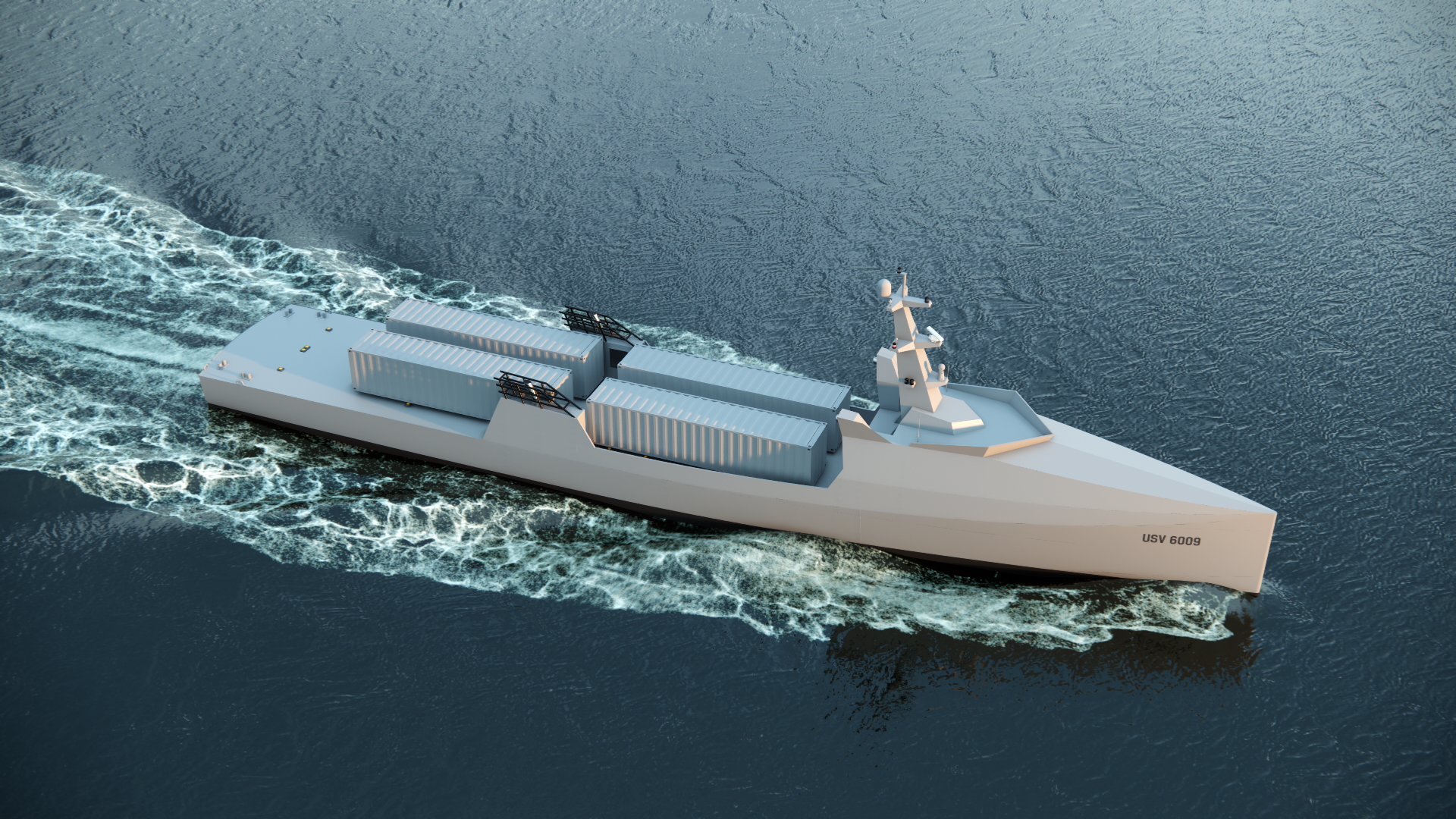
This morning, Boston-based maritime autonomy startup Blue Water Autonomy unveiled its first autonomous surface vessel: A 190-foot big ol’ drone boat designed in partnership with Dutch shipbuilding giant Damen called the “Liberty Class.”
We told you maritime autonomy is all the rage.
Feeling blue: We’ve covered BWA before, but as a refresher, the company emerged from stealth last April with $14M in seed funding before quickly raising a $50M Series A led by Google Ventures.
While a lot of startups out there are making autonomous speedboats and small surface vessels, Blue Water is thinking bigger: The company is laser-focused on building a larger-profile, fully autonomous warship for the US Navy that can stay on mission for months at a time.
Lovin’ Liberty: With the Liberty Class, Blue Water’s betting that a proven hull design kitted out with their autonomy software is just what the Navy’s looking for to fill its hybrid fleet of the future.
- The Liberty will be built on Damen’s widely used 190-foot Stan Patrol 6009 hull design, which has a range of over 10,000 nautical miles and a payload capacity of over 150 metric tons.
- According to Blue Water, they tapped the Damen design for its vertical bow shape, which minimizes slamming, and because building on a proven hull allows them to focus on gutting the insides to retrofit it for autonomous operation.
- The Liberty Class ASV will be built at Conrad Shipyards in Louisiana, which BWA inked a deal with back in September, and the company says the first vessel will hit the water this year after construction starts in March.
Robo redesign: As you can imagine, turning a manned ship—with all its plumbing, electrical wiring, living space, and everything else humans need—into a robo-boat requires a lot of rethinking, and Blue Water worked with Damen to come up with a mass-producible design for the Liberty Class.
“Blue Water and Damen together have redone the internals of the ship,” Blue Water co-founder Austin Gray told Tectonic. “Some of that is Blue Water’s IP, some of it is joint Blue Water-Damen IP on the internal ship design side, and there’s a license as well, because we’re using Damen’s external [hull design].”
“We don’t have all the extra ventilation, four-foot hallways, and cooling systems for humans,” he added. “We now optimize it for machines, and once you take all the humans out, you can make it really efficient.”
F*ck it, MASC off: Bow shape is cool and all, but Navy’s Modular Attack Surface Craft (MASC) program, launched last July, is the big reason Blue Water landed on the Damen design.
- In the solicitation, the Navy asked nontraditional suppliers to submit proposals outlining how they can help speed up “the design, development, and demonstration of [USVs],” which they’ll use to decide on who gets prototype projects for the medium-sized drone boats.
- Notably, the Navy is using the ever-popular Other Transaction Authority (OTA) to issue awards for the program, which allows for more flexible, iterative prototyping and follow-on production.
“If you compare the specs that we’re showing you—the speed, the ranges, the payloads—with the open source, publicly available MASC requirements, it’s pretty clear what this ship [the Liberty Class] is for,” Gray said. “The Navy’s been really clear about its requirements. Right now, there are three MASC buckets, and this meets requirements for all three.”
The Navy’s looking for a whole range of autonomous vessels to beef up its hybrid fleet, but Blue Water’s “laser-focused on this one,” he added. “We need to nail the ship and deliver an 800-ton robot to the US Navy that works, and then build more.”
Shipbuilding is so back, baby.