
Big week for propulsion around here.
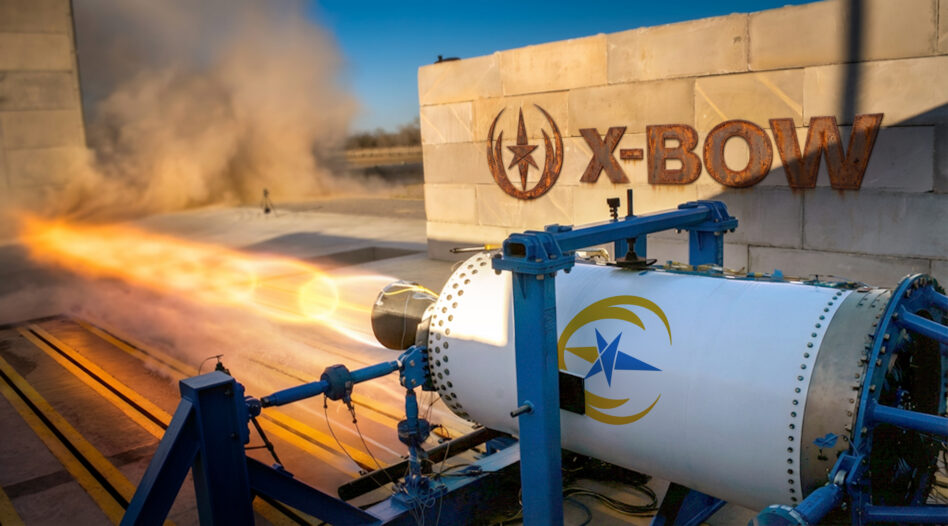
This morning, solid rocket motor startup X-Bow Systems announced in an exclusive release to Tectonic that they’ve successfully tested their 34.5-inch Ballesta SRM, first unveiled in 2022.
The big-boy motor—which has more thrust and can get up to super-fast speeds more quickly—is best suited for launch for big ol’ missiles and hypersonic systems, as well as for space launch. Good news for a government extremely keen on the Golden Dome—and even better news that it’s 30-50 percent cheaper than comparable existing SRMs.
“This one was our largest solid rocket motor test to date for our company,” X-Bow CEO Jason Hundley told Tectonic. “We’re pretty certain that this is the largest solid rocket motor tested by a company not named Northrop Grumman and or Aerojet Rocketdyne [L3Harris] in this industrial base, as well.”
Watch out, primes, the defense tech startups are coming for you.
Boom boom: We’ve talked a heck of a lot about the whole SRM problem, so we will keep it brief. Basically, production is monopolized by the aforementioned primes (Northrop and L3Harris), and as conflict has picked up around the world, they’ve struggled to keep up with demand.
- SRMs make all the tech we know and love go far and fast—they’re needed in everything from HIMARS to Javelins, Stingers, AMRAAMs, and GMLRS.
- In 2024, major producer Aerojet Rocketdyne—purchased by L3Harris in 2023—reported it was thousands of rocket motors behind schedule. Now, production is up, but they’re still “digging out of the hole,” according to the company.
- Last year, Raytheon said that the SRM shortage was still limiting missile production.
Northrop and L3Harris are both scaling production—Northrop says it will double output by next year—and Lockheed Martin and General Dynamics say they are building out a big ol’ facility in Arkansas. But the nontraditionals are catching up, too.
- Anduril entered the SRM game when it purchased Adranos in 2023. Since then, they’ve scaled up production and scored a few big DoD contracts, including $43.7M in DPA funding for SRMs last week.
- Companies like Firehawk (which we covered yesterday) and Ursa Major are all over these critical little motors.
Catch up: X-Bow, for its part, runs “both small tactical size and large strategic size, solid rocket motor programs,” according to Hundley. And they’ve had quite the run since being founded in 2016.
- The company provides, essentially, an end-to-end energetics service: They design, manufacture, test, and even launch systems loaded with their SRMs.
- In 2023, they were awarded a $17.8M contract with AFRL to demo additive manufacturing for SRMs.
- In October 2024, they were awarded a $64M contract to develop hypersonic SRMs for the Army and Navy.
- Also in 2024, they were awarded prototype contracts to build Mk 72 and Mk 104 standard missile rocket motors for the Navy, as well as a $60M contract to modernize the Navy’s SRM production.
- Last summer, they announced a joint $13.9M OSC-backed SRM investment with the Army.
Superspeed: This particular motor—the 34.5-inch variant—is best suited for the hypersonic and big-boy launch side of things.
“This motor alone can get into space and take very large payloads, like several 100 pounds of…a hypersonic glide body into hypersonic conditions,” Hundley said. “[It] is really geared for our hypersonic launch vehicle capabilities, but is also burning down for us…a lot of risk reduction and a lot of new technologies at the appropriate scale and size for our hypersonic programs.”
Plus, this kind of motor could be very useful for a program that rhymes with “Shmolden Shmome,” Hundley said.
“This particular size…is very, very synergistic with what we are looking at on what they call space-based interceptors,” he said. “We are in that very, very, very small niche of solid rocket motor providers that can play in that strategic size aspect.”
For now, Hundley says they’re poring over the data from the test (the motor has about 100 AI-powered sensors on it) and figuring out whether they can move ahead with flight testing and production.
“There’s definitely great learnings that we’re going to be building into the next things,” Hundley said, “It is extremely rare that your first test article performs flawlessly…What we’re trying to determine is—did we get enough data where we could call it done and in production?”
Go boom, indeed.