Between the Pentagon backing a $400M investment in MP Materials, a $1.4B deal with rare-earth magnet-maker Vulcan Elements, and Korea Zinc’s $7.4B refinery in Tennessee, companies up and down the critical mineral supply chain had a pretty big year in 2025.
And the Pentagon’s demand for rare earths sure isn’t slowing down in 2026. Yesterday, Australian rare-earth mining company Lynas—the world’s largest producer outside China—inked a $96M, four-year deal to supply the Department of Defense with light and heavy rare-earth oxides.
Mineral madness: For those who slacked off in high school chemistry, rare earths are a group of 17 chemically similar elements with a host of snazzy magnetic, luminescent, and electrochemical properties used for everything that makes all of our military kit go boom and zoom, from guided munitions to fighter jets.
Some of the most important ones for defense purposes are:
- Neodymium-praseodymium (NdPr), which is used to make the high-strength permanent magnets in everything from missile systems to UAV motors and radars.
- Dysprosium (Dy) & terbium (Tb), which add heat resistance and durability to magnets being used in super-extreme conditions, like on an F-35.
- Yttrium (Y), which is used in night vision, targeting lasers, and thermal shielding.
Panda problems: The problem is, China has a pretty firm chokehold on the world’s supply of these materials. The country:
- Processes upwards of 90 percent of the world’s rare earths.
- Produces about 60-70 percent of the world’s rare earth ores.
- Makes about 90 percent of the world’s permanent magnets.
- Is the source of over 70 percent of the US’s rare earth imports.
That’s a pretty glaring vulnerability (particularly if, say, we decided to help protect a certain little island in the South China Sea), and China hasn’t shied away from flexing its mineral muscles.
To address that, the government has moved quickly to shore up the critical mineral supply, including by looking to allies like Australia, with which the US inked an agreement in October to finance over $1B in critical mineral projects in both countries.
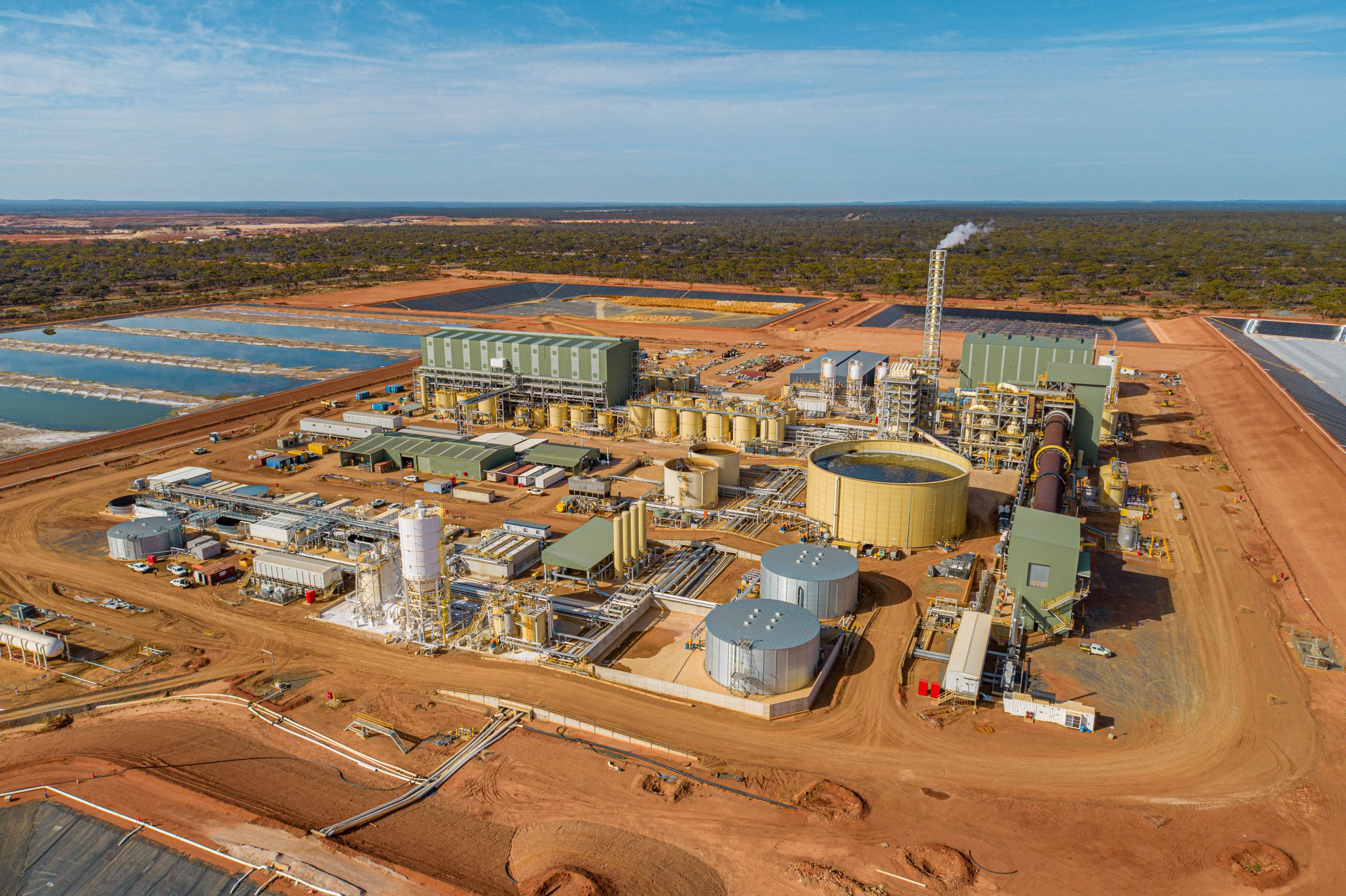
Digging down under: The Pentagon’s new $96M deal with Lynas, one of only two major rare-earth miners outside China, “establishes a framework to finalize an agreement for the supply” of critical minerals, according to the company.
- It also sets a $110/kg floor price for NdPr, the material used in those ever-important rare-earth magnets, in line with a floor price the Pentagon set in its deal with MP Materials last year.
- The agreement comes after fraught negotiations between Lynas and the Pentagon over future purchases of critical minerals refined at the company’s heavy rare-earth processing plant in Seadrift, Texas, which hit a rough patch last August.
Luckily, it looks like they’ve managed to sort things out at the negotiating table.
“Through this agreement, the US Defense Industrial Base will continue to have access to Light and Heavy Rare Earth oxides that are essential for modern manufacturing,” Lynas CEO Amanda Lacaze said in a statement. “[We] look forward to finalising the definitive agreement in due course and continuing our productive engagement with the US Government.”
Back in stock: And by the looks of it, the government’s just getting started on the whole “critically important elements” front.
- Last month, the Pentagon announced plans for a critical mineral stockpile, called Project Vault, backed by $12B in seed money split between $1.67B in private capital and a $10B loan from the US Export-Import Bank.
- In January, a bipartisan team of lawmakers introduced legislation to create a $2.5B agency dedicated to rare earths and other critical mineral production and processing.
Let’s hope the government’s mad dash for these metals is enough to wean us off China’s minerally teat before it’s too late.