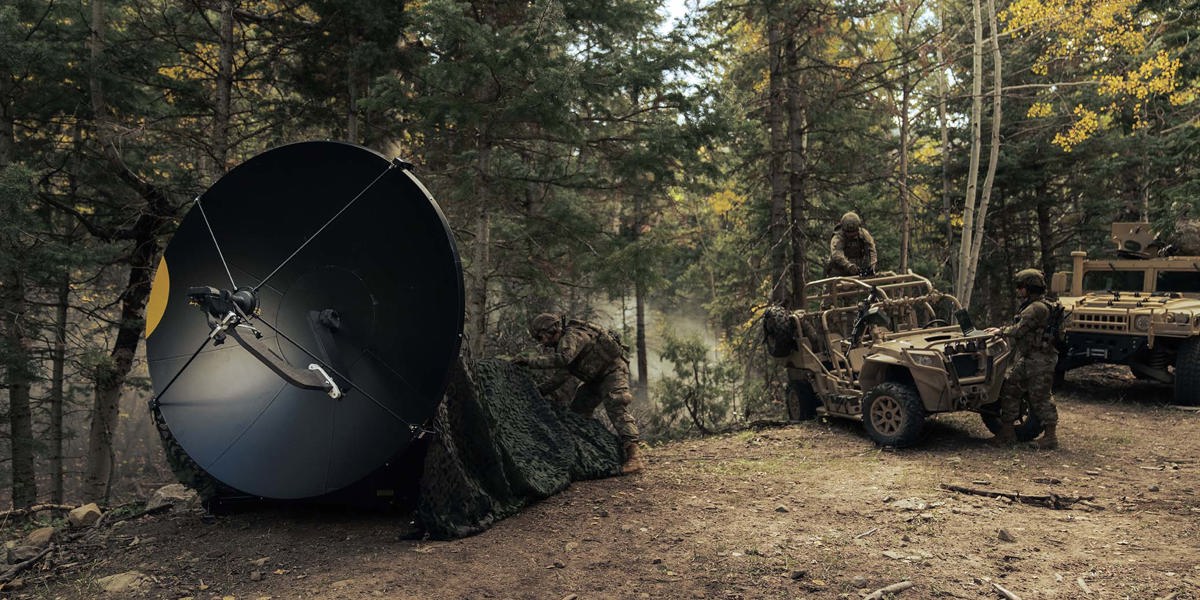
You know how the Arctic is, like, super remote, freezing, and increasingly contested? Well, all that makes comms a bit dodgy. Yesterday, defense communications and mission-systems company Ultra I&C announced that it’s sending its Archer troposcatter beyond-line-of-sight (BLOS) comms system up to the Arctic for operational trials with the Canadian Armed Forces.
Tropo talk: If tropospheric scatter (or troposcatter) isn’t in your vocabulary, you’re not alone. Let’s break it down:
- It’s a radio technique that sends microwave energy in a narrow beam just above the horizon.
- Most of that energy continues onward, but a very small fraction is scattered by irregularities in the troposphere, the lowest layer of Earth’s atmosphere.
- A receiving station far beyond the geometric line of sight can capture that scattered energy and reconstruct the signal.
That’s pretty much what Archer is. Troposcatter systems aren’t necessarily a new technology or a total replacement for SATCOM or tactical radios, but it’s extra useful when you need long-range, beyond-line-of-sight terrestrial connectivity in contested and degraded environments.
Archer’s directional antennas and lack of relay nodes also make it difficult to detect, intercept, or jam, according to the company.
“That’s what makes it the ideal alternative to satellite for links up to 250 km, in addition to being both rugged and user-friendly,” Ultra I&C’s vice president of programs, Faith Rhodes, told Tectonic. “We are seeing lots of demand for troposcatter across command-and-control, and integrated air and missile defense applications that require these kinds of standoff ranges, as well as low latency, high throughput, and high survivability.”
Arctic Archer: Ultra I&C didn’t invent troposcatter comms, but they’ve made it more resilient and deployable, especially in contested environments. “We’ve essentially brought it back with 21st-century technology, and have winterized it to handle Arctic conditions,” Rhodes said.
According to Ultra I&C, here’s what Archer brings to the table:
- Secure, high-capacity data links that offer over 200km of range with a single antenna and without satellites or fixed infrastructure.
- Automated setup and auto-alignment interface that requires minimal training, and “any warfighter can set it up in under 15 minutes” without tools, according to Rhodes.
- Built-in encryption and anti-jamming protection.
- It’s also “designed to integrate easily with any C5ISR system or Ethernet-capable radio bearer, regardless of supplier,” she added. “It extends Ethernet connectivity over long distances, so it plays well with whatever else is in the network.”
Canadian comms: Under Ultra I&C’s initial contract with the Canadian Armed Forces (CAF), the company is sending seven troposcatter terminals for trials with Canadian forces in the Arctic and Europe later this year.
The trials have two main goals. “The first is to understand the range of missions Archer can enable for the CAF, both at home and abroad,” Rhodes said. “Second, and equally important, is to get real feedback from operators in the field. That input will shape how we continue to develop and refine the system for arctic operating conditions.”
Homecoming: This isn’t Ultra I&C’s first rodeo with the Canadian military. The company’s roots are in the Canadian Marconi Company, established in 1903 to provide Canada with a sovereign comms network. “We’ve been supplying the Royal Canadian Navy since 1910 and the Canadian Army since 1914,” Rhodes said. “We’ve supported the Canadian Forces ever since and the US DoD since 1965.”
It’s all about that sweet sovereignty, baby. Comms and all.