Someone queue up Sweet Home Alabama.
On Friday, new-age manufacturing company Hadrian announced a big-time, $2.4B partnership with the US Navy—split between $1.5B in private capital and $900M in government funding—to produce components for the Virginia and Columbia-class submarine programs at the startup’s new 2.2M square-foot facility in Cherokee, Alabama.
Looks like Hadrian’s $611M in VC funding and $1.6B valuation is starting to make some sense.
Factory of the future: Of all the futuristic factory startups making a splash right now, Hadrian might be top dog.
The company, founded back in 2020 and led by Aussie founder and CEO Chris Power, is on a mission to “reindustrialize America” by building autonomous factories.
- At its core, Hadrian is a software-defined precision manufacturing company.
- The company focuses on those high-tech, tricky components that can slow down production and delivery—from engine components to spaceflight hardware.
- The company uses high-tech robots and process automation to, essentially, make high-tech manufacturing a whole lot faster and cheaper.
- On top of their own factories, the company operates a “factory-as-a-service” model that allows partners to rely on them for both components and finished products that can scale production with program demand.
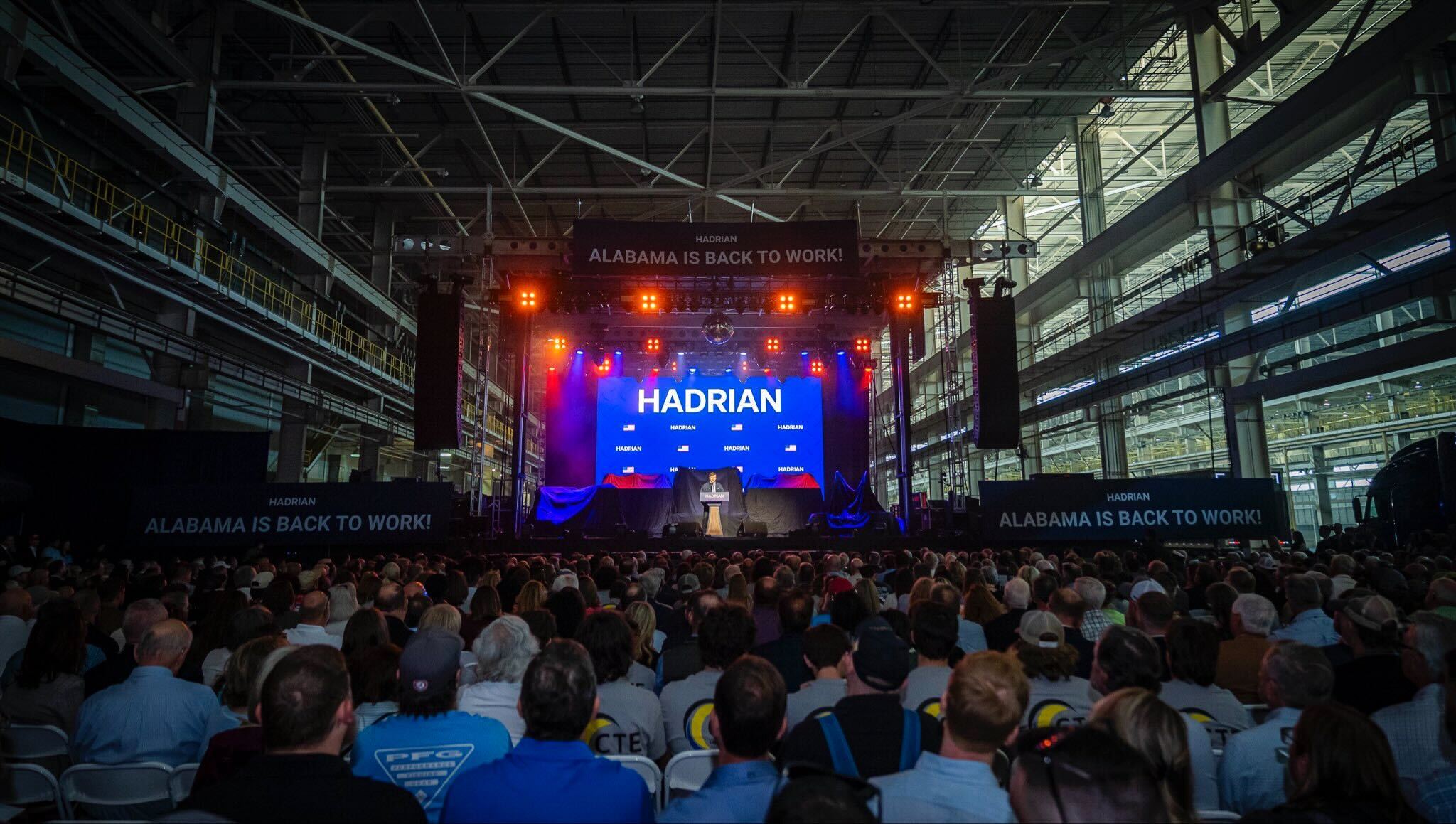
Roll tide: Hadrian’s big ol’ factory in Alabama, called Factory 4, is focused on mass production of components for submarine construction. It’s one of three factories Hadrian will open dedicated to the maritime industrial base.
On a call with reporters last week, Power didn’t disclose what the components pumped out at Factory 4 will be, but the company said they’ve been “identified by the industry as the largest drivers of submarine schedules, so increasing production allows submarines to also be produced faster.”
“The number-one problem that the Navy’s identified is we can’t find enough skilled workers, so we have to automate our way out of this problem,” Power said. “We want to be about 80 percent automated and make it simple enough that we can train, like in our other factories, a new workforce in 30 days or less.”
Maritime money: If Hadrian’s successful, that’ll be good news for the delay-plagued Virginia and Columbia-class sub programs, and both Hadrian and the Navy are putting some big dollars behind making it work. The public-private partnership combines more than $1.5B in private capital with $900M in government funding through Navy appropriations, bringing the total investment to over $2.4B.
“The Department of the Navy has a stake in the outcome, and American taxpayers will benefit from our and their success,” Secretary of the Navy John Phelan said at the Factory 4 ribbon-cutting. “That alignment matters because we are done with a system that rewards process over delivery.”
“Industry has tried to meet us before,” he added. “We haven’t always made it easy. That’s changing. We are breaking down silos, simplifying how we do business, and moving acquisition to a more urgent footing with one goal—putting the war fighter first.”
According to Hadrian, production of components is expected to kick off by the end of the year, and Factory 4—which the company says will support up to 1,000 jobs—will be fully operational within two years.
Looks like the factory of the future craze ain’t going anywhere anytime soon.