With all eyes on an autonomous future of flight, it’s easy to forget the human pilots who will remain firmly in the cockpit for the foreseeable future. Luckily, one San Francisco-based company is remaining focused on people, even as we await the rise of the robots.
Yesterday, Navi AI—a startup using AI to improve pilot training and performance—emerged from stealth with $6.7M in funding from United Airlines Ventures, BVVC, New Vista Capital, Raptor Group, I2BF, and the Pentagon. Its goal is deceptively simple: to make flying safer, one flight at a time.
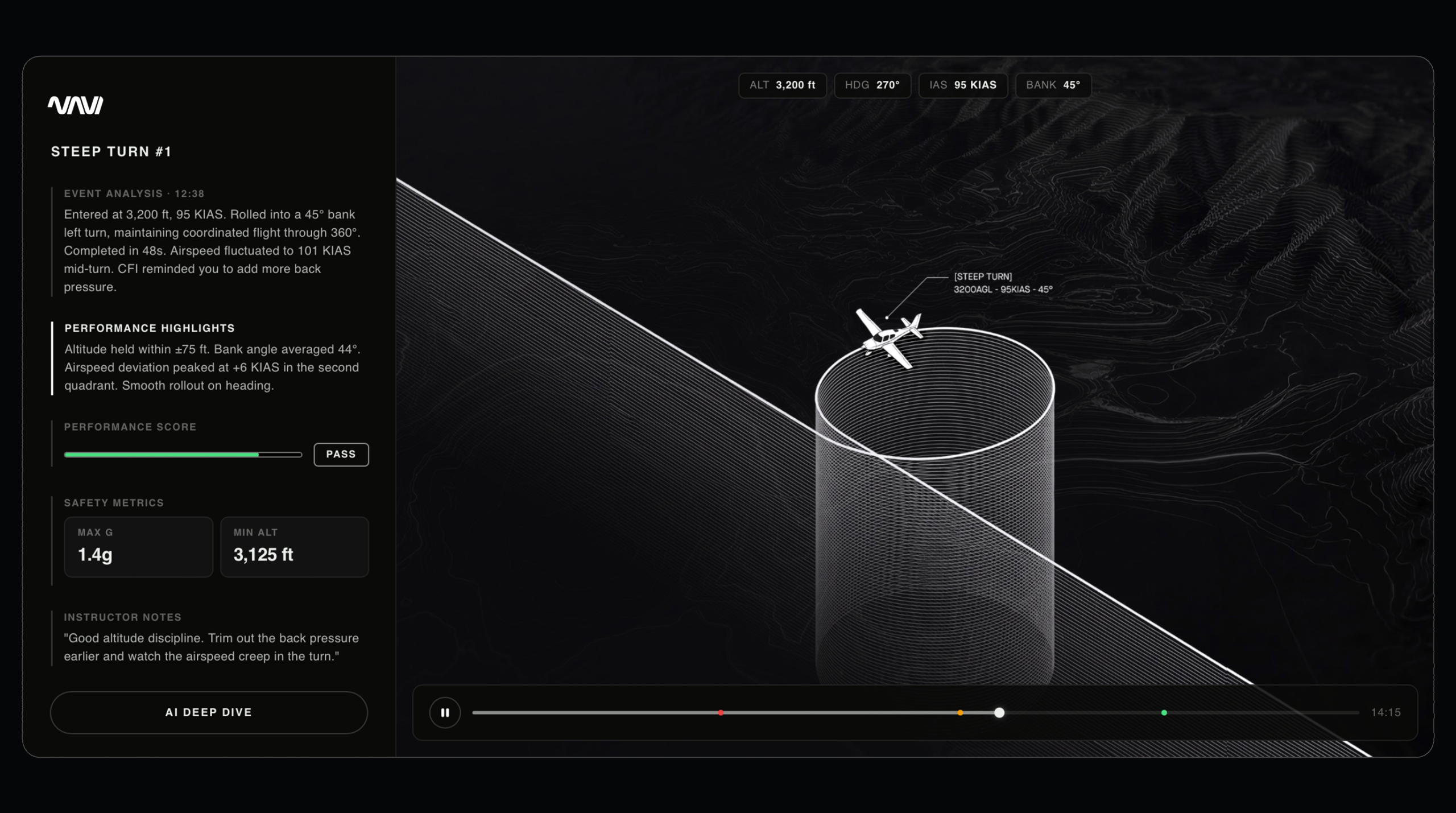
“We have an AI-connected black box that connects the planes and does a full investigation of every single flight and does it live,” Navi CEO and Founder Nikola Kostic told Tectonic. “What this means is that pilots—instructors and trainees—when they’re flying the planes, they get a full report post-flight of exactly what happened.”
In a world experiencing an uptick in aviation accidents, this seems like a pretty good idea to us.
Long-haul: Kostic isn’t coming at this problem out of nowhere—before founding Navi in 2024, he spent 15 years as a pilot, and experienced the difficulty (and dangers) of learning to fly firsthand.
“We’re in this industry where, across the board, we have 80% of pilots dropping out. We’re 2000 pilots short every single year. With the Air Force, we have a lack of instructors. We have the highest [level of] accidents that we’ve had in the last 50 years,” he said. “As any pilot will tell you, we lose a lot of friends.”
FAA certification is supposed to take 40 hours, he added, but on average it takes about 80. “We’re taking twice as long,” he said. “Why is that right? Because information is not really sticking, and you have to repeat [training] over and over again.”
“Human brains are not designed to handle this much information, to process this,” Kostic added. “We slip up on a few things. You make a mistake and something happens, and there’s a tragedy.”
In the cockpit: Navi was founded to stop these kinds of tragedies from happening.
Back when he was training as a pilot, Kostic said that he would record himself (and his instructor) to review at home. “This was a game changer for me,” he said.
Navi’s solution is basically this approach on steroids. Here’s how it works:
- The tool is basically an AI plugin for a black box that “ingests cockpit audio, aircraft data, and environmental and operational sources” during a flight.
- All that data is then fed into a dashboard that can be used by “trainee pilots, flight instructors and flight academies” to see what’s going wrong (and right) across a fleet.
- At an individual level, the tool allows pilots to work on their weak points; At a fleet level, it allows commanders and instructors to see where pilots and aircraft are having issues.
- If you think this is a 30,000-foot overview (bada-bing) of a flight, think again. In a demo, Kostic showed Tectonic that you can click into each flight on a flight map and see what’s happening, live feed style. You can also dive in with AI to better understand how the flight (or individual pilot’s performance) could be improved.
- The tool uses a whole bunch of different LLMs and machine learning—everything from Gemini, to Llama, to Whisper for transcribing, plus some models built to process flight data from the ground up.
“In aviation, we record a lot of data, Kostic said. “We record cockpit audio. We record the telemetry, and this is used in cases of an accident or an incident to launch an investigation and find out why that happened…but this is a process that takes about six months. There are a lot of lessons that we observe but never learn from. We built Navi to iterate on that cycle a lot faster.”
And—at least in theory—the tool is something that flight schools and instructors actually need and want to use. The whole shebang was built with input from flight schools, including Sling Pilot Academy, Embry-Riddle Aeronautical University, and the U.S. Air Force Test Pilot School at Edwards Air Force Base. The company’s first commercial deployment was with Sling in 2024.
If the backing from United Airlines wasn’t enough of a tip-off, Navi is pitching itself as a solution for both commercial and military pilots.
“[Commercial] just moves a lot faster,” Kostic said. “We don’t really have a lot of barriers in terms of the approval process and funding and deployment and things like that.”
Plus, it helps that the commercial aviation industry isn’t in the midst of a partial government shutdown. “The Air Force is a lot more eager, and it’s easier to adapt the technology, but…on the bureaucratic side, it’s just a lot slower,” he added.
Regardless, Kostic and his team are still gunning for scale across both commercial and military.
- Currently, the team is seven people—he says this funding will let them hire 15 more this year.
- They’re aiming to have the platform ready to use by the Air Force (which involves making sure security for the records is airtight) by September.
- They’ll also be kicking off with United Airlines “soon,” he said.