Well, if you thought that the LA defense tech scene couldn’t get any hotter, think again.
Yesterday, super-ultra-fast aircraft company Hermeus announced that they’ve raised a cool $350M Series C at a $1B valuation and that they’re building a big ol’ HQ in El Segundo.
The round was led by Khosla Ventures, with continued support from Canaan Partners, Founders Fund, RTX Ventures, Bling Capital, and In-Q-Tel, as well as new investors Cox Enterprises and their venture fund Socium Ventures, Destiny Tech100, Georgia Tech Foundation, 137 Ventures, GSBackers, and others.
Hermeus President Zach Shore told Tectonic that the cash will be used for “the continuation and completion of the series of aircraft that [they’re] manufacturing right now, the test and flight operations of those aircraft, and the expansion of [their] footprint into Los Angeles in a more significant way.”
“This is a footprint that we intend to continue to grow into as the company grows and as our prototypes expand in breadth,” he said. “It’s planting our flag there and continuing to expand as the business grows.”
The round comprised $200M in equity and $150M in debt.
Swoosh: Hermeus has skyrocketed (get it) to the top of the defense tech game since it was founded by AJ Piplica, Glenn Case, Michael Smayda, and Skyler Shuford in Atlanta in 2018.
- The thesis of the company is pretty simple—high-end, super-speedy aircraft like the F-35 take ages to test and build, and they wanted to do it better (and faster).
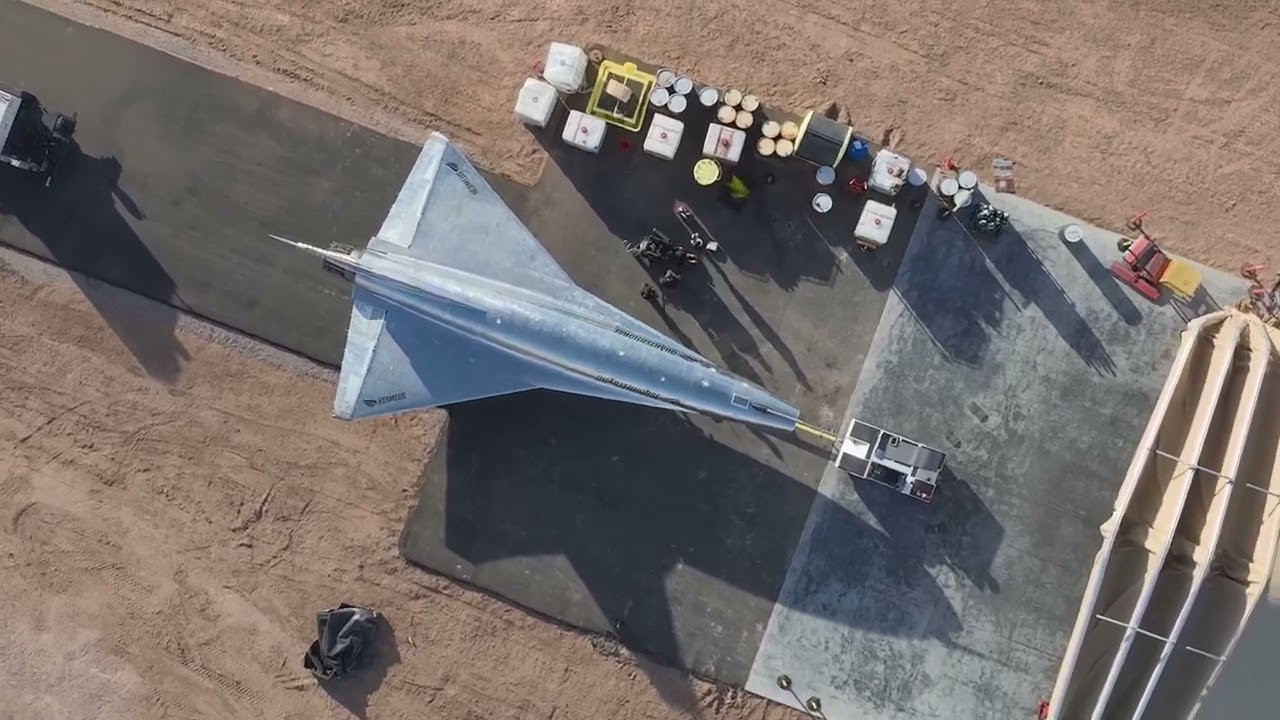
- Enter: The Quarterhorse, the company’s aircraft series. They kicked things off with the Quarterhorse Mk 0 for ground testing back in 2024.
- Last May, the company completed the first (successful) flight test for the next iteration, the Mk 1.
- Now, they’ve been working on variations of the Mk 2—Mk 2.1, 2.2 (supersonic), and soon, the 2.3, which should fly at speeds above Mach 3.
- Ultimately, the goal is to build the Mk 3—the world’s fastest aircraft—which Shore said should fly by the end of the decade. FWIW, the record is currently held by Lockheed’s SR-71 Blackbird, with recorded flights over Mach 3.2.
A lot of this money will go towards keeping that testing and building going, Shore said.
- Mk 2.1—an F-16-sized aircraft with a Pratt & Whitney F100 engine—completed a flight test in early March. Shore said they plan to get into supersonic flight “imminently,” like, in the coming months.
- MK 2.2 is now in production in Atlanta and “should be flying and well over supersonic the back half of the year,” Shore said.
- Mk 2.3 will be produced out of the new LA facility—with a nifty steel frame—and will fly in the first half of 2027.
Scaling up: The road to Mk 3 pretty much comes down to proving out a turbine engine at these Mach-3-plus speeds, Shore said.
“That ability then unlocks our ability to move into the Mk 3 version of the aircraft,” he said, “Mk 3 is the first time we would be flying our turbine-based combined cycle engine, which would be the proprietary pre-cooler up front, the turbine engine, and then the integrated ram jet.”
Zoom zoom.
Going west: Speaking of that Los Angeles facility—Shore said the decision to expand in El Segundo came down primarily to access to talent, mostly for prototyping.
“Prototyping for future aircraft will occur in Los Angeles, so that we can be co-located with the core talent that we need to build,” he said. “Atlanta then turns into a production facility that we can continue to scale into and through, but prototyping and core engineering talent would be at the LA facility in El Segundo.”
Shore said they plan to hire “hundreds” of people and spend “millions” on the facility, though they plan to do so gradually as the business grows. He also said that while they’re cash-happy for right now, they could always go out for more in the future.
“We are certainly not done…consuming capital, for this business is very capital consumptive,” he said. “But that’s not where we’re at right now.”