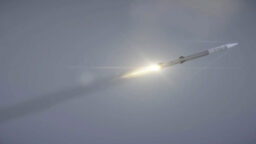
Busy times for rocket motor-makers.
Yesterday, solid rocket motor (SRM) startup X-Bow Systems snagged a $12.2M contract for “thousands” of rocket-assisted take-off (RATO) kits—including SRMs and launchers—for defense technology company Aevex’s 200lb Disruptor drone.
Big drone, big boom. We like it.
X marks the spot: X-Bow, pronounced “crossbow,” is on a mission to shake up the super-consolidated solid rocket motor (SRM) industry using their own patented propellant and additive manufacturing.
The company has typically focused on big-boy motors—like their recently tested 34.5-inch Ballesta SRM—designed for big ol’ missiles, hypersonics, and space launch. But, in case you hadn’t noticed, the smaller zoomy and boomy unmanned systems are pretty hot right now, and they need rocket motors, too.
Kitted out: Over the next few months, the New Mexico-based startup will provide Aevex with hundreds of production kits and thousands of SRMs and components, bundled under X-Bow’s RATO² (Rapidly Assembled Tactical Option for Rocket-Assisted Takeoff, say that three times fast) kit.
- RATO systems use small solid-fuel rockets to provide drones with a burst of extra thrust during launch, allowing for speedier acceleration of take-off speed and altitude.
- That allows larger aerial drones to take off from shorter runways—including on unprepared surfaces and confined spaces—and carry heavier payloads.
- X-Bow’s RATO² production kits include solid rocket motors (powered by their 3D-printed propellant), launch controllers, and cradles (the mobile structure that holds and launches drones during takeoff).
- Their SRM in the RATO² kit carries roughly 10 pounds of propellant, a whole lot less than the 3,500 pounds in their 34.5-inch SRM, X-Bow founder and CEO Jason Hundley told Tectonic.
Disrupted: Drone big dawg Aevex, which filed to go public last month, is shelling out $12.2M for X-Bow’s mini-SRMs and RATO system to give their Disruptor UAV some extra juice.
- The Disruptor, rolled out last May, slots into the Group 3 category and packs a punch with 14 hours of endurance, an 870-mile range, and a 50lb payload capacity.
- It’s mostly billed as a precision-strike UAS, but it can also carry ISR and electronic warfare payloads.
- It uses visual navigation and onboard autonomy to operate in GPS-denied or contested environments.
Of note, this is X-Bow’s first foray into the world of Group 3 UAS.
“With this current conflict environment, there’s a lot of UAVs moving from zero to production,” Hundley told Tectonic. “We’ve received a lot of inbound traffic in the last several weeks from other providers, as well as Aevex, because folks in the industry have figured out that we’re doing this.”
“Most of the capacity in the solid rocket motor industrial base is heavily taxed and constrained on existing programs, and so for them to tackle a new program and be able to scale effectively, there’s not necessarily a lot of unused capacity lying around,” he added.
Given the Pentagon’s hype about LUCAS and other one-way attack drones seeing action in Iran—and the department’s intent to scale production of them into the thousands—X-Bow’s phone line could get pretty busy.