It’s not every day that a CEO buys a company older than they are, but welcome to the new age of defense tech.
Yesterday, Mach Industries, founded in 2022 by now-22-year-old CEO Ethan Thornton, revealed that it acquired 24-year-old propulsion system and solid rocket motor-maker Exquadrum in a $50M deal back in April. The acquisition was first reported by the Wall Street Journal.
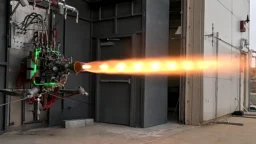
As a new member of the Mach mafia, Exquadrum will operate as Mach Energetics, the startup’s new dedicated energetics division, where they’ll both produce propulsion systems and product-specific motors for Mach and other customers.
Young money: Exquadrum may be a bit more under the radar, but Mach is a familiar name around these parts. The company raised a $100M Series B at a $470M valuation last June, led by Bedrock Capital and Sand Hill Road goliaths Khosla Ventures and Sequoia Capital.
So far, they’ve got a few products already in late-stage development at their flagship new-age “flexible factory” called Forge (a kind of defense manufacturing WeWork):
- Stratos: A high-altitude “pseudo-satellite” that deploys communications tech, sensors, and effects from the stratosphere.
- Viper: A turbojet-powered vertical takeoff one-way attack UAS. The Army Applications Laboratory awarded them a contract to build a cruise missile variant in 2024.
- Venom: A small plane-like drone designed in collaboration with Divergent.
- Dart: A low-cost kinetic drone interceptor.
- Glide: A high-altitude glider with a strike system capable of long-range, low-signature delivery.
- Pike: A long-range munition designed for decentralized modular deployment—“basically think much larger, longer range Viper,” Thornton told Tectonic.
Matchmaking: When it comes to all of the boom and zoom tech that the Pentagon’s looking for—and that Mach is making—Exquadrum was a pretty clear fit.
- Founded in 2002 by longtime Air Force Research Lab engineers Kevin Mahaffy and Eric Schmidt (not the Google one), they’ve been working on rocket propulsion technology for longer than Thornton’s been alive.
- That work’s expanded to include solid rocket motors, energetics, space launch, munitions, and, more recently, testing of hypergolic propellants—a dangerous combo of a liquid fuel and oxidizer that ignites upon contact instead of an external ignition system.
- To date, they’ve inked “several hundred” contracts with Pentagon customers, per Thornton, and many more as a supplier to aerospace and defense companies. That includes selling SRMs to Mach, which is how the two kicked off their relationship.
Working with Exquadrum from the customer side gave Thornton all of the due diligence he needed.
“They quoted us by an order of magnitude the shortest lead times, as well as the lowest cost, so we were pretty excited to engage with them as a supplier,” he said. “That said, as the business grew—and our big thing is vertical integration—we’re trying to make sure we can produce pretty much the whole supply chain for this kind of new era of unmanned warfare ourselves, as well as invest deeply in becoming the preeminent supplier for other companies in this space.”
“Exquadrum, as a company, was kind of a no-brainer for us in terms of both their ability to produce today, and then probably more importantly, a lot of the really exciting technology they have coming down the pipe,” he added.
Inheritance: With Exquadrum under the Mach umbrella, the startup will also inherit their book of contracts. That covers contracts with customers (including “primes and new startups,” according to Thornton) and the Pentagon, which includes, interestingly, work on the Golden Dome. Very timely indeed.
- Thornton couldn’t disclose what exactly that Golden Dome work entails, but said Exquadrum “does hypergolic testing, surface-to-air propulsion systems, and in-space propulsion.”
If you’re counting on Mach to lead the much-anticipated defense tech rollup, don’t get your hopes up.
“I don’t want to be a very acquisitive company—I think acquisitions are a tool, and they’re a very difficult tool to use, and it’s very easy for them to go wrong,” he said. “It’s easy to acquire too many companies too fast and sort of lose the soul of the business you’ve built.”
“For us, this was a position where to do what we needed to do, we had to make an acquisition, because you just can’t really build solid rocket motors ground up,” he added. “We’re not going to be a company that is acquiring our entire product portfolio.”