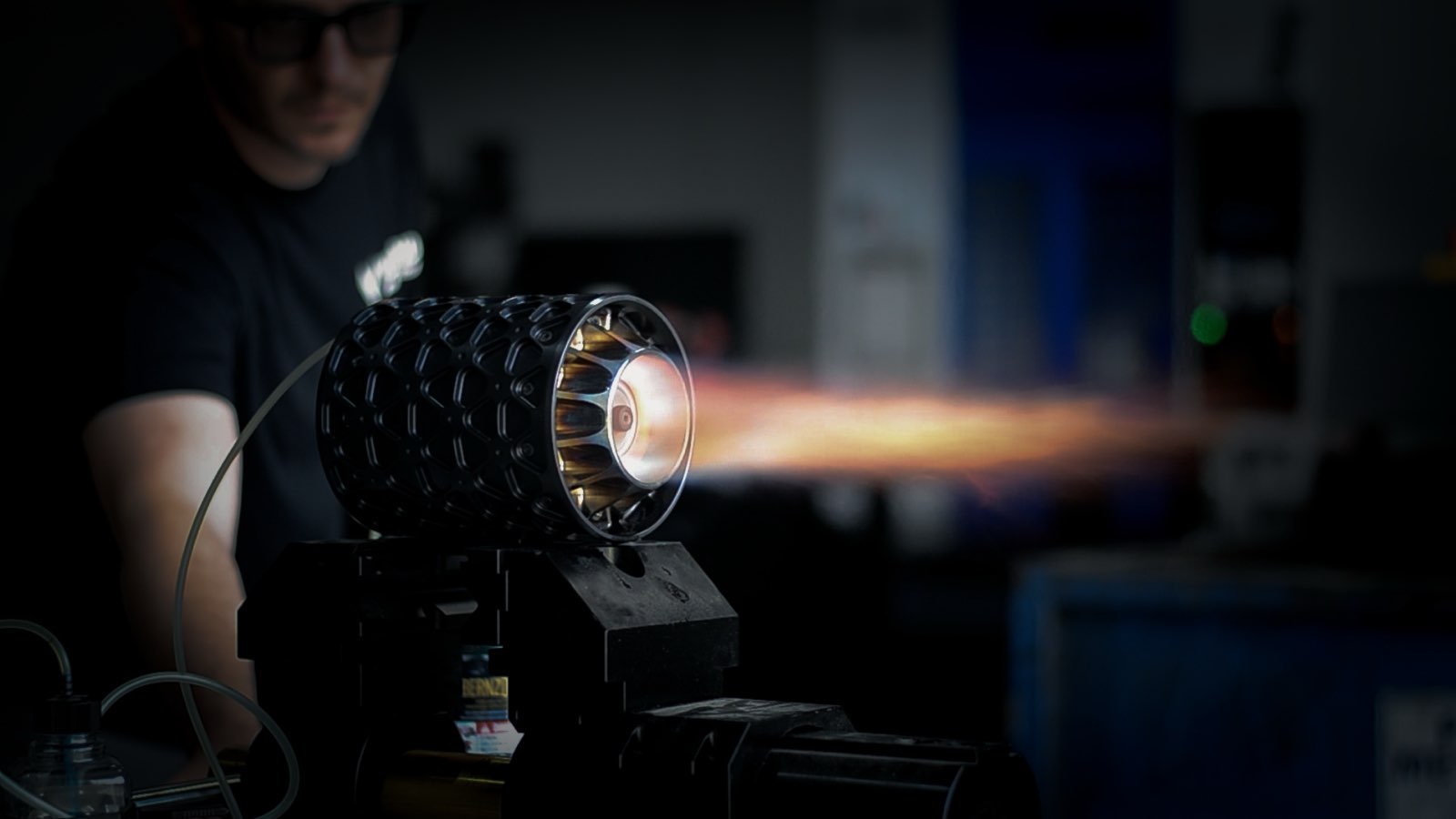
Component manufacturing really is so hot right now.
This morning, new-age manufacturing startup Volund Manufacturing announced that it’s raised a $12M seed round led by Root Ventures and Squadra to build low-cost gas turbine engines. New investor Output Capital also participated in the round, and Marlinspike, Alpha Delta Ventures, and First In returned to the cap table.
Volund founder and CEO Eric Hostetler told Tectonic that his team—now up to 14 people—will use the money to scale up R&D and “supercharge engineering efforts.”
“Volund is the output combining my long background with high-volume consumer goods…with my co-founders’ backgrounds in hardcore aerospace and defense manufacturing and quality engineering,” he said. “[We’re] really building a new factory model that’s optimized for this new world of attributable mass.”
New faces: Volund is very much a new kid on the block (the company was set up last year), but its founders have some pretty impressive experience.
- Hostetler was previously at Anduril, Oakley, and Apple. His expertise is in product development and deployment.
- Steven Stanley (CTO) was at Aerojet Rocketdyne and, later, Blue Origin. He’s a propulsion junkie.
- Ken Spaulding (CMO, Chief Manufacturing Officer) has spent his entire career in precision machining, including at Vescio Threading and Zodiac Engineering.
- James Sonntag (COO) has worked in product management and development everywhere from Yeti to Oakley and Fox Racing.
And that dream team got them some cash money early on. The company first raised an undisclosed amount of pre-seed funding from First In, Cyrus Ventures, and Marlinspike in 2025, per Pitchbook, and has spent the last year-ish building out a 5,500 sq ft facility in Huntington Beach, CA.
Go boom: Hostetler said he and his co-founders landed on propulsion as a problem to tackle because it’s the “largest problem” in terms of attritable systems.
“As we’ve watched the Department of Defense trend more and more towards attritable systems, towards lower cost, towards faster iteration and higher rates [of production], what that starts to look like from a manufacturing and industrial point of view starts to overlap quite heavily with the world of consumer goods and higher volume manufacturing,” he said.
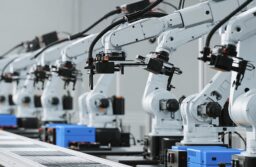
Big ups: So, what does that actually look like, in Volund’s case? Hostetler says they’re creating a vertically integrated factory with a “digital thread” running through it. “We’re building a digital backbone through that factory that allows us to realize and take advantage of efficiencies that just aren’t available with any other manufacturing model,” he added.
- Volund is using off-the-shelf PLM (Product Lifecycle Management) and ERP (Enterprise Resource Planning) systems, combined with the company’s own MES (Manufacturing Execution System).
- The idea is that the bespoke MES ties the whole manufacturing process together—that means that if an engineer changes an engine design in CAD, for example, those updates automatically flow through the rest of the factory without requiring a bunch of manual rework.
- That enables much faster engine design and redesign based on engineering, partner, or integrator needs. “We’re able to move through iterations and permutations of engine designs much more quickly than any kind of legacy system,” Hostetler said. “We’re [also] able to dramatically reduce the amount of back-office headcount that we have to employ…to run that factory floor.”
Back to basics: Right now, Volund’s engineering team is finalizing that gas turbine engine design, which they plan to wrap up by the end of the month.
- Though they do not have formal contracts or partnerships yet, Hostetler said they’re “working with integrators” like Anduril, Raytheon, Lockheed, Zone 5 Technologies, and Leidos to make sure the engine design fits their needs.
- They’ve also had traction with the services, he said, especially the Air Force. Hostetler said this engine could be a game-changer for things like the FAMM (Family of Affordable Mass Missiles) program.
- The engineering team is still finalizing what materials they will use—Hostetler said that, actually, sheet metal manufacturing might end up being more scalable than additive manufacturing.
- The goal is to build a prototype engine in the next few months, tweak it, and then have it flying with integrators (those companies named above) in the early part of 2027, he said.
“We’re building the first engine to validate the engineers’ math…then we will start the iteration process,” he said. “Then, we tweak it, we remake it, we test it. We start to bring in the secondary systems—things like ignition, things like fuel delivery, things like sensors and controllers…Then, once we’ve got them all together in one package, towards the end of the year, that’s where we start buttoning it up and speaking with partners who are excited to fly [the engine] on one of their frames.”
Scale up: By the end of next year (2027), Volund hopes to be churning out hundreds of engines a year. By the end of 2028, Hostetler hopes to ramp that up to hundreds a month (thousands a year). These kinds of numbers are critical, he says, for future conflicts.
“As we’re looking towards China and INDOPACOM as the next theater that we’re concerned about, all the distances there are in the hundreds of miles versus the tens of kilometers,” he said. “A lot of the…kind of things that we’re seeing in Ukraine and other places won’t be as relevant there. [So, we’re working] on the systems that are limiting factors for those longer distances….[which are] small air-breathing jet turbines.”