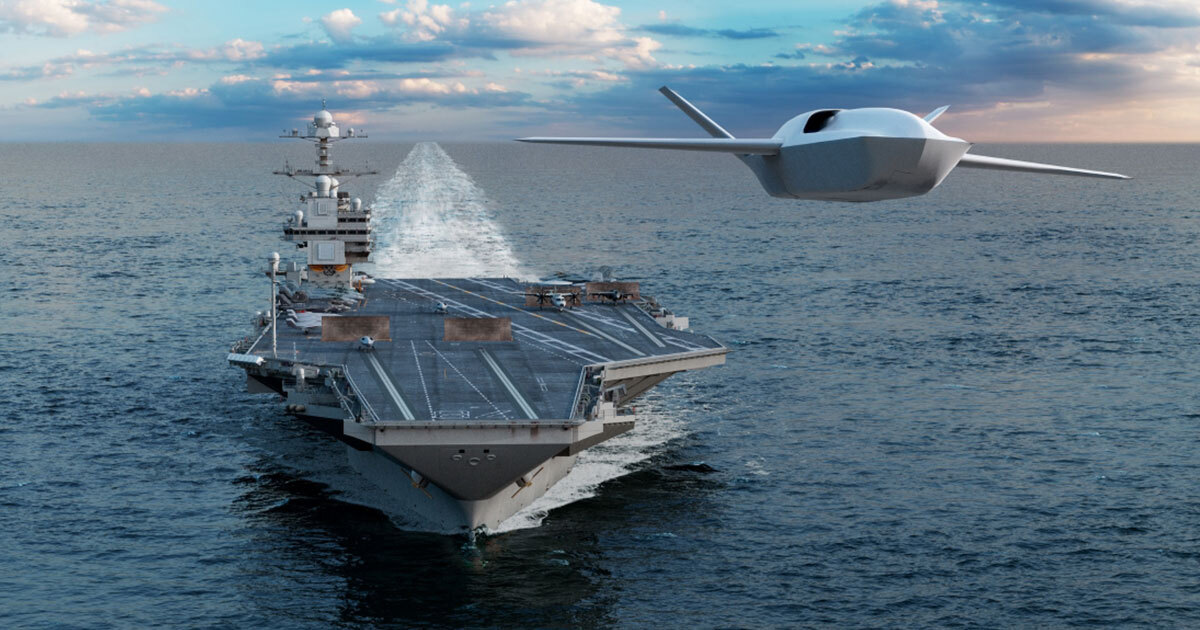
If you read our newsletter yesterday (we see you), you’ll know that General Atomics announced that they’ve been tapped by the Navy to develop conceptual designs for the service’s very own CCA program.
(For the blissfully unaware, that’s the collaborative combat aircraft, or loyal wingman, program. Essentially, it’s the effort to build drone fighters that can fly and fight alongside their full-sized brethren.)
While everyone loves a prime win (joking, joking), the whole Navy CCA effort is a whole lot more complicated than one GA concept design. So we thought we’d do a bit of a deep dive and invite you down the rabbit hole with us: What’s the Navy’s plan for CCA, where does the program stand now, who is competing for the contract, and how is it different from what the Air Force is doing?
Strap in. We’re getting tiny plane nerdy.
Teeny tiny: Rumors of a Navy CCA program that would look a lot like its Air Force counterpart first surfaced last month: On Sept. 5, Breaking Defense reported that four companies—Anduril, Northrop Grumman, Boeing and General Atomics—had been tapped to lead the service’s loyal wingman effort, according to an official Navy document.
Lockheed Martin was picked to build the C2 for the whole system—the Navy’s UMCS (Unmanned Carrier Aviation Mission Control System). It’s worth noting that this common control architecture is already being tested on GA’s MQ-20 Avenger and will eventually fly MQ-25 and the service’s future CCAs.
Anduril, Northrop, and Lockheed all confirmed that they’re part of the program; as of Friday, so has GA.
Shout it out: While the Air Force has been very gung-ho—and very public—about its efforts to field CCAs, the Navy has been a bit more hush-hush about the whole thing.
Back in April, Rear Adm. Michael “Buzz” Donnelly, Director of the Air Warfare Division (N98) within the Office of the Chief of Naval Operations, said that the Navy was taking a slower, more cautious approach to CCA than the Air Force. That’s at least partially because building unmanned fighters that can operate off of ships is, like, really hard.
“We are definitely in the follow of those three services as we look to see how Air Force is developing and fielding things, quite frankly, in a more simple operational environment than what is required for a ship-based system,” he said.
From what we can tell, here’s what the Navy wants these little drone fighters to be able to do:
- They want a carrier-suitable, unmanned fighter that can operate alongside the F/A-18E/F, EA-18G, F-35C, and eventually F/A-XX.
- According to GA’s release, the service is looking for unmanned fighters that take a “modular approach to platform selection” and are “capable of being rapidly reconfigured and upgraded to meet changing mission requirements.”
- Apparently, Navy leaders have also been listening to all of us whinge on about acquisition—the service will use a “strategy of smaller, frequent purchases that enable rapid technology insertion rather than traditional long-lifecycle programs” for the program.
The Navy’s CCA effort won’t be totally divorced from the Air Force’s—leaders have indicated that while acquisition programs will remain separate, they will coordinate on standards for things like “architecture, mission planning, control stations.” They may even share planes once all is said and done.
Right on target: But the main difference—and sticking point—remains the whole “can it land on a boat” thing. And the Navy hasn’t exactly had an easy time of it in the “getting drones to land on boats” category.
The service has been trying to get an unmanned, carrier-based strike drone since the early 2000s (yes, over two decades). After many, many program iterations, the Navy decided to issue contracts for a “carrier-based aerial refueling drone” to relieve pressure on the Super Hornet fleet back in 2018. Boeing won the contract for a cool $805M with its MQ-25 design, beating out Lockheed, General Atomics, and Northrop Grumman.
The MQ-25, well, has not yet successfully taken off and landed from a carrier. To be fair to Boeing, carrier ops are brutal: drones have to catapult off a moving deck, fold their wings to squeeze below it, survive salt and electromagnetic interference, and still catch an arresting wire on landing—all without a pilot. Plus, it’s been pretty hard to plug the drone’s control system (UMCS) into the Navy’s legacy kit.
However, Boeing (surprise, surprise) has also had serious supply chain issues and production delays.
Regardless, Navy leaders insist that the refueling drone will fly in 2027 (only three years late), and that CCA will follow the same pathway. “The baseline architecture that will be required to enable those capabilities, as well as the ground control station that we are currently utilizing for MQ-25, we expect to become the standard for all of these systems,” Donnelly said back in April.
GA was first in the air for the Air Force. Now let’s see who can be first to land on a carrier.