In the near-future battlefield, and today in Ukraine, swarms of friendly drones will be deployed as fast as enemy ones come in.
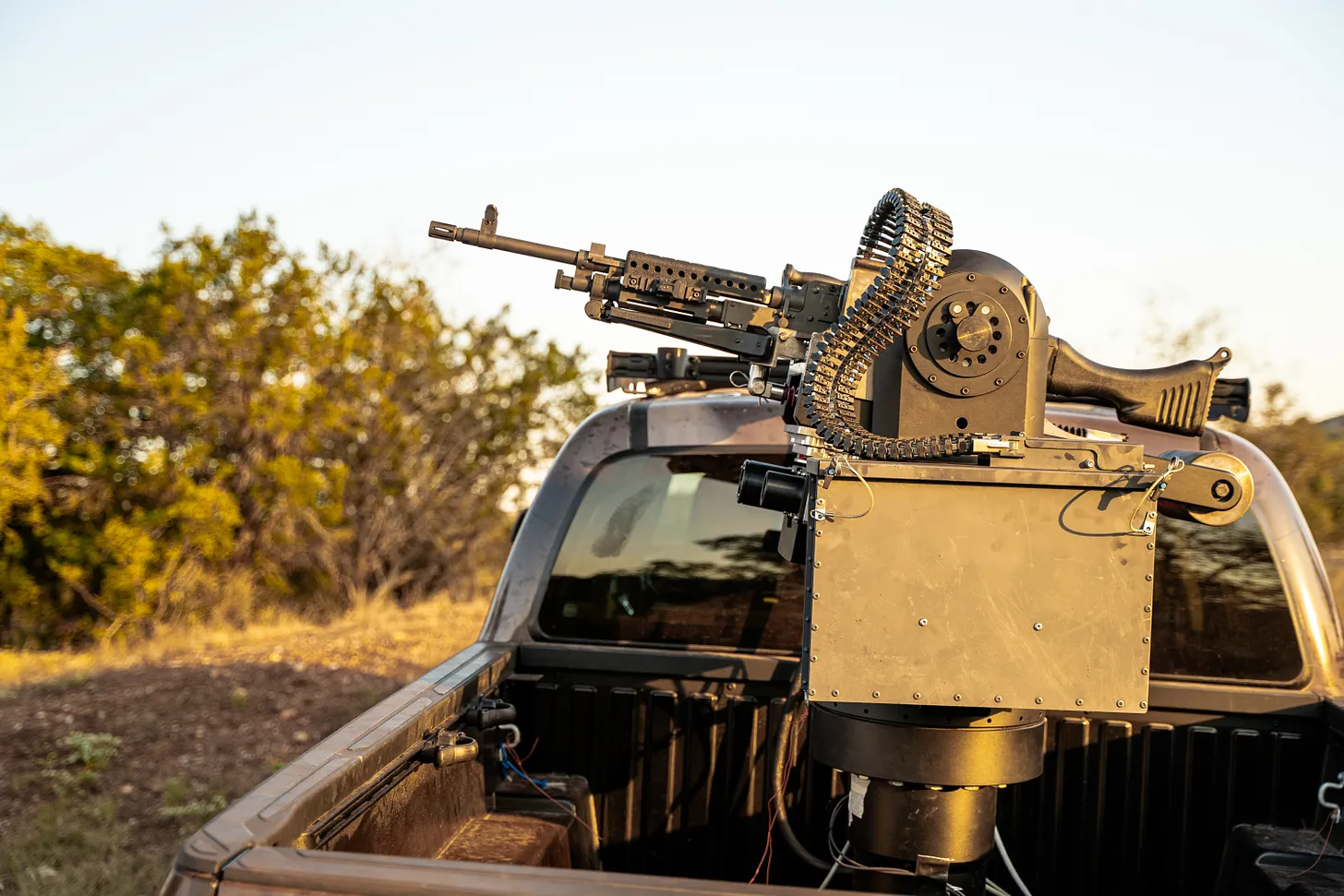
For counter-drone tech, knowing which ones to shoot down can be hard. On Wednesday, Allen Control Systems unveiled a solution to this conundrum: A cryptographically secure, radio-silent identification friend-or-foe (IFF) system that tells c-UAS platforms—like their Bullfrog automated machine gun—who the good guys and bad guys are.
Pew-pew: Right now, most IFF systems rely on detecting radio frequencies, but in a signal-contested, electromagnetic warfare-defined battlefield, c-UAS is often either indiscriminate or reliant on visual ID.
“Imagine a battlefield where there are 2, 3, 400 drones flying around, some enemy, some friendly,” ACS CEO and co-founder Mike Wior told Tectonic. “If we can’t quickly distinguish between the two, then we’ll be doing just as much damage to our own assets as we will be to our enemy’s assets.”
FAFO: Their IFF system, called the Friend and Foe Operating System (FAFOS), offers more selective engagement, which Wior compared to two-factor authentication or sending an SSL certificate across the internet. He also said that he’s not aware of anyone else taking a similar approach.
Here’s how it works:
- A little receiver weighing less than 20 grams is put on friendly drones, along with a non-visible, light bulb-like optical sensor.
- A cryptographically encoded laser on the c-UAS platform (in ACS’ case, the Bullfrog) hits the sensor, verifies its cryptographic signature, and the radio-silent receiver transmits information through its own non-visible, modulated near-infrared (NIR) or short-wave infrared (SWIR) light sequence identifying it as friendly.
- ACS says that information can be communicated in under 200 milliseconds, so Bullfrog (or another effector) can disengage from the friendly drones with FAFOS and engage the ones without pretty quickly.
“It was pretty organic to what we’re already building, since we already aim a laser at a drone from very, very far away for the Bullfrog system,” Wior said. “Because we’re using the same laser that we used for our Bullfrog system, [drones] are also being tracked by the same kinetic effector that will engage it should it prove to not be friendly.”
Setting a standard: Beyond the Bullfrog integration and the drone- and EW-dense battlefield scenario, ACS believes FAFOS has the potential to become a legal requirement for commercial drones flying in US airspace and a standard integration for BLUE UAS approval.
Wior says the encrypted laser can allow law enforcement to transmit information and commands to drone operators flying unlawfully, and set a legal precedent and mechanism for acting on and enforcing airspace violations.
“We’re expecting this to be the next big challenge once we get enough drones in the sky for it to matter,” he added, and given the simultaneous drone-philia and drone-phobia right now, that could turn out to be pretty soon.