
Move over, drones. This week is all about the science fiction-y stuff (well, at least for now).
Yesterday, connectivity company (and Google spinout) Aalyria announced that it’s raised a $100M Series B at a whopping $1.3B valuation led by Battery Ventures and J2 Ventures, with participation from DYNE and others.
Aalyria CEO Chris Taylor told Tectonic that his team will use the money to hire engineers, build out their growth and go-to-market teams, bolster their supply chain, deliver to customers, and explore new products (like 5G and 6D non-terrestrial networks).
We decided to raise now because the demand [has] really started to pick up,” he said. “Beyond the current contracts that…we must perform on, there’s an enormous amount of backlog. To be able to actually capture it, you have to have resources, people, and time to do it.”
Pew pew, baby. Space comms are back.
Back to the future: We’ve covered Aalyria before: The company started as a very highly funded secret project within Google, codenamed “Minkowski,” then spun out into its own company in 2022.
In a release from when Aalyria broke off into a solo act, the company said it aims to build “hyper fast, ultra-secure, and highly complex communications networks that span land, sea, air, near space, and deep space.”
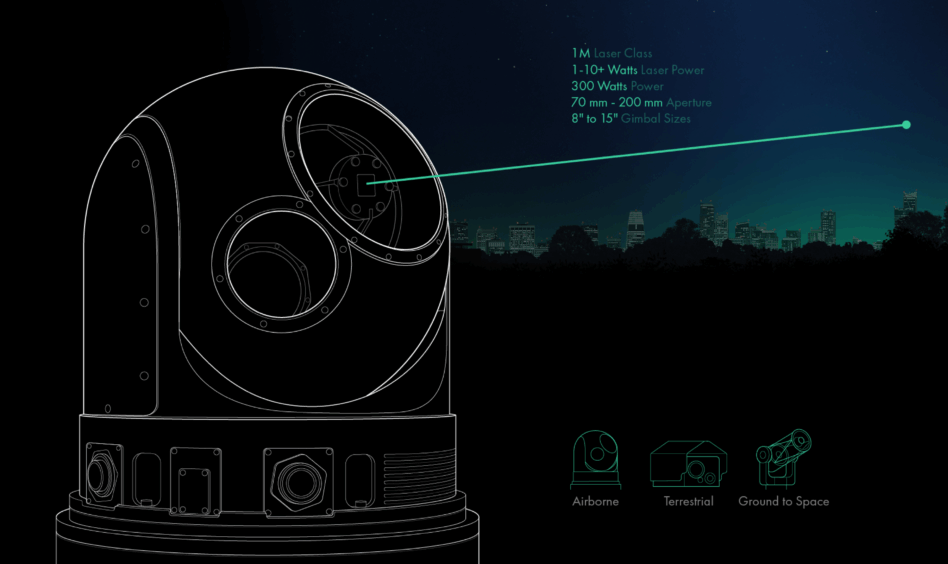
Basically, the idea is to use laser comms (which are common in space-to-space comms) to make connectivity better, like, everywhere. The company has two main products:
- Tightbeam: A laser comms system, which the company says can deliver “fiber-equivalent speeds wirelessly through atmospheric conditions where traditional infrastructure cannot reach.”
- Spacetime: A software-defined networking platform (PaaS) that can coordinate “large and constantly-changing communications networks with steerable or directional signals—like satellite constellations and airborne mesh networks.” Think of this as the brain that coordinates the comms.
Pew-pew: Now you might be sitting there thinking, like, wait, isn’t space Payload’s thing? Well, it is—but these kinds of comms have massive implications for things (especially defense-y things) here on earth.
- All of those fun, shiny defense tech baubles and bits we know and love need to be able to talk to each other and coordinate reliably (and quickly).
- Most stuff here on earth communicates using RF, but as we’ve seen in Ukraine, that’s not always the most reliable.
- Laser comms have higher bandwidth, take things off the RF spectrum, and are much harder to intercept. That’s good news for all you drone-heads out there.
“The US government has spent a lot of money on a lot of things in a lot of networks—none of them were ever meant to talk to each other,” Taylor said. “They weren’t even designed to talk to each other.”
Aalyria wants to fix this. “We want to be the digital cartilage that connects everything [across domains] that the US government and allied governments…need to be connected in order to fulfill their missions,” he added.
Getting traction: And they’re off to a pretty good start—they’ve already scored contracts with DIU and the Space Force’s Rapid Capabilities Office (RCO), just to name a few.
They’ve also been quite a hit with investors—they’ve raised a total of $130M, according to Pitchbook data, not including all that funding Google had already pumped into the tech.
Alex Harstrick, a managing partner at J2 Ventures, told Tectonic that Aalyria is basically helping all of us normies on Earth start to live in the future.
“The world is only just now waking up to the possibility of moving its infrastructure to space,” he said, “Regardless of all the use cases being funded, space is fundamentally for Earth. The best use case for a space-based company for Earth is telecommunications, and few companies are more promising in this domain than Aalyria.”