The Pentagon is buying counter-drone technology for “real-world operational use” from a startup, but maybe not from one we’d expect.
Yesterday, West Palm Beach, Florida-based drone company Powerus announced a deal with the US Air Force to supply interceptor drones “at scale,” co-founder and president Brett Velicovich told Tectonic.
He couldn’t comment on the contract details, but said the “end customer is within the US Air Force Special Operations community.”
Power up: To back things up, Powerus, founded last year, has made headlines in recent months for, um, unconventional reasons.
- The company is designed as a drone roll-up focused on acquiring Ukrainian drone companies and tech to sell to the US military.
- In March, Powerus announced investment from the president’s eldest sons, Eric and Don Jr. (Barron’s apparently focused on Yerba Mate), and plans to go public via a merger with Aureus Greenway, a Trump family-backed golf course holding company.
- The company has named some heavy hitters to its advisory board, including former Chairman of the Joint Chiefs Gen. CQ Brown (ret.) and Trump’s former special envoy to Russia and Ukraine Lt. Gen. Keith Kellogg (ret.).
As we said, unconventional, but what can ya say? It pays to have the best go-to-market guys in your corner.
Powerus has a wide range of drone-flavored products on offer—including heavy-lift UAVs, small drones, and USVs—but we’ll focus on the counter-drone stuff that the Air Force is getting its hands on.
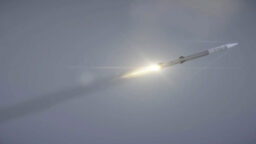
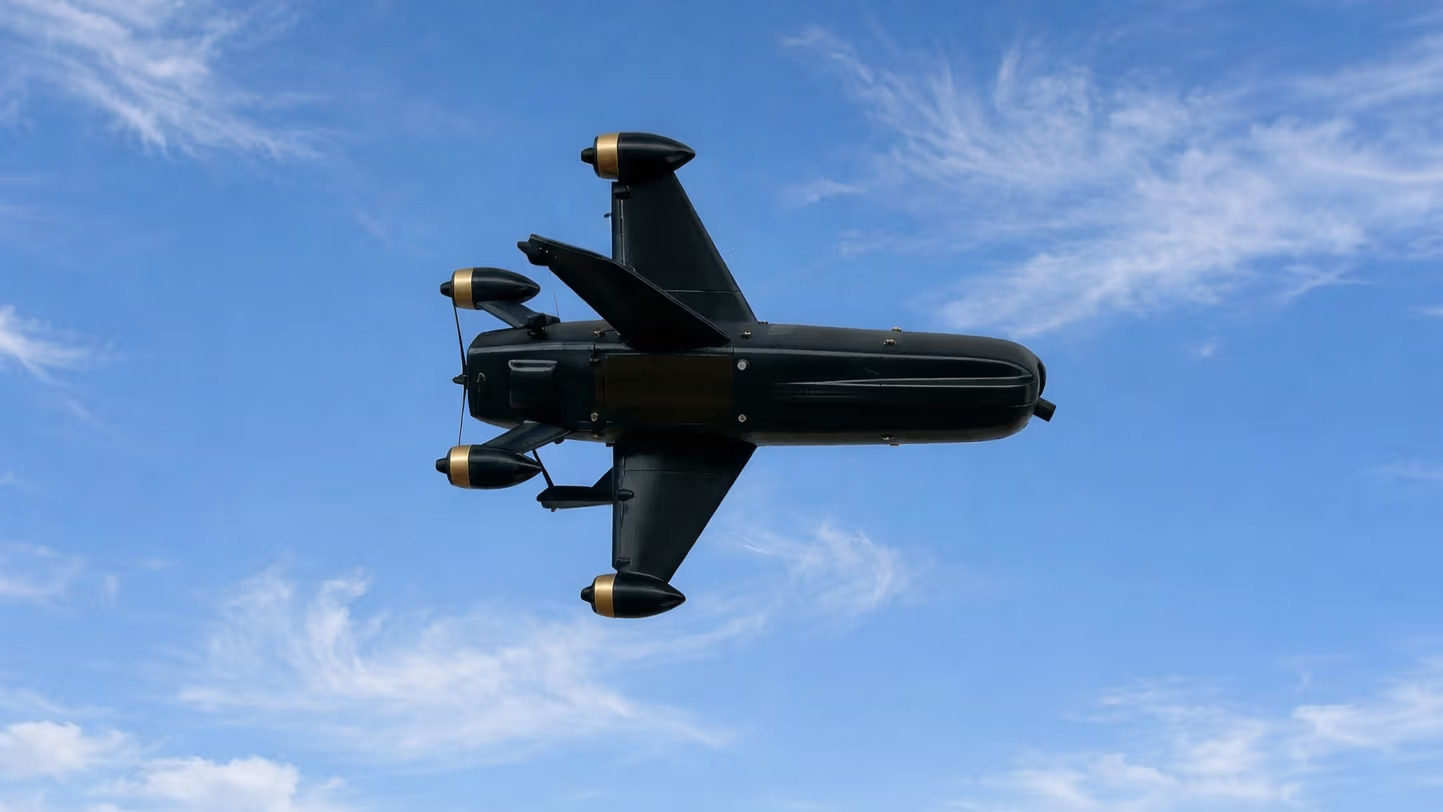
Guardian-1: Powerus’ first cUAS offering, the Guardian-1 is a compact, six-pound battery-powered interceptor drone.
- It has a cruise speed of 100mph, a top burst speed of 211mph, 10 miles of range, 28 minutes of endurance, and a max altitude of 16,404 feet.
- It uses radar-assisted target designation and camera-guided final approach, and scored “hundreds” of confirmed interceptions, according to the company.
Guardian-2: Unveiled yesterday, the second member of the Guardian family has the same form factor as the first, but with some upgrades.
- Velicovich described the interceptor as “our next-generation, semi-autonomous evolution built on lessons learned from real-world deployments and capable of integration into various sensor and radar detection systems that the US government employs globally.”
- The interceptor’s design is “informed by battlefield lessons learned in Ukraine, particularly around counter-UAS tactics, survivability, and rapid iteration,” he added, but the “systems are made and produced in the United States.”
- It was recently tested by the Air Force, which clearly took a liking to it.
Shoot ‘em down: Friends in high places aside, “This sale happened for a simple reason: the technology works,” and the Guardian-2 has “gone through multiple evaluations and demonstrations with US military stakeholders prior to this purchase order”, Velicovich said. “What we’re seeing now is a transition from evaluation into broader operational adoption.”
He added that the deal “reflects a growing demand signal and aligns with the Department of War’s broader push to rapidly deploy trusted counter-UAS systems at scale.”
When Powerus goes public with the golf course company, we’ll bet that it won’t be the greens that get investors excited. Talk about dual-use.