
To whoever thought this would be a slow news week in defense tech land, think again.
Yesterday, Anduril announced that it’s teaming up with teeny tiny startup Boeing to provide solid rocket motors for the prime as part of its bid for the U.S. Army’s Integrated Fires Protection Capability (IFPC) Increment 2 Second Interceptor competition.
Anduril will provide SRMs for Boeing’s mid-range interceptor, designed to hit those fun buzzy drones and cruise missiles we all spend so much time thinking about.
“This partnership underscores our commitment to forming innovative, disruptive and agile industry teams that deliver new capabilities to warfighters sooner,” Bob Ciesla, vice president, Boeing Precision Engagement Systems, said in a statement. He said Boeing is “confident that this partnership will result in a novel solution that helps meet the Army’s evolving air defense needs.”
An Anduril spokesperson told Tectonic that the SRMs will be built in their new, shiny production facility in Mississippi.
Down south: In case you haven’t been paying attention, SRMs are a pretty big deal around here. These little motors are the secret sauce that makes missiles go far and fast—but they’re in short supply in the US.
- Two primes—L3Harris and Northrop Grumman—have dominated the SRM market for pretty much forever. That’s led to massive bottlenecks in production.
- Military leaders and companies like RTX have said that the SRM shortage is pretty much the main reason the US has trouble producing as many missiles as it and its allies need.
- Anduril stepped into the SRM ring in 2023 when it acquired Mississippi-based Adranos.
The company officially opened an SRM mega-facility in McHenry, MS, back in August, which it says will be able to churn out 6,000 SRMs a year by the end of 2026.
Far and fast: Anduril has already scored some pretty big wins on the SRM front, despite being a relative newcomer on the scene.
- In March, the company was selected by the US Army to build a new, teeny-tiny 4.75‑inch SRM for long-range precision artillery like HIMARS.
- Last June, the US Navy awarded Anduril a $19M contract to build SRMs for the Standard Missile-6 (SM-6) program. In April, the company completed two successful live fire tests.
- In June, Saab also selected Anduril to provide SRMs for the Ground-Launched Small Diameter Bomb (GLSDB) program, which it runs jointly with Boeing. (Note: This is not Anduril and Boeing’s first rodeo.)
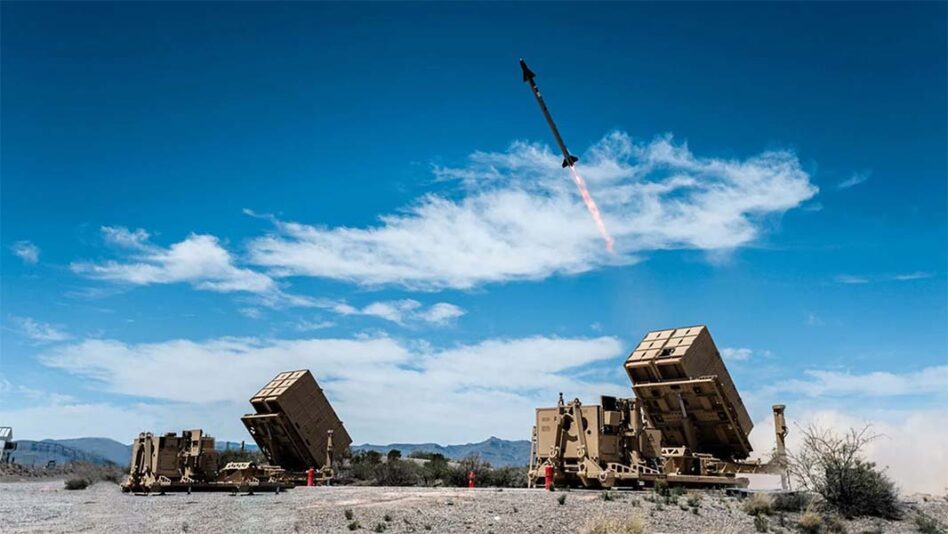
Go boom: The IFPC program that the two companies will be working on is an interesting one. According to the Army, the idea is to build “a mobile, ground-based weapon system designed to defeat cruise missiles (CM), unmanned aircraft systems (UAS), and rocket, artillery, and mortars (RAM).”
The whole setup is set to consist of a launcher and interceptors that “bridge the gap between short-range air defense (SHORAD) systems, the Patriot air and missile defense system, and the Terminal High Altitude Area Defense (THAAD) system.”
- Dynetics/Leidos won a prototype OTA back in 2021 to develop and deliver launcher prototypes, interceptors, and magazines for IFPC Increment 2. Dynetics then won an IDIQ worth up to $4.1B for the program last year.
- The Army opened up a prototype competition for a second interceptor last year (that’s kind of been the service’s thing lately), and began awarding OTAs this fall.
- Boeing scored an OTA for the interceptor on December 5. The prime will be competing against Lockheed Martin and Rafael (at least so far).
The Army plans to award prototype contracts for the program next year.