The Marines are on a bit of a spending spree this week, aren’t they?
Yesterday, the Marine Corps announced that it intends to issue a sole-source contract to Anduril for non-kinetic counter-drone technology for its Amphibious Combat Vehicles (ACVs), including the company’s Pulsar-L EW platform and vehicle integration kits “to meet an urgent requirement.”
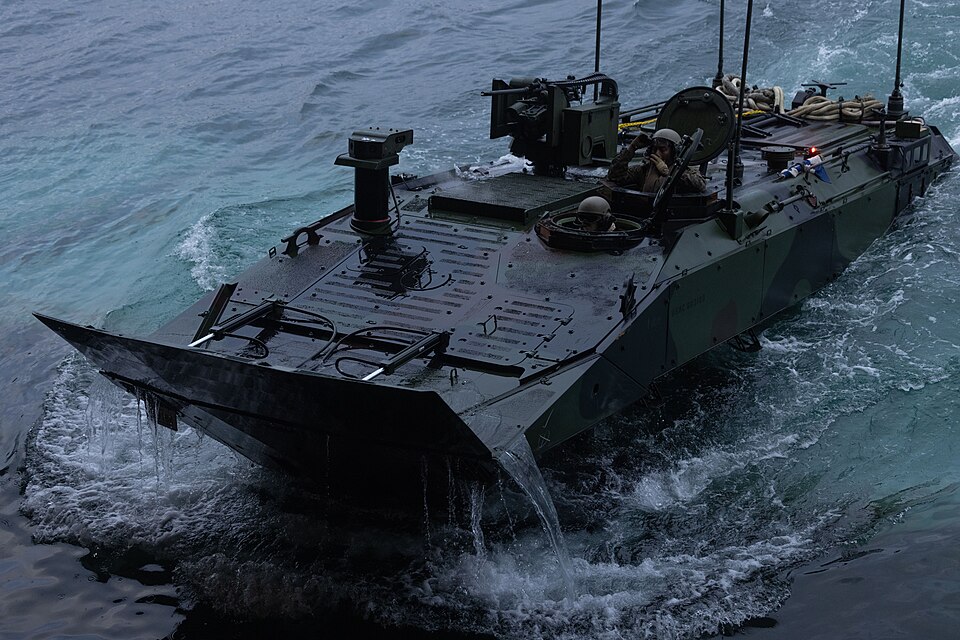
According to the service, the newly fielded vehicles—think mini-warship with wheels, or a Humvee that floats—lack “the ability to effectively execute any part of the kill-chain (detect, track, identify, or defeat) against increasingly prolific” small drone threats.
Idk, seems bad.
On land and at sea: The ACV is a funny one. To picture it, think of a heavily-armored, 8-wheeled troop carrier that can swim (like a boat) from ship to shore, then operate like a modern armored vehicle once on land.
- The platform was developed by BAE Systems in partnership with Iveco Defence Vehicles and was designed to replace the aging AAV-7 fleet that had been in service since the 1970s.
- The vehicle was designed in the 2010s and entered into service in the early 2020s.
- It comes in a few different flavors: ACV-P (for personnel), ACV-C (a mobile command post), ACV-30 (with a 30mm cannon turret), and ACV-R (with a crane and stuff for recovery).
The ACV is a big part of the Marines’ push towards distributed, littoral (meaning along the shoreline, nerds) operations under Force Design 2030. But the problem is the vehicle was designed and built in the 2010s, when things like small drones weren’t nearly as much of a threat.
That’s why they’re unprotected. But now we know (Ukraine, anyone?) how much damage even a teeny drone can inflict on an armored vehicle.
Teeny tiny: So, that’s where Anduril and Pulsar-L come in.
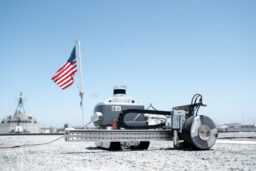
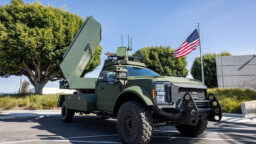
Pulsar is Anduril’s family of EW systems; Pulsar-L is the smaller, lightweight, throw it on the back of a truck version.
- The size and weight are critical here—every bit of kit you put on the ACV makes it doing its job (like, floating) harder.
- Pulsar-L is about the size of a Yeti cooler and weighs less than 25 pounds.
- It’s designed to be plug-and-play—the company says it takes just a few minutes to set up. It also plugs into Lattice, which the Marine Corps announcement said “allows for complex multi-unit operations with limited operator tasking and provides battlefield management and situational awareness to users.”
- It can also reportedly take out full drone swarms.
Plus, the service is already familiar with Anduril’s kit—last year, the company won a $642M, 10-year Program of Record to provide cUAS to the US Marine Corps.
Inside track: You might be sitting there thinking, “Wait, was there a competition for this?” The answer, it appears, would be no.
The Marines say that because there was “unusual and compelling urgency” for cUAS for the ACV (under 10 U.S.C. 3204(a)(2), as implemented by FAR 6.302-2(a)(2), if we’re being nerdy), they were able to go straight to contract here.
“The Pulsar-L provides the combination of performance, design, and production readiness that instantly meets the urgent PM AAA requirements,” the government wrote in the award announcement.
The Marine Corps expects to issue a one-year, fixed-price (price TBD) contract to Anduril, and will also “continue to monitor capabilities offered by industry for, and intends to compete to the greatest extent possible, future requirements for C-sUAS systems.”
Better known than the unknown, or so they say.