
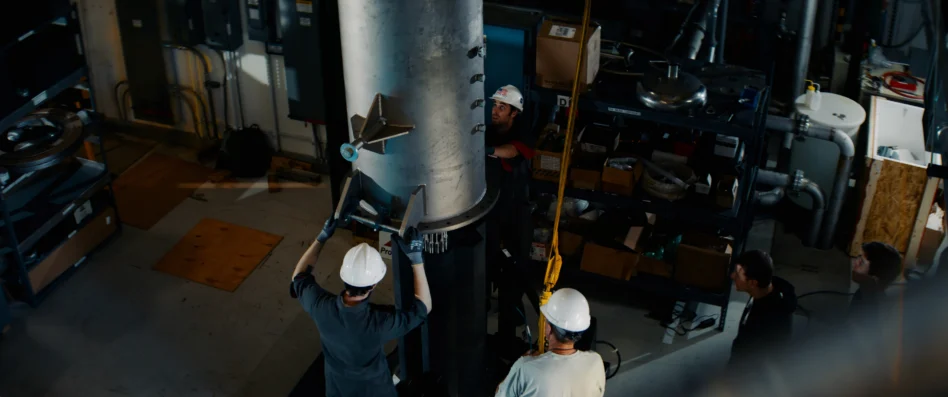
If all goes according to plan, Antares Nuclear and a handful of other nuclear startups will have a lot more to celebrate on July 4 than Independence Day.
Earlier this week, Antares, an LA-based space and defense-focused nuclear fission startup, moved closer to turning on its microreactor after the Department of Energy approved its Preliminary Documented Safety Analysis (PDSA), a step that CEO Jordan Bramble called “the most significant milestone of the entire process” to reaching criticality before the DOE’s Reactor Pilot Program’s July 4 deadline.
Going nuclear: Antares—which is working on small-scale reactors designed to meet the US military’s energy demands—has had a big last few months, and they’re in good company.
- Antares closed a $96M Series B in December, bringing the company’s total fundraising to date to roughly $134M.
- Radiant, a startup making shipping container-sized microreactors, raised over $300M in December, making it a unicorn.
- Valar Atomics, another LA nuclear startup, raised $130M in November with backing from Anduril’s Palmer Luckey and Palantir CTO Shyam Sankar.
- And just this week, Tennessee-based Standard Nuclear raised $140M to boost production of a new type of fuel used by next-generation reactors.
Mission critical: Beyond a whole lot of cash, these startups all have something else in common: They’re part of the Department of Energy’s Reactor Pilot Program, which aims to bring at least three advanced reactor designs to criticality—when a nuclear fission chain reaction becomes self-sustaining—at national laboratories before July 4th.
- Antares’ Mark-0 reactor, their first demonstration reactor, will be tested at the Idaho National Laboratory using a full-scale core and the same facility and fuel as their electricity-producing one that’s scheduled to come online in 2027.
- Antares’ microreactor is designed to be modular and compact enough to operate off the grid in remote locations, like military installations.
- The microreactor Antares is building is expected to provide between 100 kW and 1 MW of power over a 4–6 year period.
- It’s designed to run on TRISO fuel, a new type of ceramic pellet fuel that’s safer than traditional nuclear fuels (Standard Nuclear is one of the few producers of TRISO).
In order to turn on that microreactor, “there are a series of regulatory milestones, and the largest, biggest hurdle” of them all is the Preliminary Documented Safety Analysis (PDSA), Bramble told Tectonic.
Safety first: The PDSA, put simply, is the safety basis document companies need for designing and constructing new or modified nuclear facilities. The DOE green-lighting Antares’ PDSA puts them on track to reach criticality before Independence Day.
“Coming out of PDSA approval is a very clear path forward to close out the final documented safety analysis, which is the final thing [the DOE] needs to sign off on before you get into readiness activities to actually start up a reactor,” Bramble said. “We’d say this is really the most significant milestone of the entire process, and from here on out, we’ve got a lot of clarity on the platform.”
Powering up: Antares and their nuclear startup frenemies moving so fast is good news for the Pentagon, especially the Army, which launched the Janus Program—a next-generation nuclear power program aiming to deliver energy to military installations by September 2028—in October.
And according to Bramble, the military’s demand for resilient power is only going to grow, and for good reason.
“There are mega-trends that are driving new demand for next-generation nuclear on military installations,” especially the need for energy resilience detached from the civilian grid and an energy supply able to sustain everything from ground-based missile defense radars to assets in space, Bramble said, and reaching criticality this year sets Antares up nicely to capitalize on that.
“We haven’t shared the [criticality] date publicly, but we feel very comfortable with the amount of margin we have in our schedule compared to the July deadline,” Bramble said. After that, “We’ll be producing electricity in 2027, and we’ll be in a position with a maturing technology that’s designed around these military use cases, and I think we’ll be very competitive.”