Mega-giant data centers, in case you hadn’t noticed, are popping up everywhere these days.
But edge computing startup Armada isn’t interested in the supersizing of it all—they want to shrink data centers down and take them to all the far-flung places where the military needs extra processing power. And it seems like the people with the big bucks think that’s a pretty good idea.
This morning, the CA-based company announced that it’s raised a $230M Series B at a $2B pre-money valuation, co-led by Overmatch, BlackRock, and 8090 Industries. And, in case that wasn’t enough, Armada also unveiled its 400,000 square foot Galleon Forge One factory in Arizona, where it’s partnering with Johnson Controls to build its modular data centers.
- Johnson Controls—a multinational industrial systems conglomerate—also made a “significant equity investment” in Armada and “brings a significant manufacturing footprint to this partnership, including 40,000 field personnel and production hubs across all key regions,” the startup said in a statement.
Power play: To back things up: AI requires, like, a lot of compute. Frontier models are propped up by enormous, power-hungry data centers, but in austere environments without stable connectivity, this cloud-based inference—how models are deployed to the real world—structure falls apart.
“Going forward, conflicts are going to be resolved differently than they have been in the past, and a huge part of that is going to be drones, robotics, autonomous technologies, and the physical manifestations of AI,” CEO Dan Wright told reporters this week. “In order to actually make those technologies useful in areas where there aren’t large hyperscale data centers, you’re going to need localized, distributed data centers.”
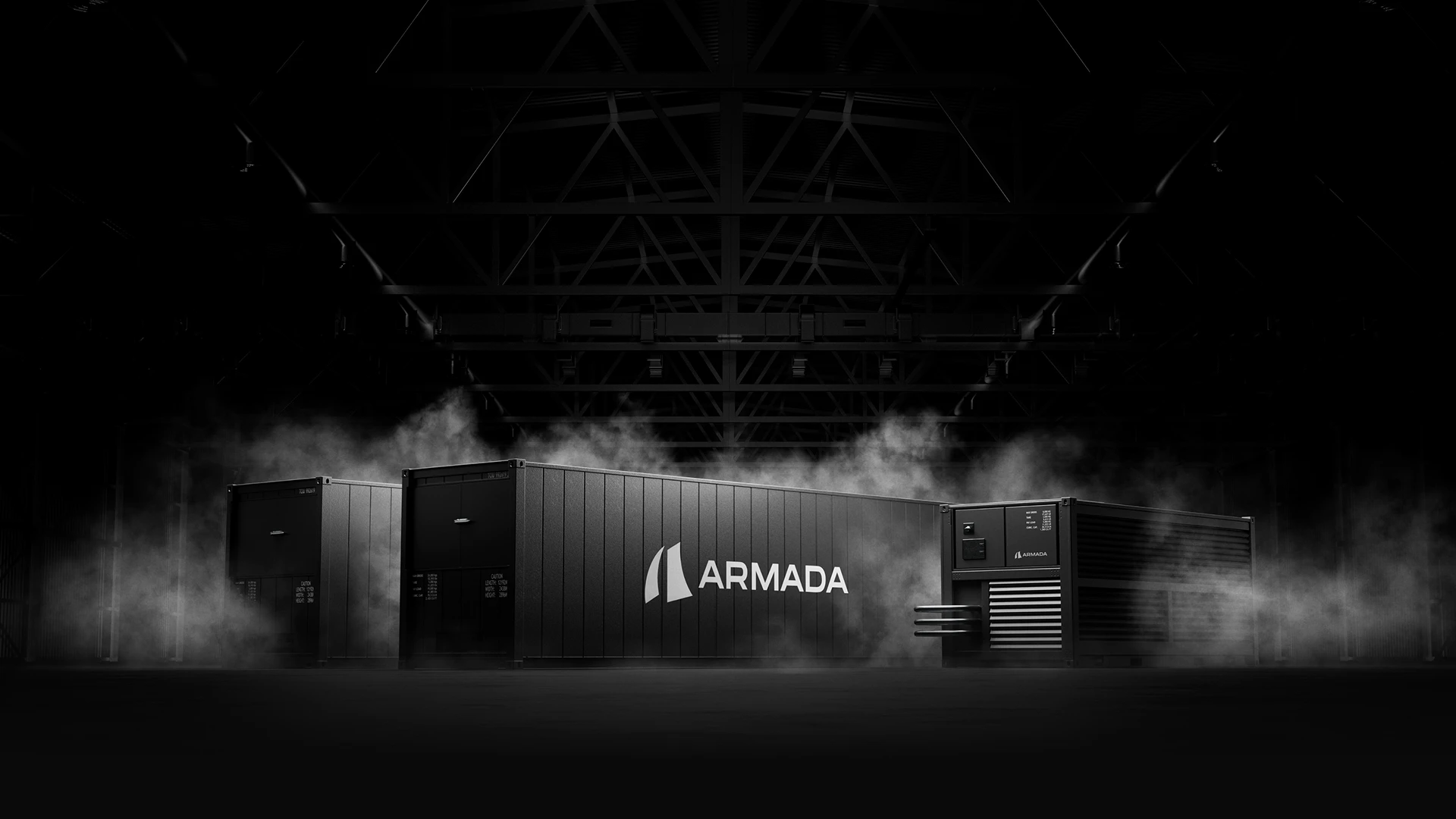
Armada’s goal, Wright said, is to become the “hyperscaler for the edge,” bringing AI, compute, and connectivity to the world’s most disrupted environments, including disaster areas and war zones, with a suite of modular data centers ranging in size from a suitcase to conjoined shipping containers.
On the edge: The company’s flagship product, Galleon, comes in four sizes with varying levels of processing power.
- Beacon: A briefcase-sized unit.
- Cruiser: A 20-foot container with “3 racks of compute,” designed to be “compact [and] agile,” designed for environments where space is an issue and able to be transported “in the back of a C-17 or a C-130,” Wright said.
- Triton: A 40-foot container containing “5 racks of compute” designed for the “heaviest workloads,” according to the company.
- Leviathan: The largest “megawatt-scale” Galleon variant, made up of two 45-foot containers (one for compute and one for power distribution) and a 20-foot container for cooling.
With AI use surging across the US military and combat operations pretty much everywhere you look, Armada’s seen a big boom in demand for that processing power.
- Armada couldn’t disclose revenue figures, contracts, or active deployments, but recorded a 540 percent increase in customer bookings in FY2025-2026, and saw a 2,000 percent increase in bookings in Q1 of FY2027 compared to the same time the previous year.
Hyperscale: With a cool $230M in fresh capital, Armada—which raised a $131M Series A last July—is looking to scale up manufacturing big time. That push starts in Arizona, where the company will kick off production of Leviathan at its new 400,000-square-foot Galleon Forge One factory in June.
“We’re going to start with two units per month before scaling up to six units per month, and we’re also producing our Tritons on a continuous basis,” Wright said. “We’re able to utilize our partnership with Johnson Controls to scale up with the explosive demand that we’re seeing both domestically and also globally as part of the AI export program.”
“Right now, we’re producing dozens of Galleons a year, and we’re deploying those all over the world. By the end of the year, my goal is to bring that to hundreds, and then next year to thousands, and then to tens of thousands,” he added. “In my view, we should have Galleons at every single base that we have, both domestically and abroad.”
We’ll have to see if the Pentagon agrees, but given the Army’s plans to build data centers on military installations and the fact that the military’s appetite for AI ain’t going anywhere, we have a hunch they might.