
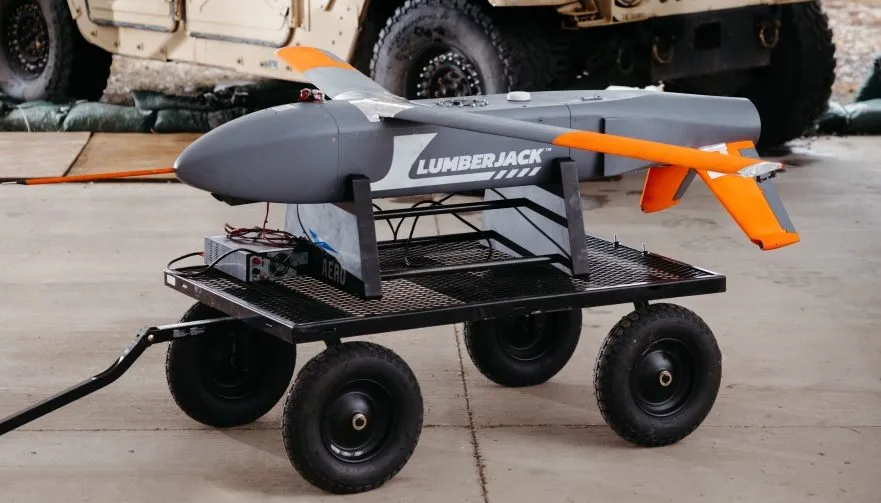
Last week, Northrop Grumman announced that the US Army’s 101st Airborne Division put its Lumberjack Group 3 UAS—kitted out with AI-enabled targeting courtesy of Palantir’s Maven Smart System and a six-pound precision strike munition—to the test during the recent Operation Lethal Eagle exercise, roughly a year after it was first unveiled.
Looks like the primes have heard all of the gripes about how they don’t move fast enough.
Out of the woods: Northrop bills Lumberjack—developed in partnership with drone manufacturing and design firm ESAero (snapped up by AV for $200M last month) and Palantir—as a multi-mission drone, but it’s really designed for one-way attack operations:
- It has an 118-pound payload capacity (total weight of 290 pounds), a 265mph air speed, a cruising altitude of 20,000 feet, and a range of “several hundred” nautical miles, according to Northrop.
- It can be launched from the air via a Group 5 drone (Northrop’s been working on a design to integrate it with Kratos’ popular XQ-58 Valkyrie Unmanned Combat Aerial Vehicle since last October) or from the ground or sea with a rail launch system or a pneumatic launcher.
- It can carry ISR sensors, but is more intended for “send and forget” strike missions, particularly when paired with Northrop’s Hatchet six-pound precision glide bomb, which the Army’s 101st tested during Operation Lethal Eagle.
- The company says it’s 50 to 80 percent as effective as a 500-pound munition, depending on the target type, and comes with an expected price tag between $75,000 and $100,000.
Smart bomb: During the Army’s Operation Lethal Eagle exercise, which focuses on air assault missions and testing new military tech, Lumberjack was paired up with Palantir’s ubiquitous Maven Smart System (which, if you’ve been paying attention to the news, has been pretty important in Iran) and Agentic Effects Agent.
- Northrop, via the Palantir integration on Lumberjack, demoed automated target identification, battlefield data analysis, and suggested courses of action (under human supervision).
- After launching the Hatchet mini-glide bomb, Northrop says Lumberjack “transitioned seamlessly” to ISR mode to continue gathering intel while maintaining beyond line-of-sight comms with operators.
“While primarily focused on readiness training, Operation Lethal Eagle also provided a unique opportunity to test and evaluate multiple new emerging systems from across the defense industrial enterprise,” the 101st Airborne Division (Air Assault) said in a statement. “Lumberjack was one of many systems tested during the exercise that provided insight into how collaboration between military and industry can drive innovation in defense.”