In case you missed 8VC and Lux Capital throwing their weight behind Nigeria’s Terra Industries this week, the big ballers of American defense tech VC have been casting their eyes abroad lately. And now, they’re looking at the land down under.
Earlier this week, Breaker—an Australian-American startup building AI voice-control software for autonomous swarms—raised $6M in a seed round led by Bessemer Venture Partners, valuing the company at $28M.
We’re talkin’ Aussies, autonomy, and Austin—say that three times fast.
AUS to ATX: Breaker, founded in 2023 by Vanja Videnovic and co-CEOs Michael Irwin and Matthew Buffa in Sydney before moving to Austin, TX, last year, has a simple goal: They want to make the remote-controlled robotic platforms and drones we all know and love more like the robots we’re used to seeing in SciFi movies.
“Look at robots like R2-D2 from Star Wars: When Luke lands on the Death Star, he doesn’t whip out a controller or [Ground Control Station] and click a couple of waypoint missions,” Buffa told Tectonic. “He just cues his radio, tells R2 what to do, and R2 can go off and solve complex problems and collaborate with other robots.”
Agent on board: The software the Breaker team built, basically, is a real-life version of the voice-controlled AI agent guiding R2-D2 in Buffa’s nerd-out explanation.
- The software is platform-agnostic and allows operators to coordinate and control teams of autonomous systems using voice commands. Breaker says their agents can operate autonomously in Denied, Degraded, Intermittent, and Limited (DDIL) environments.
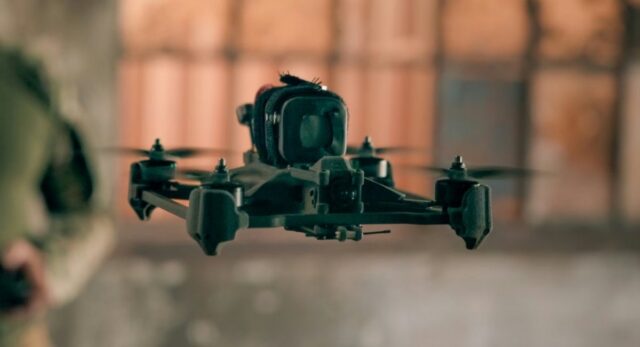
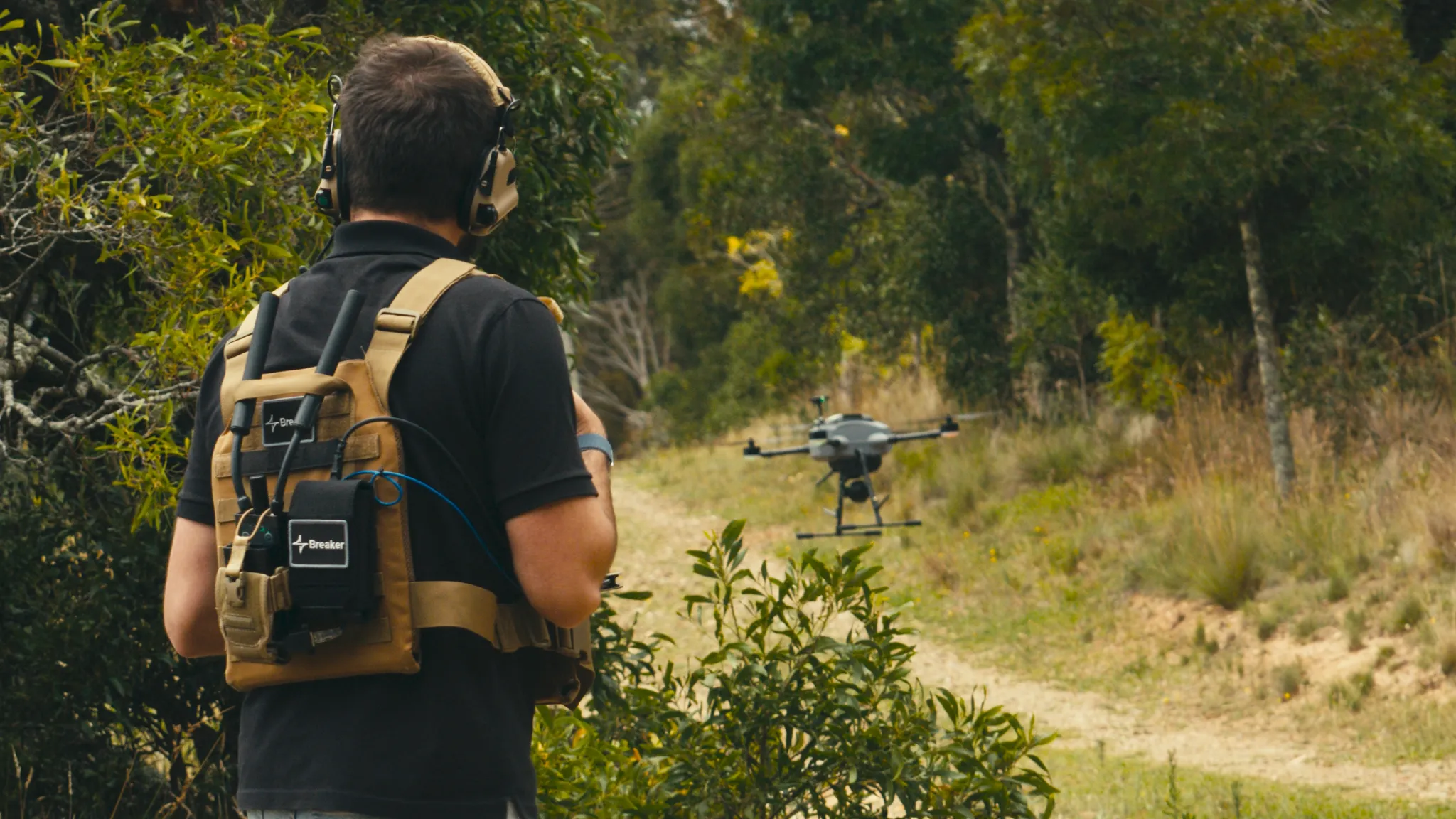
- With quadcopter drones, for example, Breaker would deploy its software AI agent on the drone’s onboard computer, without relying on external hardware, networks, or the cloud.
- Then, an operator can upload a mission brief and use the push-to-talk radios they already carry to, as Buffa said, “just talk to it like you would any other teammate,” using intent-based commands.
- They’ve seen the most traction with USSOCOM operators using drones for ISR, and Buffa said that intent-based commands the software can act on can be as hands-off as “I’m exfilling out Route Zulu—track ahead and report any threats.” Seems handy.
One-to-N: The ultimate problem Breaker is working to solve is that, while we can build a whole lot of unmanned systems, we lack enough operators to fully utilize them. Put simply, Breaker’s trying to be the orchestration layer for the future of autonomous warfare.
“We’re stuck in this one-to-one and one-to-two iterative loop when we really need to get to that one-to-N scaling,” Buffa said. “Robots need a level of agency where they can go off and complete their own objectives, and you can stay entirely focused on your mission, whether that’s driving, flying, or fighting.”
- Case in point: Breaker recently held a demo with Rheinmetall Australia, where they integrated their agent into the Boxer armored fighting vehicle’s mission systems.
- This allowed operators to “task an uncrewed aerial system for forward reconnaissance using simple, intent-based voice commands while continuing to operate the vehicle,” Rheinmetall said in a statement.
Breaker bucks: That small team with a big vision caught the eye of Bessemer Venture Partners, a San Francisco-based VC with $20B AUM known for early bets on Canva, Shopify, and, well, another drone swarming company you might’ve heard of called Auterion.
With $6M in hand—a big jump from their $1.5M pre–seed round less than a year ago—Breaker has its eyes set on scaling its engineering team in Austin and “expanding our product offering,” Buffa said. “We’ve been super focused on ISR for special operations, and now we’re expanding across to additional platforms. The product is super sticky, and every new platform we add increases the value of all the others.”
Big boys: And judging from their competition, they’re on the right track. Last month, the DIU, Navy, and the Defense Autonomous Warfare Group (DAWG) launched a $100M competition for an Autonomous Vehicle Orchestrator “that can translate a battlefield commander’s intent from voice, text, and haptic input into machine execution” for drone swarms.
On Monday, Bloomberg reported that SpaceX (and its new subsidiary xAI) is competing in that challenge.
Seems like pretty good validation.