
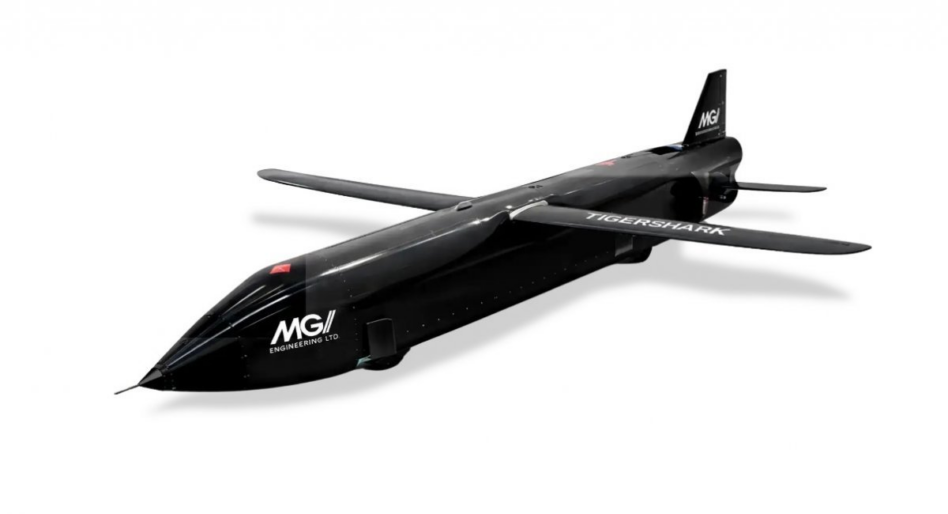
Well, these certainly ain’t your granny’s quadcopter drones.
Yesterday, autonomy and swarming software hotshot Auterion announced that it has teamed up with UK-based MGI Engineering—a, well, engineering firm—to successfully fly a cruise missile-like drone called TigerShark in the UK.
According to the two companies, TigerShark can:
- Reach speeds of 750 km/h (~466 mph)
- Operate in GNSS-denied environments
- Carry a 300 kg payload (~661 lbs)
- Strike targets at ranges “exceeding 1,000 km” (~621 miles)
MGI and Auterion say this is “the first time Europe has successfully tested a new system of this range in over a decade.”
“This is a new level for us in many regards,” Auterion Founder and CEO Lorenz Meier told Tectonic. “It’s the first group four drone [of] that weight. It is the first jet-powered aircraft we’re powering. It is certainly the fastest we’ve flown to date, and the warhead weight it can carry puts it into a completely different category.”
Teeny-tiny drones are soooo 2025.
Brainy: If you’re a regular reader of Tectonic, you’ll have heard of Auterion before. The company was founded in Zurich by Meier back in 2017, and has made a name for itself building the swarming, autonomous software brain that makes drones drone-y.
They’ve got a few core products:
- AuterionOS: A battle-hardened autonomous flight control system. This is the base for all of their tech—and the secret sauce that has won them so much investment.
- Skynode: Compact hardware modules that run AuterionOS and enable things like autonomy and mission execution. Basically, they can take any drone and make it autonomous and jamming-resistant. This is what was loaded onto TigerShark.
- Nemyx: Auterion’s swarming software, which enables multi-drone coordination and mission planning, even in contested environments.
And to say their autonomy stack has been a hit with investors and operators would be the understatement of the year.
- Last September, Auterion raised a $130M Series B led by Bessemer Ventures, bringing total funding to over $167M, according to Pitchbook data.
- Last July, they landed a $50M DoD contract to send 33,000 AI-powered drone guidance “strike kits” to Ukraine by the end of last year.
- They’ve also teamed up with defense giants like Rheinmetall and Lockheed Martin, as well as the Taiwanese military.
Zoom zoom: MGI, for its part, was founded back in 2003 by former F1 designer Mike Gascoyne, who basically took all that go-fast expertise and applied it to building lightweight structures, composites, and autonomous systems for aerospace and defense.
- TigerShark was first unveiled last year at DSEI in London.
- It looks a heck of a lot like a cruise missile and is designed to carry out a lot of the same functions at a fraction of the cost.
- It’s about 5.5m long with a 4.3m wingspan, and is powered by twin small gas turbines with rocket-assisted takeoff (RATO).
- The Skynode integration—which basically makes the whole thing autonomous—took about a week, Meier said.
“This is lifting commercially developed and derived, low-cost, one-way attack drones into a new category where they suddenly can do the same things as a cruise missile at a fraction of the cost,” he added.
Game changer: Meier sees this test—which he said the MoD was “very happy and pleased” by—as a game changer for the whole industry, especially considering the whole, erm, multiple wars thing. “This has disrupted [the industry] the same way as other drone categories [have]…there’s really no limit in how commercial technology is changing warfare,” he said.
Plus, good to have options when you’re depleting your munitions stockpiles real quick. “The highest utilization of cruise missiles ever has happened in the past month,” Meier said. “It’s unrealistic for the incumbents to replenish those inventories fast, so it needs new entrants like MGI and us.”
“Even relatively slow one-way attack drones still were able to penetrate very, very sophisticated Western air defenses, and continue to,” he added. “That shows that this class of weapon system is really relevant for the whole world. What we have been seeing in Ukraine is not isolated to Ukraine. It is, rather, the future.”