
Lasers…so hot right now.
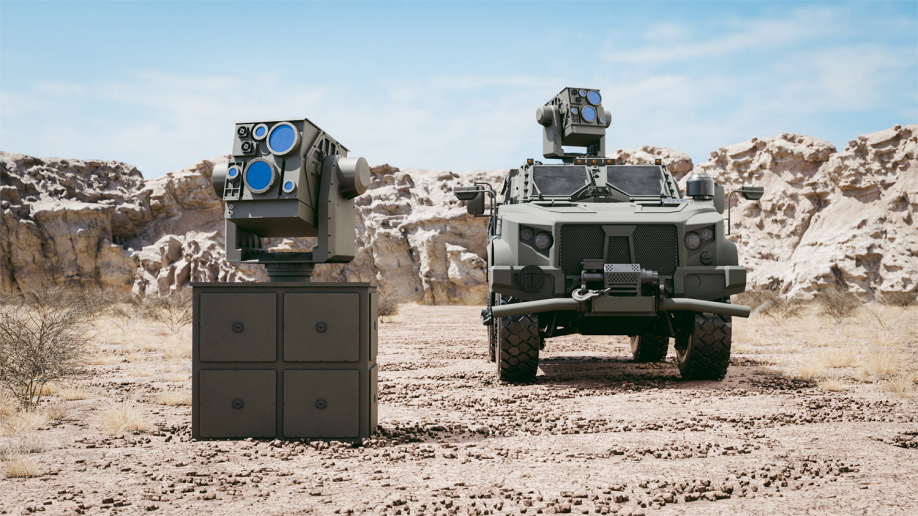
Yesterday, AeroVironment (AV) unveiled the latest and greatest version of its LOCUST counter-drone laser, the X3. The platform, which AV says offers “engagements below $5 per shot,” is designed to take down small- to medium-sized drones.
Lightshow: In case you haven’t been keeping your eye on the war in Iran, figuring out how to intercept drones cheaply has been a bit of a hot topic.
Directed energy platforms—especially lasers—have long been touted as a potential solution, offering an “infinite magazine” that doesn’t run out of ammunition (so long as they have a reliable power supply).
- Undersecretary of War for Research and Engineering Emil Michael named directed energy as one of the Pentagon’s six Critical Technology Areas last year, and has been cooking up some eye-catching graphics of lasers recently.
Putting zap on the map: LOCUST was originally developed by BlueHalo, which AV snapped up for a cool $4.1B last year, and it’s got quite the reputation, to say the least.
In February, the pew-pew platform was used by Customs and Border Protection (despite belonging to the Army) to shoot down an alleged cartel drone (later found to be a balloon), causing the FAA to shut down the airspace around El Paso for eight hours last month.
Strong start.
Drone downer: All press is good press, however, and on the bright side, at least we know the laser works, operator error aside. According to AV, their newest version offers even more drone-zapping power:
- The LOCUST X3 comes with a scalable 20–35 kW laser, a modular beam director, and AI-enabled and automated target acquisition and engagement through AV’s c-UAS C2 software, AV_Halo PINPOINT.
- AV delivered two LOCUSTs integrated onto Infantry Squad Vehicles to the Army in September and two Joint Light Tactical Vehicle (JLTV)-mounted LOCUSTs in December under the Army Multi-Purpose High Energy Laser (AMP-HEL) prototyping program.
- AV says the X3 is platform-agnostic (maritime use-cases included) and built with commercially available components to make it as widely deployable and mass-producible as possible.
- The company has also put some money behind ramping up LOCUST production, announcing plans to invest over $30M to boost manufacturing capacity for the system in New Mexico earlier this month.
“In today’s rapidly evolving battlespace, adversaries are deploying mass drone attacks and saturation tactics that threaten mission success and warfighter survivability,” AV CEO Wahid Nawabi said in a statement. “With LOCUST X3, we deliver an affordable, scalable solution to outpace and neutralize large-scale aerial threats, safeguard critical infrastructure, and maintain decisive advantage wherever the fight demands.”
Given the scramble for cost-effective and layered c-UAS solutions in the Middle East and the threat of cartel drone incursions on the border, LOCUST could see a lot of love from the Pentagon.
Let’s just hope this juiced-up version stays in their hands. Airport lines are already long enough.