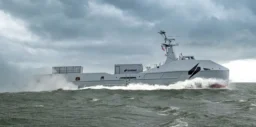
Turns out that drone boats can do a lot more than just zip about and terrorize Russia’s Black Sea Fleet, y’all.
Yesterday, USV company BlackSea Technology announced that it’s been awarded a $256M Navy contract to “build and support the Seabased Petroleum Distribution System (SPDS) program.”
For those of you not steeped in specific Navy programs (for shame), that’s the service’s push to build sea-based fuel distribution systems that basically allow you to pump fuel from a boat to shore without an attack-prone port.
“SPDS answers a real logistics challenge for the joint force, getting fuel where it is needed, when fixed infrastructure is unavailable or at risk,” Charles Engstrom, BlackSea’s SPDS Program Manager, said in a statement.
“We are grateful to the Navy for its confidence in BlackSea Technologies and our team,” Bob Pudney, president of BlackSea Technologies, added in a statement to Tectonic. “This award reflects the importance of strengthening the maritime industrial base and delivering practical, reliable systems that support the fleet.”
Under the contract, the company will produce “up to five SPDS units” from May 2026 through March 2031. First deliveries are expected in 2027.
Supersize me: Now, you might be getting a little brain-fried here. Doesn’t BlackSea build cute lil’ USVs like GARC? What are they doing working on (essentially) a tanker?
Well, turns out the company—founded back in 2022—actually builds a whole lot more than that little drone boat. They’ve got:
- Global Autonomous Reconnaissance Craft (GARC): A 16-foot USV (you’ve definitely seen it) designed for ISR, autonomy, and distributed maritime ops. The company is on a contract worth up to $213M with the Navy to deliver about 30 of these a month. Despite some rumors of performance issues, they’ve reportedly been deployed against Iran in the Strait of Hormuz.
- NightTrain: An autonomous logistics vessel built to move ISO containers and supplies directly to not-so-easy-to-access shorelines without ports or cranes.
- Chaser: Basically a combat-capable GARC (aka GARC 2.0), designed to fit inside a 20-foot shipping container. The company says Chaser has a larger payload capacity than GARC and can do everything from ISR to the spicy go-boom stuff. The company has demo’d integrations with LM JAGM launchers and EOS 30mm cannon systems. Boom boom.
- Comet: A larger USV (43 feet) with top speeds of 45 knots and a 10,000-pound payload capacity. The company advertises it as p flexible—they say it can do everything from air defense, to anti-submarine warfare, to counter-UAS, to EW (and more). Get you one (bigger) boat that can do it all.
They also build all the “mission solutions” that make these boats go splish-splash—from “motherships,” to sustainment, to the autonomy stack that drives them.
All in the family: The SPDS vessel will be less “single vessel” and more of a “tanker plus fuel distribution system designed to get the oily good stuff from boat to shore ASAP.” Here’s how the whole thing will work:
- The core of the system is a submerged bulk fuel barge that can park offshore, plus an “over-the-shore system to form a delivery point,” a BlackSea spokesperson told Tectonic.
- The novelty here seems to be in how that fuel (and the infrastructure pumping it to shore) is delivered. “Both conventional and autonomous surface vessels could be used to deploy SPDS elements,” the spokesperson said. “BlackSea’s family of USVs are ideal components to deploying SPDS elements and would not require any design changes.”
- The SPDS “system integrates a bulk fuel barge and over-the-shore support sleds to deliver high-capacity fuel at operational ranges while minimizing the shore footprint,” Pudney said.
- They’ve also made everything computer. SPDS will use a “custom-designed control system with touchscreen interfaces…[that] controls barge operations and reports cargo status to the operator.”
- Plus, the whole thing is designed to be tough to detect, “operating with a low visual and radar signature,” Pudney said.
“The increased automation and novel design significantly reduce the manning requirements relative to legacy systems,” the spokesperson added.
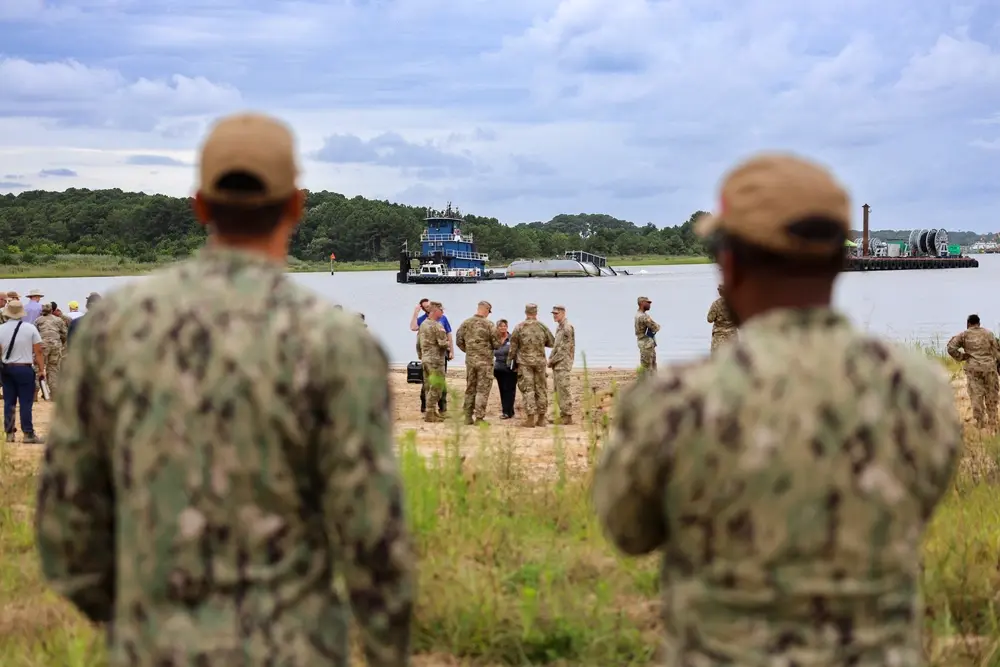
Real world: And this ain’t no render—the system has already performed well in testing, per Pudney. The last test with the Navy was August 2025 at the Joint Expeditionary Base in Little Creek, Virginia.
In that demo, the SPDS “system submerged, transferred simulated fuel to bladders located on the beach and subsequently resurfaced, demonstrating the full mission profile of deploying in open water, pumping and recovering the submersible barge, connector hoses, generators, and supporting equipment from a vessel directly over the shore,” per the Navy.
As of now, BlackSea said that the “system has completed prototype development, operational testing, and is transitioning into production.”
Cash money: So, how much will this whole thing cost?
The BlackSea spokesperson told Tectonic that “the system cost varies by outfitting options but will average around $50m.” ($256M divided by five. Makes sense.)
And for all the Maryland stans out there: The whole shebang will be built out of BlackSea’s production facilities in Baltimore, “with additional work supported by partners along the Gulf Coast.”