
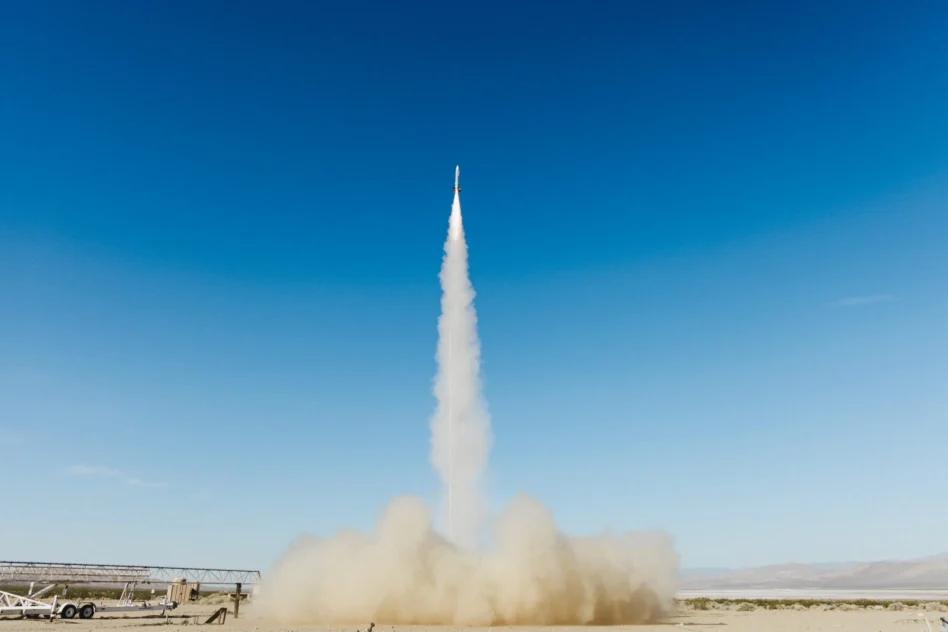
The hype for hypersonics is back, baby. On Friday, hypersonic missile company Castelion announced that it has won multiple awards to integrate its Blackbeard “hypersonic strike weapon” (read: super-fast missile) onto operational US Army and Navy platforms.
Castelion couldn’t reveal too many details of the contracts—the DoD is keeping deets hush-hush during the shutdown—but Castelion co-founder and COO Sean Pitt told Tectonic that they plan to test the integration in 2026 and field it by 2027.
“These integration contracts validate that affordability and speed are critical to modern deterrence,” Castelion CEO Bryon Hargis said in a statement.
These are the first integration contracts for the El Segundo-based company.
Fast and furious: It’s been a while since we talked about Castelion. The startup was founded back in 2022 by three SpaceX alums—Bryon Hargis (CEO), Sean Pitt (COO), and Andrew Kreitz (CFO)—to produce affordable, mass-producible hypersonic weapons.
Blackbeard is their flagship long-range, hypersonic strike weapon, designed to fly at speeds of Mach 5+.
- Back in July, the Army requested a cool $25M to develop a Blackbeard variant that can be launched from HIMARS.
- The Navy and Air Force have also awarded Castelion contracts worth over $23M, according to Obviant data.
- Blackbeard is designed to cost a fraction of what traditional hypersonics do—Lockheed Martin’s “Dark Eagle” Long Range Hypersonic Weapon (LRHW) costs about $41M apiece, while Blackbeard costs “hundreds of thousands of dollars per unit,” according to Pitt.
Pitt and Castelion couldn’t reveal what platforms Blackbeard would be integrated onto, but it’s worth noting that while the Army is eyeing that HIMARS variant, the company’s work with the Navy has been on an air-launched variant. Get you a missile that can do both.
Show me the money: Hargis, Pitt, and their team have done a pretty good job of convincing investors that the whole “affordable hypersonic missiles” thing is a good idea.
- The company has raised a total of $464.14M and now boasts a $2.83B valuation, according to Pitchbook data.
- They’ve got some pretty heavy-hitters fighting their corner: investors include major defense tech players like Lightspeed, Altimeter, Lavrock, and Andreessen Horowitz (a16z).
Plug it in: With all of the different kinds of contracts out there (OTAs, we see you), it can be pretty easy to gloss over what, exactly, an “integration contract” is—or why it’s significant.
Basically, think of it as the try-out phase—this is where the Army and Navy are going to do all of the expensive engineering and R&D to make sure that Castelion’s missile can actually fire from a HIMARS (or other operational platforms).
While—duh—this isn’t a major program contract yet, it’s a pretty good sign for the hypersonic guys out in the Gundo. The services don’t spend cash on integrating new weapons into their very exquisite, very expensive systems unless they’re serious about them.
Between this integration and the carveout for Blackbeard in the Army budget, it looks like Castelion might give the primes (and Dark Eagle) a serious run for their money.
Speed it up: And those affordable stores of hypersonic missiles Castelion is promising can’t come fast enough—as DoD has wobbled across the board while trying to field hypersonics at scale, adversaries like China and Russia have pushed full steam ahead: According to US intelligence, both adversaries have tested hypersonic missiles, and Russia has used them in combat in Ukraine.