
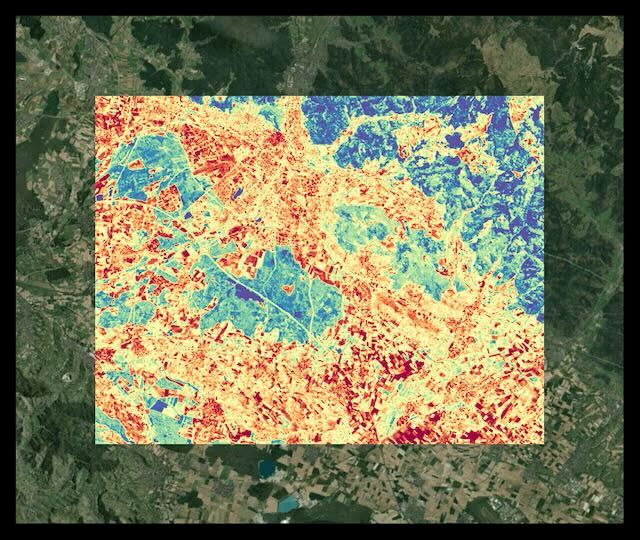
We may have just announced the Payload X Tectonic mashup at our summit in March, but we ain’t done talking about space-y defense-y stuff yet.
This morning, German thermal intelligence company constellr announced that it’s raised a €37M ($44M) Series A led by Alpine Space Ventures and Lakestar. The company says it will use the cash money to “accelerate the expansion of constellr’s pioneering, fully operational thermal intelligence capabilities and advance the system to defence grade status for governments, military entities and security agencies.”
“Sovereign resilience requires understanding real activity on the ground, not just seeing objects,” constellr CEO and co-founder Dr. Max Gulde said in a statement. “Thermal intelligence provides the earliest and most reliable signal of operational change, from detecting rocket and airbase activity to identifying active reactors and hidden industrial operations. Europe must own this capability.”
Sovereignty is really the name of the game these days, huh?
It’s getting hot in here: In case you weren’t aware (or don’t read Payload, if so, what are you doing?), stuff that’s in orbit has a huge impact on defense and security here on the ground.
The constellr team seems pretty darn aware of this. The company—founded in 2020 as a spin-off from the German Fraunhofer Institute—builds and operates its own small satellites that deliver high-precision thermal intelligence from space.
- Think of this as real-time surface temperature data that shows not just where things and systems are and what they look like, but how they move and behave over time.
- The company says that the thermal intelligence “adds the behavioural insight layer, revealing what assets are doing and why, complementing radar’s structural mapping and optical imaging’s visual classification.”
- constellr says its intelligence “delivers earlier detection, independent verification, and highly reliable assessments of activity in contested or deceptive environments,” and can help militaries “uncover hidden operations, track non-cooperative assets, and anticipate deployments before they occur.”
Dive deep: For the visual learners among us—or for those who think this all sounds too good to be true—constellr provided an example of how this all works.
The company says that their “thermal infrared data was used for strategic intelligence to monitor maritime activity in the vicinity of the Rybachiy nuclear submarine base in Russia.”
- By detecting subtle changes in the surface temperature of the water around the base, constellr’s satellites (and processing package) were able to track the location of vessels and their movements.
- The tracking even worked at night—no light required for temperature tracking.
- The satellites, the company said, added a layer to things like SAR and open source tracking.
“Thermal signatures of wakes remained observable for up to 60 minutes, allowing inference of direction and speed of vessels, while distinct thermal patterns around piers confirmed presence of submarines,” the company said.
Partly cloudy: Thermal intelligence is powerful—but it’s not magic. Typically, thermal images can be vulnerable to atmospheric interference and can be skewed by thermal saturation (like in cities in the summer or in the desert).
However, constellr is careful to classify its offering as another layer—when traditional satellite imagery and open source intelligence isn’t enough.
“The thermal layer complements very high-resolution optical data and serves as an independent means to corroborate and validate open-source intelligence, which can be scarce or unreliable,” the company said.
And it sounds like this new pile of cash is only going to amp up reliability and precision even further. The company says the funding “will drive the expansion of constellr’s satellite constellation for broader global coverage, enable next-generation platforms with sub-5-metre resolution, and ensure secure, sovereign control over data-driven intelligence for national and allied defence customers.”
Big week for defense tech across the pond, huh?