
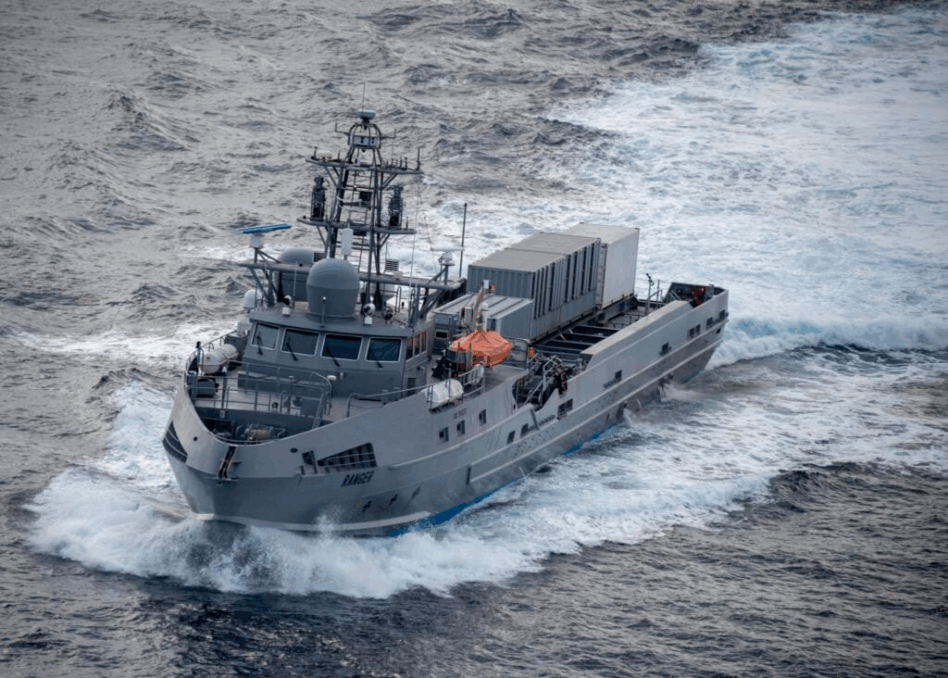
DIU is wasting no time getting to work under its new leadership.
Last night, the innovation unit posted a new $100M (yes, $100M) prize challenge to “prototype market-ready solutions to establish a robust, scalable and vehicle-agnostic capability for understanding, tasking and coordinating autonomous systems at the fleet level.”
Using normal words: They’re looking for a way to coordinate all the autonomous boats, ships, and torpedoes y’all keep setting out to sea, and they’re going to spend up to $100M trying to find a solution.
The challenge is co-sponsored by DIU, the Defense Autonomous Warfare Group (DAWG, the artist formerly known as Replicator), and the Navy.
It would appear that maritime autonomy remains all the rage.
Mix it up: In case you haven’t heard, the Navy really (like really) wants a hybrid fleet.
For those who only pretend to understand what that means, the idea is that the US could have a giant fleet of manned and unmanned vessels that operate, basically, as a swarm and can counter massive maritime forces—like China’s.
- The whole idea is framed as not only a force multiplier but also a way to tackle the shipbuilding crisis. Drones are a hell of a lot cheaper and quicker to build (at least in theory) than an exquisite, manned vessel.
- SecNav John Phelan loves a hybrid fleet. Back in September, he ordered a reorg that created a bunch of new robotic and autonomous systems-focused roles (RAS) and prioritized PAEs, essentially, buying drone boats and other autonomous systems.
- In November, he issued a memo calling for a redesign of the Navy’s acquisition system (in line with Hegseth’s own shakeup) that would prioritize autonomous systems for the ever-desirable hybrid fleet.
As we’ve talked about ad nauseam, the service is also gung-ho on building and buying autonomous vessels that are more warship-flavored—bigger, badder, and designed for big ol’ bodies of water, like the Pacific.
- Back in July, the Navy launched a solicitation for the Modular Attack Surface Craft (MASC) program. In short, the service wants medium and large USVs that can travel relatively fast and carry containerized payloads.
- The BBB allocated a whole $2.1B to medium and large USVs.
- The NDAA allocated a whole bunch of funding (like, over $47M) to unmanned undersea capabilities and a few million to unmanned surface “enabling” capabilities.
- Companies from Saronic to HavocAI to Blue Water Autonomy have jumped headfirst into the big drone boat-building craze.
Under control: But no matter how many fun, look-ma-no-hands vessels you’ve got, they’re pretty useless if you can’t control them.
“The Department’s fleet of autonomous vehicles is the future of warfighting – but they are nothing without the intelligence and experience of the operator,” Mike Dodd, the acting deputy director of DIU, assistant secretary of war for critical technologies, and former DoddFather, said in a statement. “This … will deliver a human-machine interaction layer that will directly impact the lethality and effectiveness of these systems.”
The “orchestrator,” as the department is referring to the solution, will need to be capable of three core functions:
- Issue Intent: It can “interpret human intent inputted via voice, text, and a graphical user interface (GUI)” and use that to issue intent (commands) to the fleet. The solicitation puts a lot of emphasis on the system needing to understand human-style speech.
- Situational Awareness: It can “[consolidate] awareness of what the fleet is doing by aggregating data already provided by platforms through their native systems.”
- Synchronize autonomy: It can “enforce fleet-level constraints” and issue commands/intent.
Importantly, whatever solution vendors come up with must not “[modify] existing platform autonomy stacks or [require] access to vehicle control layers.” Basically, it needs to be able to control the fleet without actually interfering with all the fun onboard autonomy software or the data it transmits.
A puppet master, but for autonomous systems.
Like many Pentagon competitions these days (looking at you, NGC2), the competition sounds like it’ll break the problem down into sprints and then make companies compete with their solutions Hunger Games style.
- If selected, a vendor needs to be able to start “sprint one” within ten days. The whole development process—including all of the sprints—should take no more than six months.
- Vendors will only be able to progress to the next “sprint” if their solution to the last sprint has, well, actually worked when tested by operators. The last men/women standing win.
The sprints are designed to be increasingly complex:
- Sprint 1: Software-Only Integration and Intent Translation, focused on making sure the command inputs work primarily.
- Sprint 2: Homogeneous Pod Control, making sure the software can control a pod of vessels that are, well, the same.
- Sprint 3: Heterogeneous Pod Control, making sure that the software can control a pod of (you guessed it) varied vessels.
- Sprint 4: Terminal Environment Behaviors, the more sophisticated stuff like phased action and target awareness/sharing.
- Sprint 5: Full Mission Profiles, put simply, making sure the software can handle the whole damn thing.
That $100M will be spread across prototype awards for all five sprints; the government expects to issue multiple awards. Whoever makes it to the end will be eligible for the big boy procurement contracts.
Who’s throwing their hat in the ring?