
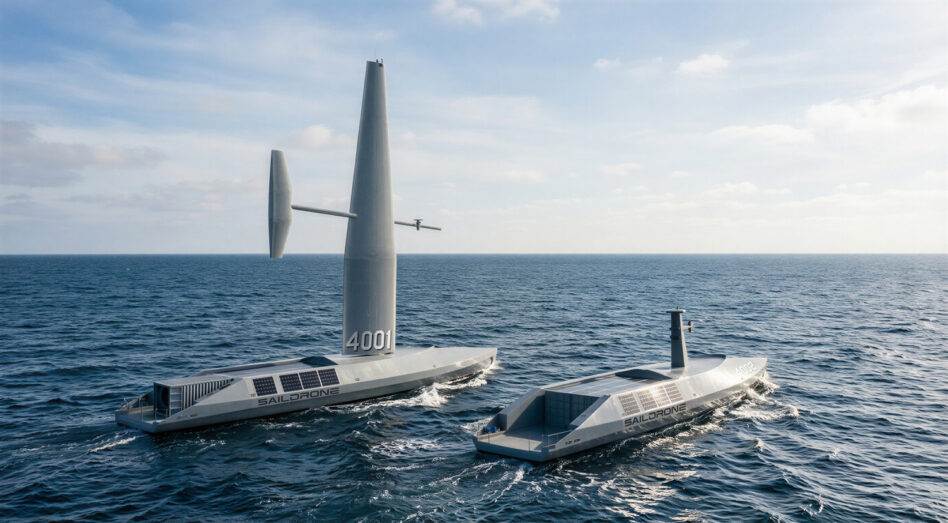
If you thought all of the Modular Attack Surface Craft (MASC) cancellation drama was in the rear-view window, buckle up: We’re just getting started.
Late last month, two unmanned surface vessel startups—Blue Water Autonomy and Saildrone—filed separate lawsuits against the Navy after their medium-USV designs were rejected from the MUSV marketplace that replaced the canceled MASC program.
Both companies had made it through the MASC selection process, and their vessels were already under construction, according to the complaints unsealed this week.
MASC off: To set the stage: The Navy launched the MASC program last July, setting up a multi-stage selection process with clear requirements for medium-sized drone boats.
Then, in a twist, the Navy canceled the program in March, after a handful of companies had made it to the final stages and already kicked off construction. BWA and Saildrone were among the companies left hanging.
In its place, the Navy launched a “regular and recurring marketplace” for MUSVs in late March.
- The thinking behind the shift, according to the Navy’s Program Acquisition Executive for Robotic and Autonomous Systems (PAE RAS), Rebecca Gassler, was that mature-enough MUSVs are already on the market without MASC’s prototyping push.
- “It’s our new approach to accelerate this autonomous capability to the fleet as part of the Golden Fleet,” Gassler told reporters at the time. “Our goal is to create a regular and recurring marketplace, not just for the MUSV, but for other classes of vessels as well.”
Changing tack: That might not have been an issue had the requirements not changed.
- The new marketplace requirements called for MUSVs capable of traveling 2,500 nautical miles at 25 knots while carrying a 25-ton load on the payload deck in Sea State 4, an 11-ton reduction from the MASC payload requirement.
- That payload reduction, naturally, affects the range and power engines need to generate. For the companies that had spent close to a year and millions of dollars to develop MUSVs in line with the OG requirements, it was a major pain point that forced last-minute redesigns.
”We have a ship under construction because the Navy selected us. We went through a three-phase competitive process with over 100 companies…We moved out to build, and then over the last couple of months, [the Navy] kind of stalled,” one USV exec in the mix for MASC told Tectonic on the condition of anonymity back in March.
Redesigning the USV would “cost, minimum, months, and low tens of millions of dollars, and the Navy’s literally gonna get the opposite of what they’re asking for,” they added. “They’re asking for speed and [a] ready product. Instead, they’re gonna get slower, and they’re gonna get something we had to change to meet their new f*cking idea of the month.”
Left behind: Then, last month, the Navy announced seven USV companies selected to advance to the prototype stage of the medium unmanned surface vessel (MUSV) marketplace.
- Those included Sea Machines, Leidos, PacMar Technologies (using HavocAI’s autonomy software), Saronic, HII, Edison Chouest Offshore (ECO), and Birdon (using Mythos AI’s autonomy software).
- To make things crystal clear: That list does not include BWA, Saildrone, and several others whose designs reached the final stretch of the MASC program.
- According to reporting by the New York Times, some USV firms “told contacts at the Pentagon or in Congress they believed the Navy gave Saronic preferential treatment” as a result of Saronic’s influence within the Trump administration.
Lawyer up: In its unsealed suit, Saildrone alleged that their design—a 170-foot vessel built with shipbuilding giant Fincantieri Marine Group called Spectre— was rejected as a result of an “arbitrary and capricious evaluation of Saildrone’s proposal by Navy Portfolio Acquisition Executive for Robotic and Autonomous Systems.”
- “Despite these qualifications, Saildrone first learned from a public news article that RAS had selected seven other awardees,” the complaint said. “Only after Saildrone inquired did RAS notify Saildrone, in a four-sentence email, that its ‘proposal was not selected for further consideration under this solicitation,’ offering no explanation tied to the criteria.”
- Saildrone added that their USV had already been “validated and certified on key metrics” after a “multi-year development effort,” and that they had “ordered all long-lead-time components for the first SPECTRE in late 2025, supporting fielding in fiscal year 2027” even before proposals were due, making them “uniquely qualified for a prototype [OTA contract].”
In BWA’s suit, the Boston-based startup alleged that the “Navy evaluated Blue Water’s vessel solution through a multi-stage process and selected Blue Water’s solution before the Navy abruptly canceled the MASC program and replaced it with the MUSV program,” according to the filing. “Rather than allow Blue Water to test its surrogate vessel and demonstrate that its vessel met the Navy’s requirements, the Navy arbitrarily and prematurely excluded Blue Water from further consideration in the competition.”
- “Because the Navy’s determination to exclude Blue Water from consideration was arbitrary, capricious, and not in accordance with statute or regulation, the Court should sustain this protest and enjoin the Navy from concluding testing and from obligating all program funding for follow-on production contracts until it remedies its prejudicial errors and Blue Water is afforded an opportunity to complete testing and demonstrate its eligibility for a follow-on production contract,” the startup added.
Big money: And this isn’t for nothing—there’s big money on the table. Congress set aside $2.1B last year to acquire MUSVs, and for the venture-backed companies vying for a chunk of that cash that have spent a whole lot of capital raised on designing and building for MASC, the shift is a big setback.
Now, when you sue the military, lawsuits can go two ways: You can either win and end up like Palantir, suing the Army on its way to becoming an indispensable commercial software provider with a $320B market cap, or you risk an Anthropic-esque situation, with a big black ball next to your name.
We’ll see how this plays out in court, but the drone boat drama isn’t going away anytime soon.