
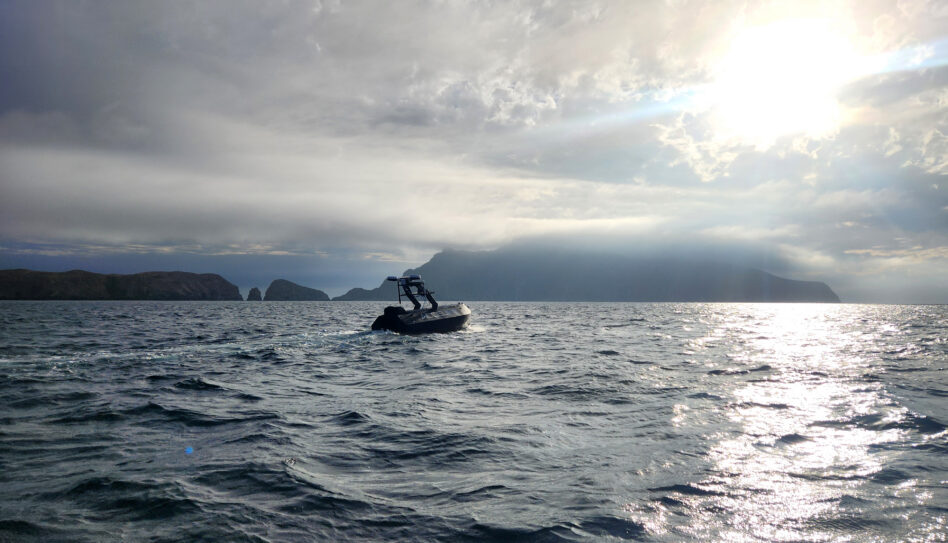
If you thought the unmanned surface vessel world couldn’t get any more crowded, well, think again.
This morning, Accelint announced in an exclusive release to Tectonic that its new MV-20 surface vessel has set out on a 600+ mile-long long-endurance mission in the Gulf of Mexico to prove “endurance, navigation, and integrated payload performance under operationally realistic conditions” for the Office of the Under Secretary of War for Research and Engineering (OUSW R&E).
The vessel—built in collaboration with NODA AI, Safran Federal Systems, and Striveworks—will putter along off the coast of Florida with a sensor payload for the next two weeks.
The company is also opening a “purpose-built USV integration facility” in Panama City Beach, FL, to “support rapid integration, testing, and delivery of unmanned surface vessels at operational scale.”
For context: Accelint was awarded an EMC2 OTA to deliver surface vessels to the Department of Defense (DoD) and the OUSD(R&E) Maritime Domain portfolio team last year.
Gang gang: Accelint is one of those fun companies that is everywhere—but that you might not have heard of.
- It’s actually comprised of five different defense companies—SoarTech, Forward Slope, Highbury Defense Group, Systems Innovation Engineering, and Hypergiant—that united under a single umbrella to “[provide] comprehensive AI-forward solutions” for the government.
- The company does a bit of everything—AI-powered command and control, autonomy and sensors, logistics and sustainment, and even training and simulation tools.
- The company-cum-consortium snagged a spot (along with several others) on the Missile Defense Agency’s $151B Golden Dome IDIQ.
Tiny little boat: Development of the MV-20 USV started a little over a year ago, and it was unveiled last summer (when the company won that sweet, sweet OTA).
- The 20-foot boat is designed to be cheap, quick to produce, and able to carry an “advanced sensor suite and…various mission-specific payloads.”
- Benjamin Pinx, Accelint’s president of sensors and autonomous solutions, got into specifics. “It is designed from keel to stern so that we can implement any of the payloads the US Navy and or other DoW organizations would like to use. Anything from intelligence, surveillance, and reconnaissance all the way out through kinetic payloads,” he told Tectonic.
- The hull was built by Bluefin in Louisiana.
“It is designed specifically to be like a multi-purpose truck,” he added. “Think of an F-350. You want to haul a trailer, you want to haul furniture, you want to haul people…we can do whatever you need to with this platform. We can use it for sustainment. We can use it for persistent ISR. We can use it for kinetics and non-kinetics.”
Pinx said that price-wise, the boat starts at $350K and goes up from there, depending on sensors and payloads. To date, the company has built three boats.
Workout regimen: Prototypes of the MV-20 participated in a bunch of exercises over the course of the last year, Pinx said, but this is the first time it’ll be playing the long game. Over the course of the next two weeks, it’ll carry out a series of maneuvers and intermittently loiter overnight—capturing sensor data all the while.
“This shows a number of different things: The boat’s endurance, the capacity of the boat has to do multiple missions, and [how we trigger] the different payloads that are on the boat,” he added.
Plus, it’ll show how the MV-20 handles itself in, like, real open water.
“You get sea states, you get the weather. The boat is going to go out and sit in a persistent loitering position so that we can collect data on not just the platform and the payloads, but how it’s operating within that operational environment, as opposed to being in a lab—a pristine, clean place where nothing ever really affects it,” Pinx said.
Bon voyage, MV-20.