
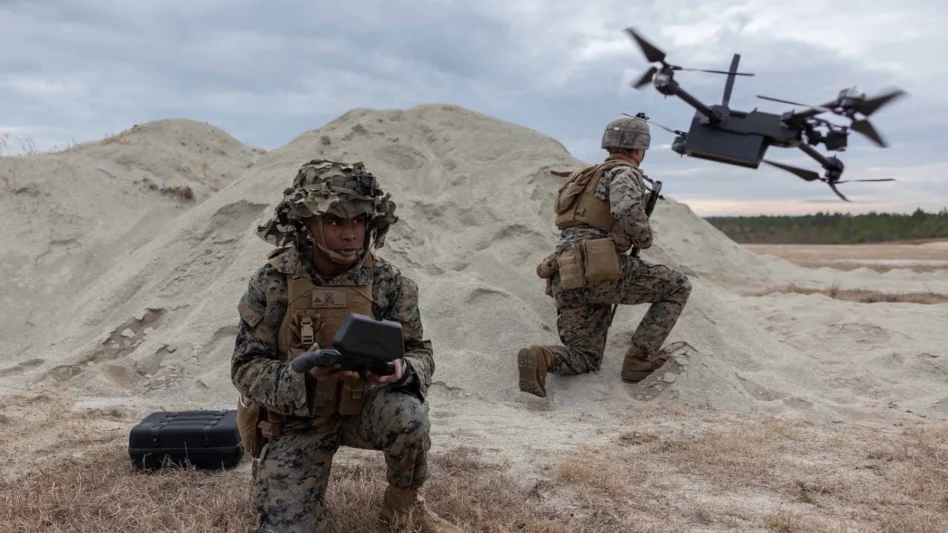
If you’ve seen—or been on—the battlefield in Ukraine, one of the most significant shifts in drone warfare has been the proliferation of fiber-optic FPV drones. There’s a good reason for that: most UAV detection tech relies on RF sensing or expensive radars, which can be easily sidestepped—or saturated—by RF-silent drones.
Enter brand-spanking-new startup RADD.
This morning, the TurbineOne spinout emerged from stealth in an exclusive release to Tectonic, with a promise to fill the gap between radars and RF-based drone detection with highly portable, soldier-borne acoustic sensing tech.
Big bad RADD: RADD may be new on the scene, but their tech—and founding team—isn’t.
- The company is led by Army Reserve officer and former TurbineOne Chief Growth Officer Court Vanzant (CEO) and 29-year Army Special Forces officer Dave Lucas (COO).
- Their first offering, called GLADIUS (Ground-based Lightweight Acoustic Dismounted Integrated UAS Sensor), is based on an acoustic UAS-sensing prototype TurbineOne developed early last year but ditched when they went all-in on software.
- Vanzant, TurbineOne’s former CGO, saw the potential to miniaturize the tech to give operators an individual drone detector that relays threats back to a C2 node.
- TurbineOne “didn’t want [the prototype] to languish,” he said, and transferred the IP to RADD. Vanzant brought on Lucas to incubate it within TurbineOne and launch the company after Lucas wrapped up his military career.
Buzzing around: RADD’s thinking behind developing acoustic sensing tech is pretty straightforward: Look to Ukraine, and you’ll see fields and towns covered in shiny wires.
“[Fiber-optic FPVs] can be programmed to fly below the radar detection threshold, so the only sensor that’s going to pick that up at this point is acoustic,” Vanzant told Tectonic. “It’s the one signature that UAV manufacturers have not yet been able to mitigate, so that’s what we’re exploiting first.”
“In the beginning, you had RF detection, but much like IEDs, where the tactics and techniques changed, not even over the years, but over months, weeks, and days, you now have wire-guided drones that are RF silent,” Lucas added. “None of the RF detection is going to pick that up.”
Tiny tech: GLADIUS, the solution that RADD is pitching, comes in two parts:
- The uber-portable, dismounted acoustic sensor carried by individual operators
- The C2 node (with its own sensor) that receives threats transmitted by the mini-detectors and is operated at a fixed site or “by the squad leader,” Lucas said.
Currently, the soldier-borne GLADIUS prototype is roughly the size of a tissue box, but “at the end of the day, it’ll be about the size of a personal radio that soldiers wear right now, but we’re aiming for even smaller than that,” Vanzant said.
- It’ll weigh about 20 percent less than one rifle magazine and pack “enough battery to last a week-plus.”
- According to RADD’s founders, it can detect aerial threats up to 500 meters away, and the tech is already at Technology Readiness Level (TRL) 6 (out of 9).
GLADIUS, obviously, has a microphone and other internal components, but “the magic behind our solution is the AI and machine learning algorithms we’ve trained to listen for specific waveforms and acoustic signatures coming off the blades of the gyrocopters,” Vanzant added.
“When it alerts, it goes through our mesh network back to a control node integrated with [the Team Awareness Kit] and other vendors in the common operating picture software suites and C2 networks,” he said.
Desert demo: This stuff isn’t theoretical—last week, RADD’s GLADIUS prototype was put to the test in the New Mexico desert with the DIU and CENTCOM through an Army Transformation in Contact (TiC) exercise (EXTiC 26-01).
“We weren’t always told what was flying, but we had quadcopters, six and eight-blade rotor platforms flying against us at various altitudes and speeds,” Vanzant said. “We detected 100 percent of the drones that came within range of our sensors, and we think the furthest detection we got was pushing 500 meters, and that was phenomenal.”
“The feedback we got from the evaluators was literally superb—they were extremely excited,” he added. “Comments we got ranged from ‘the warfighters need this in the field tomorrow’ to ‘we will help you all proliferate this effective capability across the force.’”
Next steps: Up next, RADD has a few partnerships in the works—one of which “produces a common operating picture software”—and is wrapping up talks with a manufacturer to get the miniaturized GLADIUS drone detector into low-rate initial production.
While GLADIUS is RADD’s focus right now, “but we make no mistake—we’re building a system of systems,” Vanzant said. “This just happens to be the first product that we’re launching because of the acute, immediate need for it and the clear gap that our technology can fill.”