Last month, the FAA quietly announced that it, together with the Pentagon’s JIATF-401 counter-drone task force, carried out “a thorough safety assessment of a high-energy laser counter-drone system.”
Well, the cat’s out of the bag.
This morning, AV ($AVAV) exclusively revealed to Tectonic that their LOCUST laser was the mystery counter-drone system tested by federal regulators and JIATF-401 for use on US soil.
And, by all accounts, the technology passed with flying colors in the first-of-its-kind test for a directed energy weapon.
Beam me up: In case you’ve missed the Pentagon’s prolific posting about it, the hype around directed energy has hit new heights this year. A big part of that laser focus (sorry) has been driven by the increasing ubiquity of the drone threat and the debate over cost-effective ways to counter it.
Directed energy weapons, offering an “infinite magazine” (so long as they have a reliable power supply), have long been touted as the solution, and the government’s starting to put some serious money behind it.
- It was named one of the Pentagon’s six Critical Technology Areas last year, and the Department requested over $2B in directed energy R&D funding in its FY2027 budget.
- In a statement ahead of his House Armed Services Committee hearing last week, Defense Secretary Pete Hegseth said laser weapons “represent a transformative capability,” and called for “a strong and consistent demand signal for the production of greater quantities of these weapons, on the order of tens to hundreds of units.”
Lightshow: LOCUST, originally developed by BlueHalo (snapped up by AV for a cool $4.1B last year), has taken pole position in the race for delivering directed energy c-UAS capability at scale, and it’s gotten quite the reputation, to say the least.
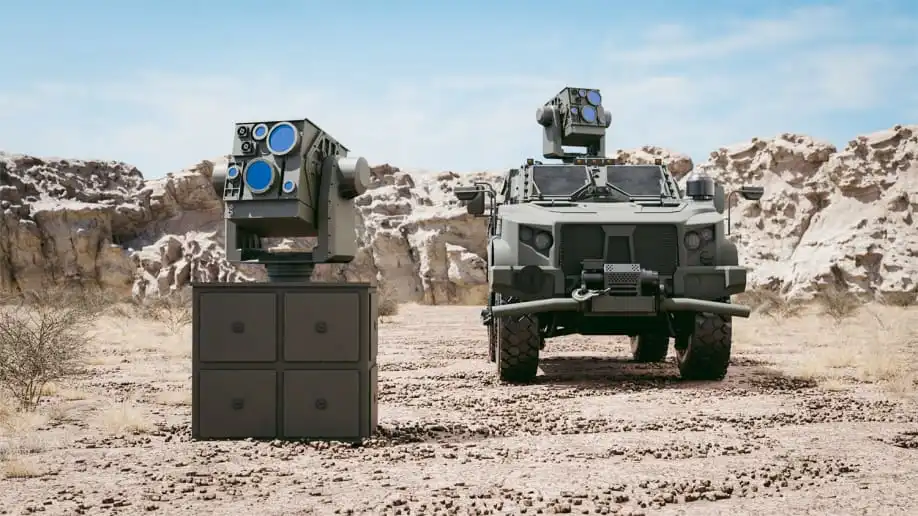
- The Army first received two LOCUSTs in 2022 through the Palletized High Energy Laser (P-HEL) program, and AV delivered two more integrated onto Infantry Squad Vehicles in September and another two mounted on Joint Light Tactical Vehicles (JLTV) in December under the Army Multi-Purpose High Energy Laser (AMP-HEL) program.
- It flew under the radar until February, when the pew-pew platform made headlines after it was used by Customs and Border Protection to shoot down an alleged cartel drone (later found to be a balloon), shutting down the airspace around El Paso for eight hours.
- In March, AV unveiled the latest version of the system, the LOCUST X3, which comes with a scalable 20–35 kW laser, a modular beam director, and AI-enabled automated target acquisition and engagement.
- Last month, the Navy tested it on board the USS George H.W. Bush, where it had “100 percent success” in downing drones. In a statement, AV said hitting that success rate “in live testing is notable” for any c-UAS solution, but “for a palletized laser operating from a carrier, it was a clear signal: the technology is ready.”
Ready to rock: The FAA and JIATF-401 test of LOCUST at White Sands Missile Range (WSMR) in New Mexico made the case for scaling up production and procurement of the technology, proving that it’s effective and, more importantly, safe.
“The FAA was trying to prove that the system doesn’t create a hazard for civilian aircraft, so they were flying drones around and flew an aircraft in the background to prove that the laser automatically inhibits, and they demonstrated that successfully,” AV’s Senior Director of Business Development, Aaron Westman, told Tectonic. “What the FAA saw reframed the issue for [them] to realize just how safe these things really are—there’s not a person pulling the trigger on a laser gun that’s going off into space forever and can shoot down airplanes.”
“What got people really excited is when they had a couple of chance occurrences with civilian aircraft flying over the test range, and the system worked flawlessly,” he added. “We’ve tested at over 70 test events and shot down thousands of drones, so we know the system works, but to see it work in that kind of environment how it’s supposed to work, it really seemed to me like a new paradigm.”
Easy peasy: Another takeaway from the test was that, despite the sci-fi aura around laser weapons, they’re pretty dang easy to use.
“When you see the laser, you see how easy it is—the beam is invisible, there’s no noise, and you watch these engagements and you’re like, ‘Really? That’s it?” Westman said. “When you see soldiers using the system, they’re just comfortable with it…so it’s no surprise that regulators are wanting to push it forward.”
Rolling it out: AV couldn’t comment on any contracts (but they “feel good about [their] positioning”), and Westman said what comes next is “TBD.”
However, the FAA’s declaration that LOCUST is low-risk for US airspace “takes away one of the major policy overhangs over directed energy technology,” Westman said, and sets the stage for broader deployment both domestically and at military installations abroad (including, as the Navy’s carrier-based test showed, naval assets).
Plus, the use of the technology on US soil—where drones have been increasingly spotted at US bases, nuclear sites, and even Hegseth’s and Secretary of State Marco Rubio’s houses (where the Pentagon is also reportedly looking at deploying LOCUST)—holds a lot of promise.
“The [drone] threat has taken off—it’s essentially democratized the guided weapon, and everyone’s trying to figure out effective ways to deal with these threats,” Westman said. “Almost all critical installations are seeing increases in drones flying around.”
“[LOCUST is] the first laser counter-UAS solution to go through this kind of testing,” he added. “I think people will look back at this as a milestone in the history of direct energy, and I suspect that this will lead to all sorts of interesting and good things in the future for the technology.”