
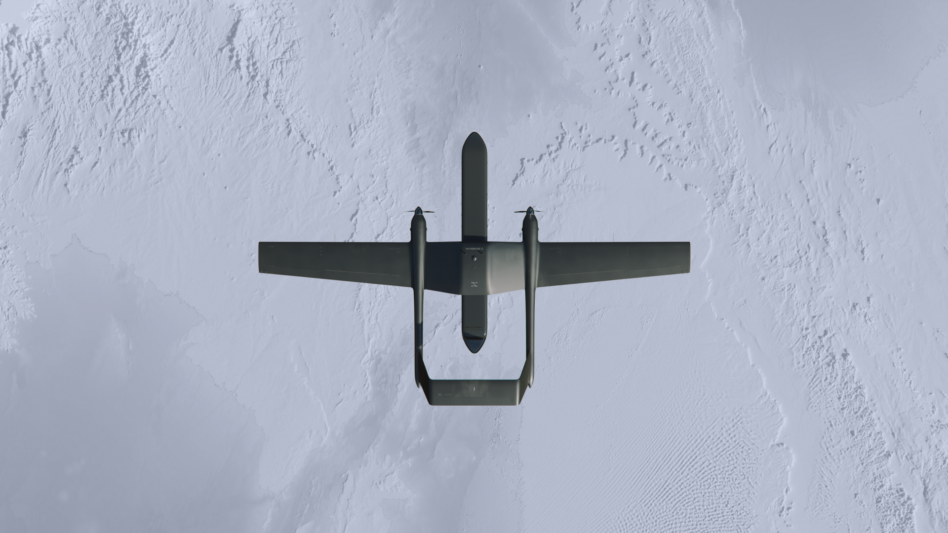
For this morning’s exercise, we want you to take everything you’ve ever known about the way a drone looks or acts and throw it out the window.
This morning, contested logistics startup Enigma emerged from stealth with a $5M Air Force contract and about $2M in VC funding in an exclusive release to Tectonic. The company is building an autonomous logistics platform (and a handy-dandy C2 to go along with it) that’s less “drone plane” and more “autonomous wings with an air-droppable pod that can carry 1,000 pounds up to 2,000 nautical miles.”
The idea is to get critical supplies to frontline operators in way-out-there locations quickly—without having to wait for a C130 or C17 to free up.
“We’re building what could best be described as a software-defined, autonomous logistics network that enables the resupply of cargo at extreme distances, heavy loads, and without the need for a runway,” Enigma Founder and CEO Reese Mozer told Tectonic.
“Other companies are focused on building an aircraft,” he added. “We’re focused on building a capability… We’re not interested in science projects. We’re interested in things that can actually be fielded, you know, within 12 to 24 months.”
Helps when you’re building a quick-to-build capability that happens to fall within one of the Pentagon CTO’s six new critical technology areas.
Drone dominance: Enigma actually isn’t all that new of a company—the startup was founded by Mozer, Dr. Vijay Somandepalli (co-CEO), Andrew Sousa (Director of Engineering), and Col. (ret.) Bart Gray (EVP of Strategy and BD) back in 2023.
- Mozer, Somandepalli, and Sousa all built American Robotics, a drone company they sold to Ondas Holdings for a cool $70.6M. Pocket change, really.
- Mozer said that a big part of why they built Enigma was watching the proliferation of drone companies here in defense tech land. “One of the issues that we have with the drone space…is that it’s a lot of solutions looking for problems. This time around, we really wanted to understand the market, the use case, [and] the mission as deeply as possible, then work backwards to requirements,” he said.
- The team conducted over 500 “stakeholder interviews” to understand the problems the Pentagon faces before landing on the need for a runway-free solution for contested logistics.
From the ashes: The startup has so far built two products:
- Phoenix: This is the logistics drone itself. The whole thing looks a bit like a sleek fixed-wing glider with a central drop pod. With the pod full—1000-lb max—the drone can travel up to 2,000 miles, further with a lighter payload. Mozer described it as “a flying wing that you can attach this cargo pod onto.” The company has built 5-6 so far, he added, and they’re all an “order of magnitude” cheaper than typical drones with these specs.
- Strata: The logistics C2 brains for Phoenix. Mozer described this as the “heavy software component that can actually facilitate [autonomous logistics] at scale.” The software allows operators to see what is going where and when, where there are shortages, and what is available to fill them. It also plugs into C2 and orchestration software made by giants like Palantir and Anduril.
“The idea is to bring a capability that starts to look a lot closer to what we already experienced in the consumer sector with Amazon and Uber,” Mozer said. “You order something and it gets there the same day [or the] next day. The military is exceedingly far away from anything like that.”
Drop-in: A key part of Enigma’s pitch is that you don’t need a runway or any sort of landing infrastructure to use Phoenix. Because the payload pod detaches, you can basically fly the drone thousands of miles (with or without comms) and drop the payload over, say, islands in the Pacific.
“If we look at a place like the Pacific, the vast majority of those islands don’t have any sort of runway infrastructure,” Mozer said. “If we were to get into a conflict there, a lot of it may be bombed out anyway. So the reliance on runways has to be avoided.”
Plus, the whole thing is, like, actually autonomous, Mozer said.
“It’s not enough to just make one drone autonomous. You have to be able to orchestrate fleets of these systems across massive distances, across different groups, different origins, different destinations,” Mozer said.
Big guns: As part of its pitch as “a company building stuff that operators actually need,” Enigma has amassed a pretty impressive slate of advisors—including Gen (ret.) Mike Minihan (former commander of USAF Air Mobility Command) and Gen. (ret.) Charles Hamilton, former commander of US Army Materiel Command.
In case those titles didn’t tip you off, both have a lot of experience moving important kit around pretty spicy places—Minihan was in the seat during the evacuation of Afghanistan and the start of the war in Ukraine, and Hamilton has spent a bunch of his career in the Indo-Pacific.
Both told Tectonic that they joined Enigma because it fills a gap they saw during their military careers.
“There’s never been one part of my professional career where we had enough supply to meet demand in a crisis. That’s just the nature of the beast. There are critical warfighter needs going unmet on a daily basis,” Minihan said. “The ability to have an automated system [that] is distributed down to the lowest levels, allows lower level commanders to handle their own priorities and service them so they don’t have to get in line and wait for a C130 to show up.”
Hamilton agreed. “I think the secret sauce to our military being so great is that, you know, we really have a very synchronized logistic system….[but] we can’t get complacent in that,” he said.
“I think there’s a universal demand signal for this,” he added. “You can take [Phoenix], plug in all the coordinates, and it’s off and running. That momentum is not held up in the fight at all. You can get those supplies there. You can get the things there that need to happen. “
Foot in the door: So far, Enigma has the $5M in contracts from the Air Force, plus “a lot of traction…with the Army and with various SOCOM organizations,” Mozer said.
- They’ve also got two CRADAs—one with DEVCOM and one with the Air Force.
- Mozer said they’ve also received 11 letters of support from different Army, Air Force, and SOF organizations.
The goal, Mozer said, is to get Phoenix into large-scale production within 12 months and have it in operations in 2027.
“We’re just at a point where we can actually work with others and start to grow,” he said. “The other piece is the level of interest that we’ve seen from our customers. It just feels like, at this point, we have to tell this story, because I think we’ve really struck a chord with what we created here.”