We’ve spent a heck of a lot of time talking about stuff that flies and goes boom lately, so today we’re gonna mix it up a lil’ bit.
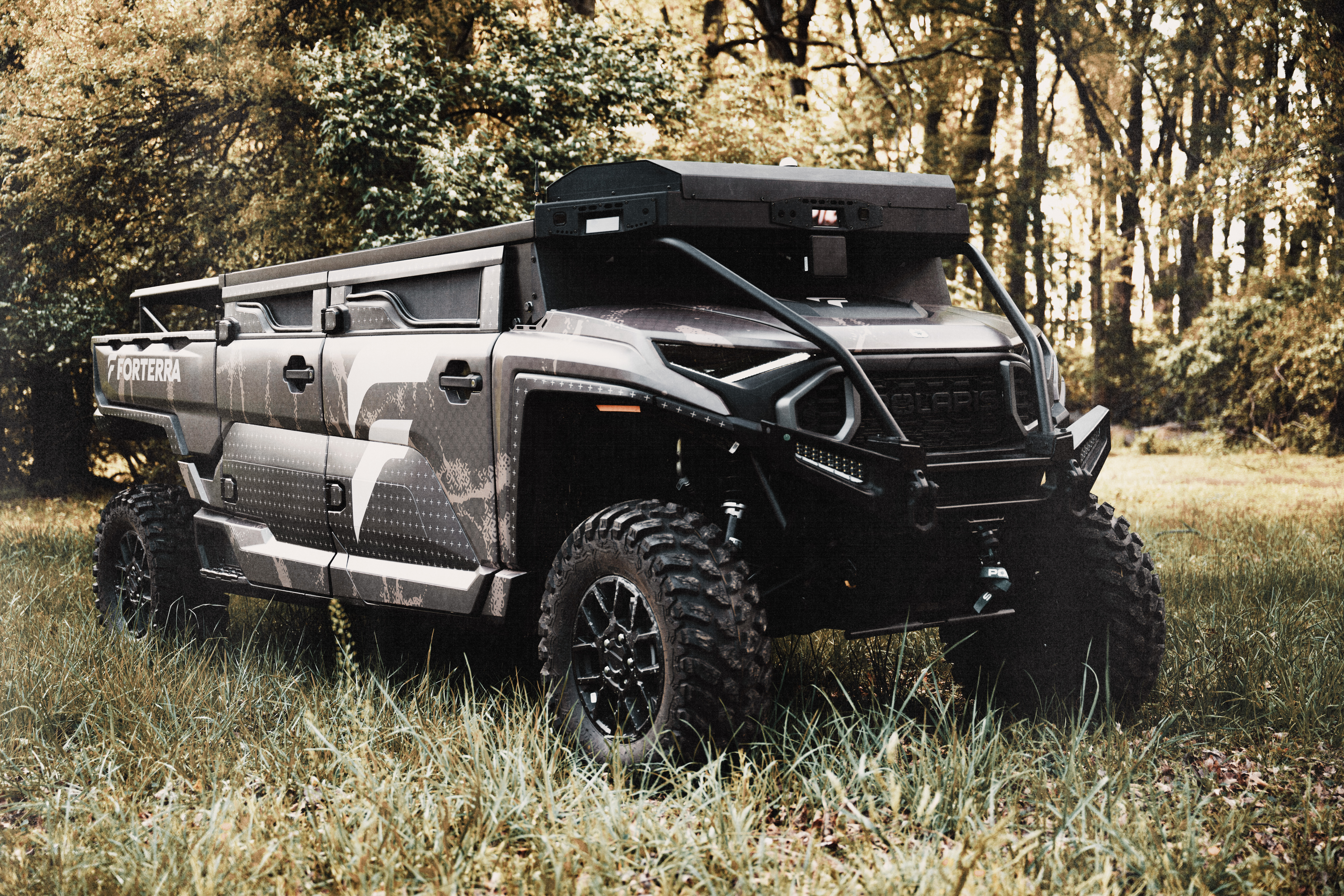
This morning, in an exclusive release to Tectonic, ground autonomy wunderkind Forterra unveiled a new autonomous vehicle called MESA, built on a “factory modified” Polaris Ranger XD 1500.
The whole thing is designed with a large, flat payload deck that can carry up to 2,000 lbs. Think rugged, off-road, heavy-hauling vehicle, but make it “look ma, no hands.”
“What we’ve seen from a lot of operational deployments is that the need for better decking, better space…is clear,” Forterra’s VP of Defense Growth, Pat Acox, told Tectonic. “There is a need for highly reliable operational systems to go and fill this mission need, whether it’s the last tactical mile, or protection of the force, or CASEVAC or anything along these lines…we’re seeing it play out in the real world in conflict zones across the globe.”
Polaris’ John LaFata told Tectonic that the whole integration process—from “hey, this is a good idea” to delivery—took less than six months.
“[Ranger] was already out in the market,” he said. “We had volume there already. We had platforms we could get our hands on quickly. And it also met the specifications that [Forterra] was looking for…in terms of payload capacity and the size of the deck that we could install onto the platform.”
Big bucks: If you’ve never heard of Forterra, either you’re not reading Tectonic closely enough or you’re new around here.
The company is a giant in the ground autonomy game—they’ve raised a cool $556M in funding (most recently, a $238M Series C) at a $1.12B valuation, largely on the merits of their AutoDrive vehicle autonomy software.
- The “full stack solution”—including hardware, software, and sensing—basically takes anything and makes it a ground drone.
- They’ve teamed up with a whole bunch of big-time producers—including Oshkosh, General Dynamics, BAE, Mack, Rheinmetall, and (yes) Polaris.
- They’re providing the autonomy brains on a whole bunch of big-time program vehicles, including BAE’s Armored Multi-Purpose Vehicle (AMPV) (Army) and with Oshkosh on the Remotely Operated Ground Unit for Expeditionary Fires (ROGUE-Fires) (Marine Corps). The autonomy piece of ROGUE-Fires (awarded to Oshkosh, built by Forterra) is worth about $29.9M.
- They’re also on a $114M US Army contract delivering autonomous breaching systems, among other programs.
Retrofit: Forterra specializes in taking existing fleets (like, ones that humans usually operate) and making them AGVs. But this time, they worked hand-in-hand with Polaris to build MESA.
- The idea was to modify the Minnesota-based company’s Ranger to make it a picture-perfect, heavy-lift AGV. That meant removing some parts—the human-y bits—while keeping the Ranger extra rugged.
- It’s still got features—30-inch tall tires and a lower-gear ratio, for example—designed to keep it rugged and good for offloading, but it’s designed from the ground up to be unmanned.
- If those lightbulbs haven’t turned on for you yet, MESA sounds a whole heck of a lot like a good candidate for things like the Army’s Unmanned Ground Commercial Robotic Vehicle (UGCRV) program, the successor to the failed RCV program. And luckily—even if the program shifts again—they’ve got logistics and breaching on lock.
To that end (like, per UGCRV’s specs), the whole thing is designed to cost less than $650K (hence the part removal) and haul the RFP’s desired 2,000+ pounds. The vehicle also has a range of 217 miles and run time of up to 48 hours, according to the company.
- Like all of Forterra’s vehicles, MESA (using AutoDrive) delivers “reliable autonomous navigation in complex, GPS-denied environments,” and Vektor (the comms and connectivity package released after Forterra purchased GoTenna late last year), provides “secure, resilient connectivity across distributed forces,” per the company.
- It can also plug into whatever C2 or coordination software you’re already using. Pick your flavor, as it were.
- It’s also designed to be pretty mission agnostic. MESA can act as anything from “counter-UAS to [a] remote weapons station,” Acox said, or you can just use it for logistics. “The Department of War and other federal agencies could go out and try to find 75 bespoke platforms,” he added. “But [MESA] takes a lot of the confusion and dilution of taxpayer capital out of that mix by pulling it back to a common source.”
“We start with a workhorse, not a show pony…it’s built to go drive pretty rugged missions,” he added.
Plus, because Polaris, like, already makes the Ranger en masse and has the production and supply lines ready to go, it’s easy to churn these out quick. “We’re built to scale… [and] Polaris is built to scale,” Acox said. “We can go actually address needs and not need a five-year ramp-up time to do it.”
Scale it up: LaFata said that—at least at the start—the vehicles will be built out of their Minnesota facilities. “If the demand’s there, we can ramp up to multiples in a day,” he said. “We build hundreds of Rangers a day.”
And it does sound like, in fact, the demand may very well be there.
“My pain point is I have to put in more orders and continue to work,” Acox said. “Just when we think we have a good enough test fleet size, the demand is so high that I have to go back and backfill those.”
Good problem to have, we’d say.