Well, folks, we’re starting the week off with a bang. (Forgive us.)
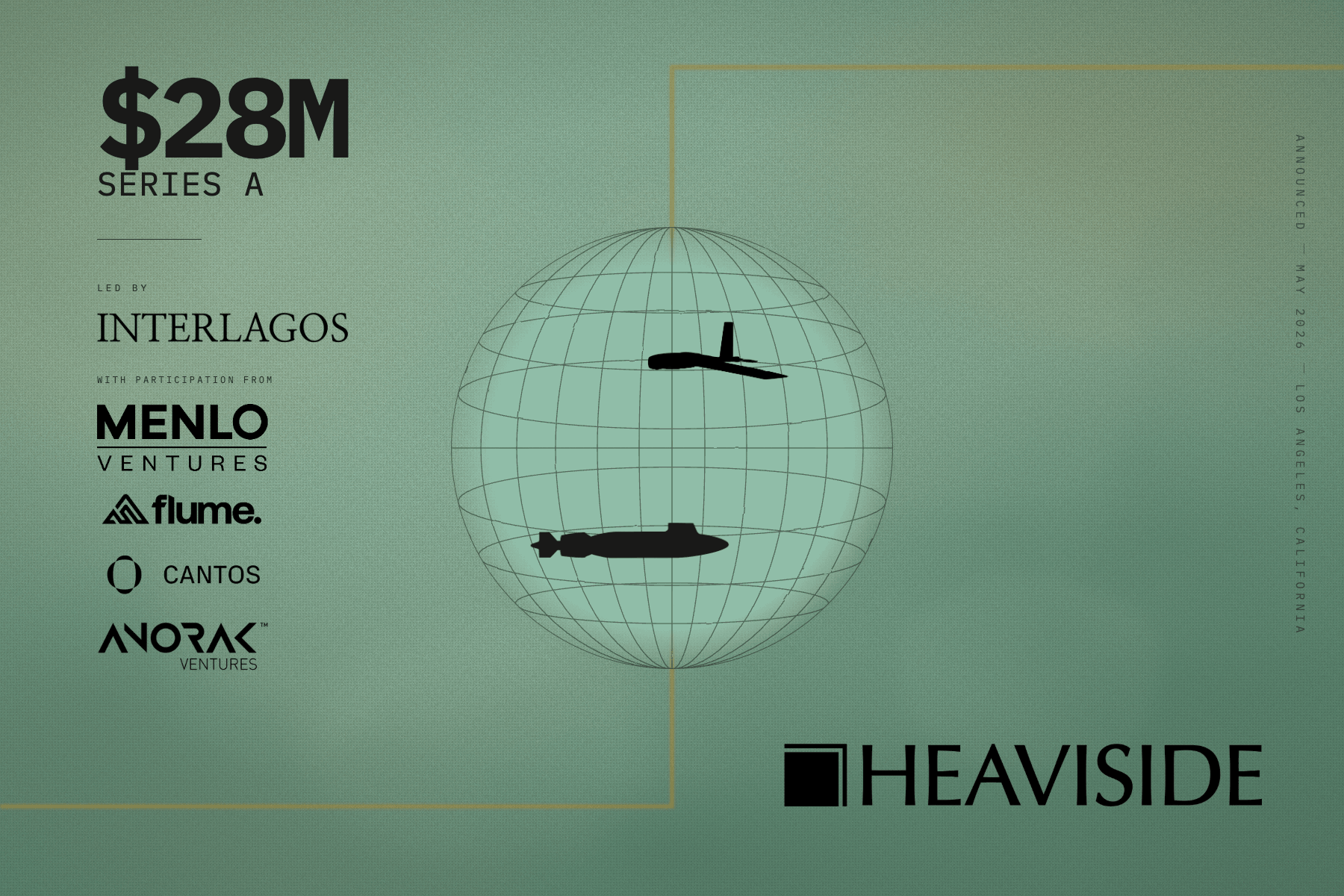
This morning, munitions startup Heaviside came out of stealth with a $28M Series A in an exclusive release to Tectonic. The round was led by Interlagos Capital with participation from Menlo Ventures, Flume Ventures, Cantos Ventures, Anorak Ventures, Frank Finelli (senior advisor and former MD of The Carlyle Group), Paul Dimitruk (co-founder, vice chairman & senior partner at Partners Capital), and former Dedrone CEO Aaditya Devarakonda.
The company has been quietly building autonomous precision munitions for the US and allied forces for about two years. Heaviside CEO Phillip Walker told Tectonic that their tech is already being tested by US special forces, NATO special forces, and conventional forces in “multiple NATO countries and the US.”
“We started the company to focus on closing the gap between price and precision for autonomous precision munitions,” Walker said. “Our focus is on being able to hit a sub-one-meter target at a very affordable price point.”
“If the US and its allies want to get a leg up on our adversaries, we need to make these munitions very affordable…but also very precise,” he added. “That’s really our core focus right now.”
Look out, Lockheed. The startups are coming for your bag.
Go boom: Now, we’ve talked, like, a lot about America’s munitions issues, so we’ll keep it brief.
To boil it down to brass tacks: The US military uses precision munitions (and all munitions, really) way faster than it can produce them.
- Basically, the Pentagon bought a relatively small number of these bad boys during the War on Terror. The assumption was that war would be different now—high-tech, limited, and reliant on US air superiority.
- The war in Ukraine blasted through that assumption. At peak fighting, Ukraine and Russia were both firing thousands of munitions a day.
- To use the 155mm as an example—before the war in Ukraine, the US was producing about 15,000 of these a month. Ukraine was using nearly that many in a day.
- When we look at missiles, it’s even worse. Things like JASSMs (Lockheed), LRASMs (Lockheed), Patriots (RTX and Lockheed), and Tomahawks (RTX) are all super-duper exquisite systems produced by the primes, and can take years to build. Plus, there’s the whole SRM bottleneck thing.
Crash and burn: The military operation (war) in Iran has shed some pretty harsh light on just how, well, screwed we are munitions-wise.
According to a report by the Center for Strategic and International Studies (CSIS) from late April, since the start of Operation Epic Fury, the US has used an estimated:
- 53–81 percent of its prewar THAAD interceptor inventory
- 46–58 percent of its Patriot PAC-3 interceptor inventory
- 45–55 percent of its Precision Strike Missile (PrSM) inventory
- 40–50 percent of its SM-3 inventory
- 30 percent of its Tomahawk inventory
- 20–25 percent of its JASSM-ER inventory
- 20 percent of its SM-6 inventory
And that stuff takes a heck of a long time to build back up. Plus, these go-boom things aren’t always as accurate as they say they will be on the tin.
“A lot of the munitions out on the market, although they might have a really great and very tight target accuracy, when these products go to a real battlefield out in…Ukraine or the Middle East, it’s not as simple as deploying it in…the Mojave Desert or Death Valley,” Walker said. “They’re seeing that these munitions [that] were advertising one or two meter…accuracy [are] now seeing eight, ten, 20, 50 meters.”
That’s bad news for, like, anyone in remote proximity to a target.
New kids on the block: Anyways, this munitions cluster (get it) is right where Heaviside is slotting itself in. While Walker couldn’t get into too many details about what they’re building, he said they have “autonomous precision munitions in the air right now” and “more than one autonomous precision munition on the water.”
- The goal is to take those super-expensive, super-exquisite precision munitions and bring them into startup-land. Think lower-cost, faster production, with the same precision and performance.
- Walker said that the company has worked hand-in-hand with SF operators to build exactly what they need. “We have been able to get to where we are [because] we have a very marquee base of tier one special forces [and] conventional forces…not just for the US, but also international partners,” he added.
- The munitions are currently in low-rate production with operators testing them out and giving feedback. In tests, Walker said their kit is achieving that one-meter precision goal “to a degree.”
- He couldn’t tell us how many they’ve built (sneaky), or the secret sauce to the precision (sneakier), but ultimately, the goal is to churn tens of thousands of precision munitions across domains annually.
- Walker also said the goal was to have “dozens” of products in each domain portfolio (land, air, sea). We ain’t just building a single mini missile here.
Build-up: With this new cash money, the name of the game is scaling production. The company currently has about 50 employees in offices in Los Angeles and Oslo, Norway. (They produce the munitions in both countries, as well.)
“The reason we raised the Series A was to fuel adoption across our customer base,” Walker said. “We’re working with those customers to make sure we’re achieving their mission profiles. We’re using it to begin increasing production capacities…going from small batch production to low-rate and medium-rate production.”
“The US needs these, and they need them now,” he added. “They need a practical partner that can get them to them very quickly. And I believe Heaviside is going to be able to move product very quickly into their hands because of the way that we’re set up.”