Told you it was a big day for the backend side of defense.
This morning, Nikon SLM Solutions—a unit of Nikon Advanced Manufacturing—announced in an exclusive release to Tectonic that shipbuilding giant HII’s Newport News Shipbuilding (NNS) division has placed a second order for its NXG 600E metal additive manufacturing system.
Hamid Zarringhalam, CEO of Nikon Advanced Manufacturing (among a ton of other titles within the Nikon corporation), told Tectonic that the machines—basically giant 3D printers for metal alloy components—will help HII build for the Navy and speed up both fabrication and maintenance for one of the biggest naval manufacturers in the world.
In the midst of a shipbuilding crisis, we’re guessing this comes as music to the ears of at least a few policymakers out there.
“Now, we’re not suggesting that additive manufacturing here is the silver bullet,” Zarringhalam said. It’s not going to solve all problems. But the ability to have this capability at your disposal allows you to be able to address some of the supply chain challenges that [we] have. This is exactly how the Navy is looking at it.”
Big boys: Now, you might be sitting there thinking—wait, isn’t Nikon the camera company? And isn’t HII, like, a massive traditional shipbuilder? Why are we talking about this in Tectonic?
Well, friends, this story right here is about the tech—Nikon SLM Solutions (the Nikon corporation bought Germany-based SLM Solutions for €622M back in 2022). SLM Solutions (again, now fully owned by Nikon) has taken the 3D-printing-for-defense we all know and love and brought it to industrial scale.
- The company builds a range of laser melting machines that can process materials such as aluminium, titanium, steel, and nickel alloys like Inconel.
- That means that rather than making parts (or full systems) by hand, you can just print them. That’s especially useful for bits that are hard to find or might be out of production.
- The team up with Nikon has brought on board best-in-class cameras, optics, and sensors—all the better for printing advanced and niche parts.
- Nikon SLM Solutions has facilities around the world, including a 90,000 sq ft advanced manufacturing campus in Long Beach, CA, where they do everything from printing to R&D to design.
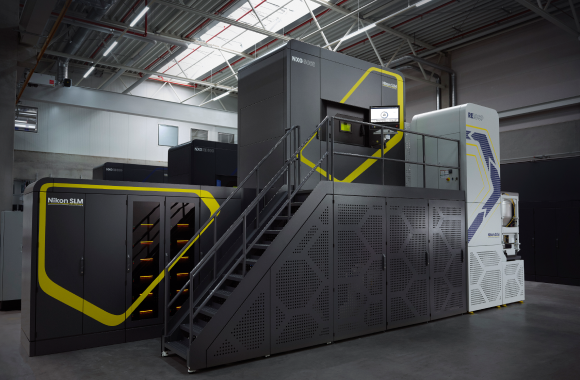
Double-decker: The NXG 600E is Nikon SLM Solutions’ big boy metal 3D printer, ideal for big ol’ parts (like, in this case, for HII’s ships):
- It can print parts up to approximately 600 × 600 × 1500 mm, giving it one of the largest build ranges in the industry.
- It uses 12 1 kW lasers operating simultaneously, which speeds things up and increases output.
- It uses proprietary laser bed fusion tech that melts metal powder layer by layer, which means it can build structures with fine feature detail and complex internal geometries that would be super-challenging using traditional manufacturing.
- In the HII example, it’s printing using a copper nickel alloy on the first machine and nickel aluminum bronze on the second (which is even more corrosion resistant), Zarringhalam said.
- It looks like a sexy, duplex shipping container that can be installed on pretty much any large factory floor.
- According to Zarringhalam, there are around 80 of these printers deployed, with more than 80 percent of them operating in “fleets” (groups of two or more).
And it sounds like the giant metal printer has been a hit with our friends in Newport News: HII only placed its first order for the NXG 600E last December, and is already coming back for seconds.
The company has also partnered with the Navy—the service purchased an NXG 600E that operates out of the company’s Long Beach facility last year. Lockheed Martin also purchased two of the machines for its additive manufacturing facility in Texas in 2024.
Without naming names, Zarringhalam said that they were working with “all of” the big primes, and most of the nontraditional defense companies we all know and love.
Need for speed: When we asked Zarringhalam why Nikon SLM had been such a hit with defense firms, he said it comes down to four things:
- First: Advanced weapons development. “When you do that, it’s important that you have very sophisticated parts that ordinarily you’d have to weld or put together that might be heavier…The metal additive manufacturing allows you to go from a digital design format…right into a built product,” he said. Plus, you get “lighter, better performing, [more complex] parts.”
- Second: With additive metal manufacturing, you can “rapidly [go] from prototyping into manufacturing,” without building molds and iterating and all those icky things.
- Third: You can scale quickly. “This is printing. It’s not the same as inkjet printing, but you’re actually printing these things. And you can print lots of parts this way,” he said.
- Fourth: It makes sustainment a whole heck of a lot easier. “You’re talking about sustaining an arsenal that’s been out there for years and years with spare parts that [were] produced a long, long time ago,” he said. 3D printing makes even these hard-to-find parts available. Plus, it keeps the supply chain in the US.
“Metal additive manufacturing is one of the knobs that can be [turned] towards…scaling,” he said. “It’s a reliable technology. It’s one that’s being used on an industrial scale. And so it’s really ready for deployment.”