
Say it louder for the people in the back: Welcome to the golden era of defense tech’s picks and shovels.
This morning, Chariot Defense—which builds new-age power systems for, well, defense—announced that they’ve raised a $34M Series A led by Andreesen Horowitz (a16z), with participation from DCVC, LMNT, Marlinspike, Overmatch, Shield Capital, Ensemble, and Trenches Capital. OG Chariot investors General Catalyst and XYZ also came back to the table.
Chariot CEO Adam Warmoth told Tectonic that the investment is part of a broader shift to a battlefield powered by a hybrid architecture rather than just old-fashioned diesel.
“What [Andreessen Horowitz] sees is this big vision…this complete transition in how we’re going to basically power our systems at the edge, how all military platforms are going to be powered,” he said of their lead investor. “[They see this] transition from the combustion engine world to this hybrid world.”
And Chariot’s rugged super-batteries, it seems, are part of how a16z sees the world getting there. Warmoth said that the money would be used to scale production, invest in their power-optimizing software, and explore new product lines.
“The speed with which warfighters have adopted our systems is a testament to our technology and our incredible team,” he said in a statement. “We’re already turning this capital into capabilities as we scale to meet the growing demand.”
Rocket ship: Chariot is a fairly new kid on the block.
The startup was founded by Warmoth (an Anduril and Archer alum) last year, and came out of stealth with $8M in July. Put simply, the company set out to change the way that energy and power are controlled on the battlefield.
Their initial means of doing that is with a software-driven hybrid power system called Amphora.
- The company describes the whole shebang as a “software-defined power layer that senses, prioritizes, and routes power across mission-critical systems in real time, enabling warfighters to operate without interruption, detectable signature, or wasted capacity.”
- Think of it as an ultra-smart battery system. Amphora can be powered by anything from generators to solar power, then store that energy to power things like sensors, drones, and even cUAS systems when needed—all with little noise and basically no heat signature.
- The software layer of the thing is all about optimization—Amphora stores energy and only releases it when needed, rather than keeping a noisy generator running for hours.
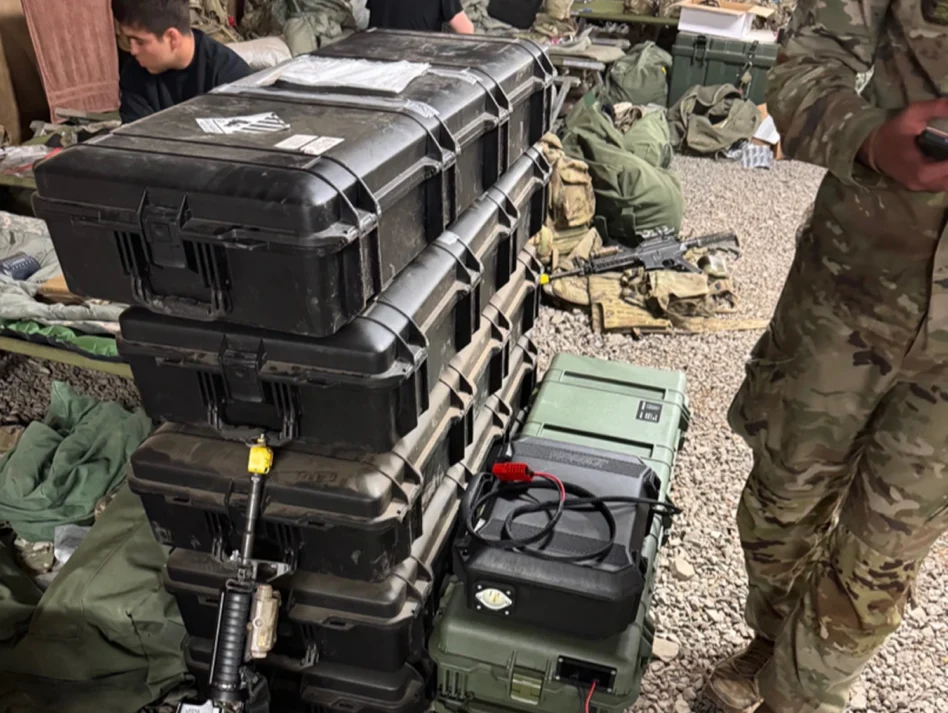
- The whole thing is designed to be portable—the smaller Amphora 24 (5 kWh) can fit in a Pelican case, while the larger Amphora 400 (315 kWh) can be wheeled out to provide big-boy power (like for EW and C2).
“We’re moving towards drones, sensors, compute, communications. All of that kind of needs electricity as the core layer,” Warmoth said. “It’s not just about miles per gallon, turning fuel into propulsion, into movement. It’s turning fuel into effects, which are increasingly electronic.”
Tech like Chariot’s changes the way that missions are planned and carried out, he added. “[When] military planners do mission planning today, they think in gallons, and they think in miles per gallon,” he said. “We’re really trying to raise the primacy of the kilowatt hour.”
And this isn’t just pie-in-the-sky thinking—while he couldn’t get too far into specifics, Warmoth said they’re already working with “multiple army units” and have Amphora “deployed and operational” outside the US in contested environments.
They’ve also sold to commercial companies that use Amphora as an “easy button” to power their kit, he added.
But the goal—especially with this new pile of cash—is scale. Warmoth says they’re working with Pentagon leaders to get Amphora and Chariot onto programs of record (where he said they’re getting traction) and that they’ve set up a new production line for the 24 and the 400 in San Francisco.
He said they’re also looking into deeper product integrations as well. “Today, our platforms are really just drop-in—they’re meant to be minimally invasive,” he said. “As we start to think about the next generation of platforms, you can extract even more value if you can start to build this in from the beginning.”
If you’re trying to think big—like, changing the way war is powered big—it can’t hurt to have the American Dynamism team on your side.