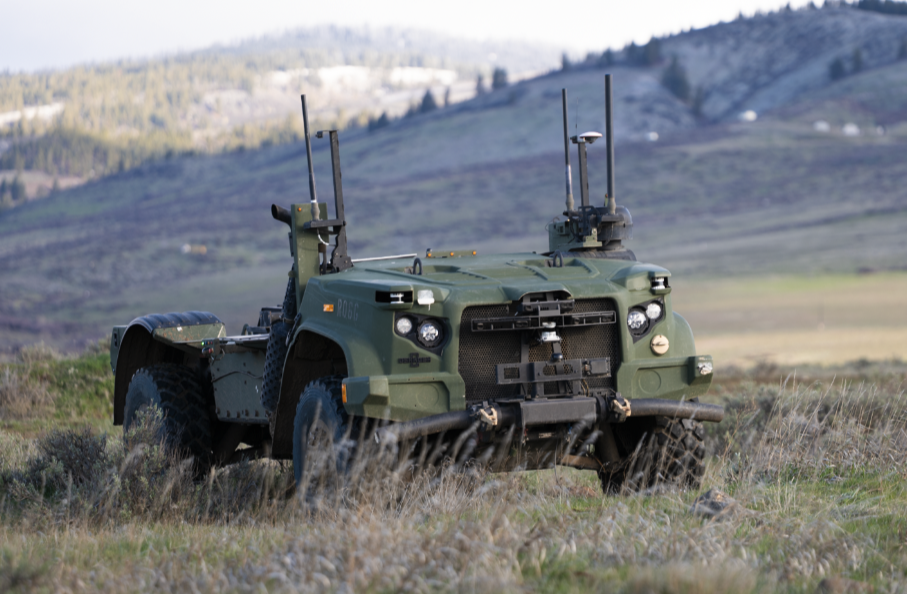
Overland AI’s souped-up autonomous ATV, ULTRA, has been a hit with the Army, but the Marine Corps is, quite literally, thinking bigger.
The Seattle-based ground autonomy startup announced in an exclusive release to Tectonic today that it’s on contract with the Marines to integrate its OverDrive autonomy stack on the Corps’ ROGUE Fires prototype vehicle—and that they showed it off at a recent demo.
Rise of the robots: For the Tectonic newbies, Overland—spun out of DARPA’s RACER ground autonomy program—has become a pretty major player in the UGV space in the last couple of years.
The Seattle-based company is best known for its flagship ULTRA platform, a fully autonomous tactical UGV with a flat deck to carry a range of payloads, but its autonomy kit is its secret sauce. That’s delivered through two main products:
- OverDrive, the autonomy brain behind Overland’s “look ma, no hands” vehicles. The stack perceives and maps terrain with active and passive on-board sensors without relying on GPS or pre-mapped routes.
- SPARK, Overland’s autonomy “upfit kit”—featuring sensors and compute—that can plug and play into pretty much any ground vehicle and drone-ify it. Its core component is a ruggedized, compact computer module running OverDrive that fits in most ground vehicles.
Gone ROGUE: With the Marine Corps, Overland AI integrated the combo deal onto a prototype of the Remotely Operated Ground Unit for Expeditionary (ROGUE) Fires platform.
- Based on the Joint Light Tactical Vehicle (JLTV) produced by Oshkosh Defense, ROGUE Fires is designed as an unmanned, missile-launching ground vehicle for remote (especially coastal) areas.
- The platform is modular, but the Marines are looking to mount the NMESIS ground-based anti-ship missile launcher onto the JLTV chassis, for, well, obvious boomy reasons.
- The Marine Corps is also working with other autonomy hotshots on the program, awarding contracts to Forterra last January ($30M, per Breaking Defense) and Kodiak in February.
- Overland AI couldn’t disclose how much they’re on contract for, but Congress set aside $59M for ROGUE Fires “autonomy kits” for FY2026.
A big focus of the ROGUE Fires autonomy capability is leader-follower operations, where one or more unmanned “follower” vehicles autonomously follow a manned lead vehicle in a convoy. That’s a big part of what Overland AI was demoing in comms- and GPS-denied environments and off-road terrain with the Marine Corps at a recent exercise in Washington.
“We demonstrated a few things: The first was completely autonomous operation of the vehicle, where we essentially showed them several runs where the vehicle moved through a series of checkpoints to show that you can drive it autonomously,” Overland AI CEO Byron Boots told Tectonic. “We also showed leader-follower with both a human-in-the-lead vehicle and an autonomous lead vehicle.”
Old pals: The ROGUE Fires integration might be new, but this isn’t Overland’s first rodeo with the Marines; they’ve just been quieter about it.
“We started to work with the Marine Corps in late 2023, developing and showing them autonomous capabilities on ground vehicles, and they were very interested in leader-follower and convoy operations,” Boots said.
With ROGUE Fires, they’ll leave the ship-sinking missile launching stuff to the Marines, but they’re “continuing to work with the Marine Corps on the development of ground autonomy and convoy operations for moving these types of vehicles autonomously in the Pacific,” he added.
Given the program’s focus on operating from remote islands and coastlines, we can think of how that might come in handy in that part of the world.