
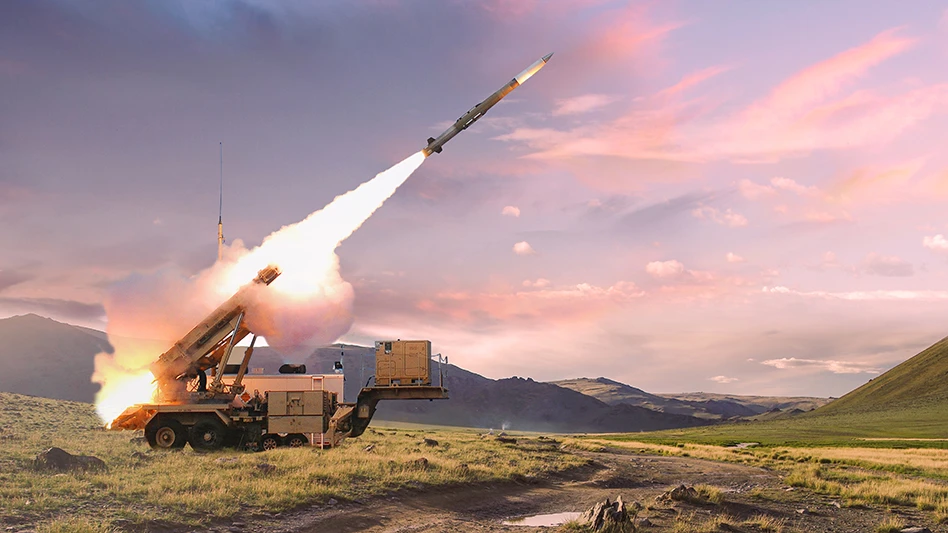
If we learned one thing from China’s response to President Trump’s tariffs in April, it’s that the US is still deeply reliant on its biggest rival for those ever-important rare earths. That’s especially true for the ones that make all of our military kit go boom and zoom.
Luckily, startup Niron Magnetics has come up with a novel solution to weaning off China’s minerally teat. The company makes magnets that are actually rare earth free, and it seems that at least one major contractor thinks they actually work: This morning, in an exclusive release to Tectonic, they announced a partnership with aerospace and defense company Moog to evaluate and test Niron’s magnets in guided munitions systems.
Huge—and we mean huge—if it works.
Movin’ magnets: Under the partnership, Moog and Niron are looking to speed up the integration of Niron’s rare earth-free magnets in Moog’s guided munition actuators.
Actuators, for the non-engineers among us, are the electromechanical or electro-hydraulic mechanisms that physically move a missile or guided projectile’s control surfaces—the fins, thrust-vectoring nozzles, or internal components—to steer it accurately during flight and respond to navigation inputs.
The China chokepoint: Right now, the actuators in pretty much all modern missiles rely on rare earth magnets, mostly made from neodymium, iron, and boron (known as NdFeB magnets).
For a Pentagon worried about China, rare earths, and its munition stockpile, that’s a big problem:
- NdFeB magnets are found in everything from F-35s to nuclear subs, missiles, and drones because of their magnetic strength, thermal stability, and miniaturization capabilities. Put simply, they turn electricity into motion.
- China controls 60 percent of the mining and processes upwards of 90 percent of the world’s rare earths used in magnets—only slightly more than America’s 1 percent. Roughly 90 percent of the world’s rare earth magnet production is also located in China.
- The Pentagon has rushed to decouple the rare earth supply chain from China, including by investing $400M in rare earths mining company MP Materials in July and providing a direct loan to rare earth magnet startup Vulcan Elements in November.
- Congress, meanwhile, prohibited the use of Chinese magnets in the DoD under the FY2021 NDAA, which kicks in in 2027, and required country of origin tracking at every processing step for magnets in the 2023 NDAA.
Rarer than rare: Instead of using rare earth elements like NdFeB, Niron—spun out of a University of Minnesota research lab in 2014—is pioneering the use of breakthrough iron nitride magnet technology in high-power permanent magnets. Luckily for them (and their customers), iron and nitrogen are two of the most abundant elements in the Earth’s crust and atmosphere.
Niron has received $150M in early backing from Samsung and car manufacturers, including GM and Stellantis. The startup also recently broke ground on a 1,500-ton plant in Minnesota, which it says could meet 3 percent of US magnet demand.
That facility is expected to come online by mid-2027, but their current one in Minneapolis is already making “hundreds of magnets a day at the ton scale,” Niron CEO Jonathan Rowntree told Tectonic. “We already have an end-to-end manufacturing line for commercial qualification efforts, but we’re actually catching up pretty quickly on the defense side.”
Up to snuff: According to Niron, their iron nitride magnets perform just as well as rare earth magnets at high temperatures, which could be pretty handy for missile-makers and integrators like Moog.
“We’re providing the magnets, and they’re optimizing their designs, testing, and evaluation to make sure that it meets the stringent requirements that are needed for the solutions that they’re providing to their customers,” Rowntree said. “They’ve committed significant engineering resources and time to partner together to develop their systems around our magnet technology.”
The partnership is still at an early stage, and the two have a lot of testing to do before Niron’s magnets are fully integrated, but the two companies are pressing full-speed ahead.
“It’s not just national security that relies on magnets, but the whole modern world as we know it. The attraction of Niron’s technology is that we could eliminate all reliance on a pretty short timeframe,” Rowntree said. But this is an all-hands-on-deck situation. “We’re in a crisis right now, and we need all solutions to bolster the supply of magnets for all applications.”