
Well, Nominal is certainly having quite the past few weeks.
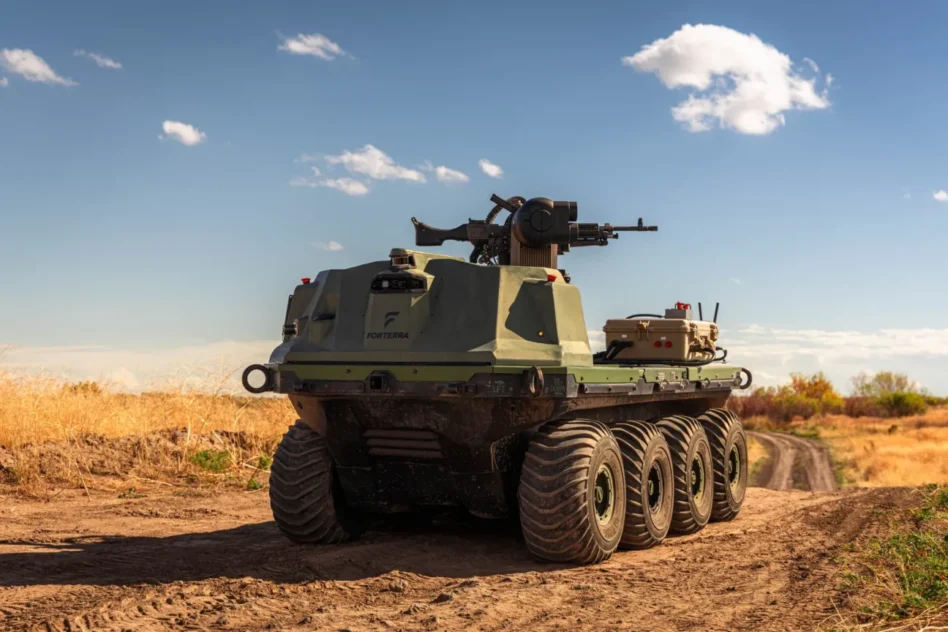
This morning—on the heels of an $80M raise led by Founder’s Fund and an official partnership with Anduril—the Austin-based testing startup announced in an exclusive release to Tectonic that they’re officially teaming up with ground autonomy hotshot Forterra.
Nominal CEO Cameron McCord told Tectonic that they’re becoming Forterra’s across-the-board test stack, and that teaming up on the company—which has some big ol’ contracts with the Army and Marine Corps—helps them offer up a neat testing-and-autonomy “joint offering” to the government.
“This is a really big moment for Nominal,” McCord told Tectonic. “It helps us validate that our solution for accelerating testing is truly multi-domain,… [and] having one of the leading ground autonomy companies using Nominal for [ground-based] use cases is really, really powerful.”
Forterra CGO Scott Sanders said that they chose to team up with Nominal for testing because, well, it helps them get things right faster.
“We teamed up with Nominal because if you’re building anything in the physical space, [simulation] only gets you so far,” he said. “We need to deploy things that don’t break for warfighters. The fault tolerance is super, super low.”
We’ve been chatting about Nominal a lot lately, so let’s kick things off with Forterra.
- Their flagship product is vehicle autonomy software called AutoDrive, which they bill as a “full stack solution” that includes hardware, software, and sensing.
- They’ve integrated AutoDrive on a whole range of vehicles from big-time producers, including Polaris, General Dynamics, Mack, and Rheinmetall.
- Last month, they partnered with BAE to prototype AutoDrive on its Armored Multi-Purpose Vehicle (AMPV)—an Army program worth up to $2.28B—and followed that up by unveiling a prototype of the DeepFires autonomous launcher built with RTX and Oshkosh at AUSA.
- They also fully acquired networking and secure comms company goTenna in October because, as CEO Josh Araujo told Tectonic, “self-driving can work great, but if you don’t have comms, you’ve got a brick sitting out there.”
- They’re also on a $114M US Army contract delivering autonomous breaching systems.
Back in November, the company raised a cool $238M Series C at a more than $1B valuation. In total, they’ve raised nearly $556M. Pocket change, really.
Nominal is no slouch. The company doesn’t build hardware—but it’s built a mini-empire making sure that the flashy, go-boom kit all y’all are churning out actually works.
- Nominal’s secret sauce is its platform called Nominal Core. Think of it as an everything platform for testing—rather than flicking between a bunch of different legacy tools, engineering teams can collect, visualize, monitor, and analyze hardware telemetry, logs, video, and test data in real time.
- The idea is to bring testing into the 21st century along with all the new-fangled tech we’re so pumped about. “A lot of the software in the testing space hasn’t really been innovated against in decades, literally,” co-founder Cameron McCord told us last month.
- Beyond Anduril, Nominal also works with defense tech favorites like Shield AI, Hermeus, Vatn, Scout AI, Antares, and others.
- They’ve also raised a (technical term) shit ton of money—$180M from some of the biggest names in the game, including Founder’s Fund and Sequoia.
Fast friends: The two companies say that the goal is to use Nominal’s testing stack across Forterra’s fleet, including by ingesting vehicle telemetry data, organizing it into a shared data catalog, and generating collaborative post-test analyses. Sanders says they’ve got 238 systems deployed around the world.
“That doesn’t sound like a lot of scale, but it’s 238 more than anybody else,” he said. “It allows us to get feedback. Not just on testing, but as we roll this out more broadly, we can figure out where an operator made a choice, [and] how we can then retrain the model to be more efficient. All of those things are imperative to deploying the best software and hardware at the edge with the warfighter.”