
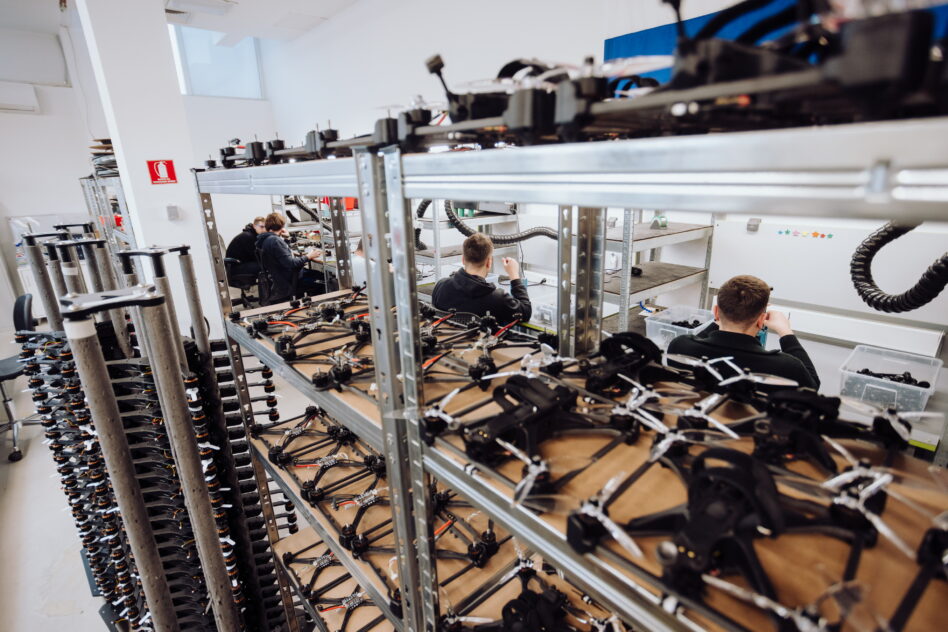
Remember on Friday when we said that the Americans were coming? Well, turns out the Europeans are coming, too.
This morning, FPV hotshot Orqa announced in an exclusive release to Tectonic that they’ve raised a €12.7M ($14.7M) Series A led by Expeditions Ventures and signed a teaming agreement with Texas-based Red River Army Depot to expand its presence in the US.
After mostly growing organically (like, through sales, imagine) for years, Orqa CEO Srdjan Kovacevic said that this new funding will basically be fuel on the fire.
“You can do only so much with just organic growth,” he told Tectonic, “We wanted to break new ground when it comes to valuation…top up the war chest. So we can be bolder [and] more aggressive, whether it’s with just investing straight cash or going for acquisitions.”
Other participants in the round include Lightspeed Venture Partners, Taiwania Capital, Aymo, and Radius Capital. The company says it will use the funding primarily to build out its “Global Manufacturing Program,” an “international network of trusted manufacturing partners building standardized systems based on Orqa designs and components.”
Partnerships, drones, and hyper-scaling manufacturing around the world. Can it get any more 2026 than that?
SBD: Orqa is one of those quiet killers on the drone scene.
The company was founded back in 2018 in Croatia and has made a name for itself building small FPVs that have proved pretty popular on the battlefield in Ukraine.
- Orqa (to date) makes three drone models: The MRM1-5 training drone, the NDAA-compliant and EW-resilient MRM2-10, and the more commercially marketed Dream X.
- They also make all the kit that makes those drones go zoom in-house: goggles, flight controllers, motors, printed circuit boards (PCBs), cameras, radios, and all the mechanical drone parts. Chinese parts are not part of the equation here.
- Back in December, the company announced that it had scaled production capacity to 280,000 drones a year.
Slow but steady: Despite all that growth, Orqa hasn’t actually raised all that much cash money from VCs (in defense tech terms, at least). Back in December 2024, they raised a €5.8M ($6.7M) seed round led by Lightspeed.
The company also scored a €10M contract for FPVs with the Croatian military and has reportedly supplied drones to the Ukrainian armed forces and the Pentagon. They also teamed up with Firestorm to supply FPVs to the US, and the drone competed in the first “gauntlet” of the Drone Dominance Program.
“We’re very proud to be able to support some of the great companies that are competing…the partnership with Red River is a step towards being able to support the ecosystem even more strongly through capacity to build technology in the United States,” Kovacevic said.
Star spangled: To that end, it sounds like Orqa is entering its red, white, and blue era. By teaming up with Red River—a military manufacturing company founded all the way back in 1941—Kovacevic said Orqa will be able to scale manufacturing in the US for the Pentagon’s small drone needs.
“You can think of this as staking the ground where we start to get serious about building a US supply chain of drone technologies,” he said. “This is the framework within which we can start meaningful technology transfer.”
Sky’s the limit: And from there, the world.
The idea is that manufacturing partners today will start building Orqa-style FPVs, but they’ll also be able to develop more advanced systems as Orqa conceives of them. (Kovacevic said, “long term, [they are] setting [their] sights on robotics more broadly.”)
“The global manufacturing program is just a way to plant these little seeds and then let these ecosystems grow around those nodes,” he said.
And this global spread won’t be limited to organic growth—part of the idea behind raising cash is that they can acquire a company or two.
“Typically, we want to look at amazing teams that are complementary to our existing technological capabilities. We’re [also] really serious about vertically integrating,” Kovacevic said. “It’s going to be more around acquiring capability, but I’m not also excluding the ability to acquire access to certain markets.”
South Pacific: We noted that Taiwania Capital—a public-private VC linked to the government in Taiwan—came to the table for this round. Kovacevic said it was all about access to semiconductors.
“Taiwan is still the hotbed of the semiconductor industry, and I stand firmly behind the belief that what’s going to enable us to break new ground in what aerial robots can do…is made on the semiconductor level,” Kovacevic said. “For us, the partnership with Taiwan was more than financial.”
Sounds like yet another person with an eye on the ever-closing Davidson window.