Valinor launched last year with a focus on building the unsexy but critically important tech for modern conflict, and that pitch is starting to pay off.
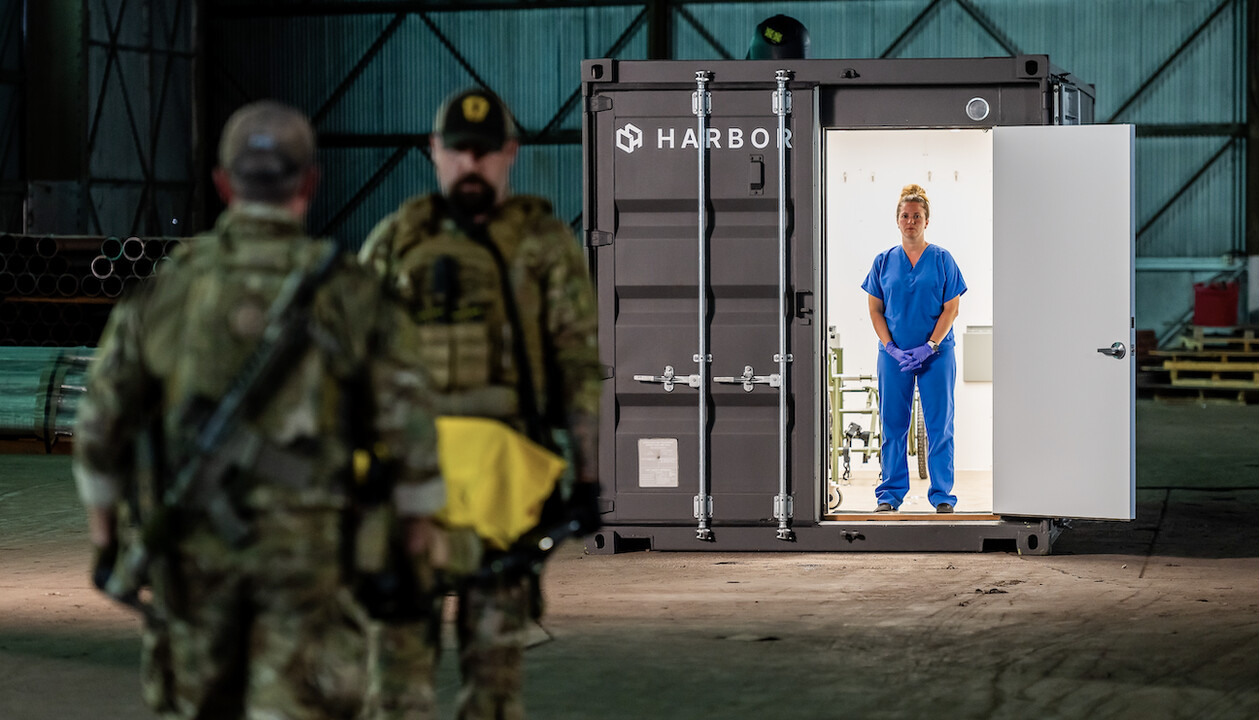
This morning, the new-age defense tech holding company announced in an exclusive release to Tectonic that it secured a Marine Corps contract for Harbor, its modern, mobile, and software-centric field hospital unit built inside a shipping container.
Hub and spokes: As a refresher, Valinor, founded and led by Palantir alum Julie Bush (hence the Lord of the Rings-themed name), has been on a bit of a tear since emerging from stealth just six months ago.
That’s in large part thanks to its fairly unique setup. Instead of focusing on a core technology and going from there, Valinor is betting that a “hub and spokes” model is the real key to speed and scale.
- Valinor works as an “operational holding company” with a central “hub” that provides go-to-market, financing, prototyping infrastructure, and legal help to its “spokes,” the subsidiary “product-companies” focused on individual technologies.
- The spokes and their employees, in turn, have more autonomy over engineering and product development, allowing them to optimize time and talent by focusing on building the tech and leaving the boring stuff to the hub.
Alongside Harbor, that’s led to a pretty (intentionally) random and ever-growing family of product-companies, including:
- Dispatch: A mobile small drone charging dock that can be plugged into different military platforms in remote environments.
- Streamline: A secure data capture tool designed for disconnected environments and distributed teams.
- Reflex: A next-generation smart optics system with advanced vision models that “embeds intelligence at the point-of-capture.”
- Condor: A speedy and attritable air- and ground-launched small UAS. Yesterday, the Army’s Europe and Africa component bought ten of them for flight testing and evaluation.
In the field: Harbor, the containerized and modernized field hospital, is the one the Marines are getting their hands on under the new contract. It comes in two variants (the Marines are buying one of each), both of which are housed in a standard 20-foot shipping container:
- Critical Care Unit (CCU): Focused on more intensive treatment, it can hold six casualties and is designed for emergency care, patient stabilization, and resuscitation procedures.
- Acute Care Unit (ACU): Designed to accommodate up to 12 patients who have been stabilized but still require continued medical care and close clinical monitoring.
The combined offering “ensures you have the complete framework for providing care out at the edge,” Valinor Chief Growth Officer Kurt Freshley told Tectonic. Both variants are kitted out with a lot of high-tech features to keep them up and running wherever they’re deployed.
- Harbor has integrated power generation to be “self-contained and [run] without any resupply for 72 hours,” Freshley said, along with “climate control, oxygen generation on board, satellite communication,” and even an “integrated bathroom.”
- The units run on Valinor’s in-house HarborOS software, which tracks medical supply stock and logistics, supports telehealth treatment, and integrates with sensors, computing power, comms, and Anduril’s Lattice.
- That Lattice integration means HarborOS can push patient and supply data from the units into “the next-gen command-and-control (NGC2) system that the Army is fielding,” Freshley added.
- At current capacity, Valinor’s Harbor team can build 300 Harbor units a year in their Texas facility, and the base price for the units is around $300,000. Valinor’s also “providing another two for the Army right now.”
Med on the move: The contract with the Marine Corps was awarded through the Marine Corps Warfighting Laboratory (MCWL) in support of the Marines’ Haven Shelter System (HSS) program, designed to “provide a new deployable medical capability,” Freshley told Tectonic.
He couldn’t disclose the contract figures, but said “they’re taking two of our Harbor variants through acceptance, testing, and validation, and then actually moving them out into operational units. This is very exciting for us at Harbor because this is an accelerated path to get our products out there.”
“It’s a very clear statement from the Marine Corps that they’re prioritizing survivability. They’re pretty much starting a new program, prioritizing larger resources and investment into it, and accelerating fielding,” he added. “These will be the first Harbor variants that go into operational units, and that’s why it’s so exciting—these will be out [there] and actually used to treat real patients. As a former Marine, I’m pretty pumped the Marines are gonna have these soon.”