Minehunting is back in vogue, and for good reason. If you’ve been keeping an eye on a certain strait off the coast of Iran, sub-sea mines—or the threat of them—have been causing a whole lot of problems.
The US Navy, which decommissioned half of its Avenger-class mine countermeasure ships last year, is looking for more answers to the mine menace that’s freezing shipping in the Strait of Hormuz and, potentially, other critical maritime chokepoints in the future. Luckily, Vatn has something up its sleeve.
In an exclusive announcement in Tectonic this morning, the Rhode Island-based autonomous underwater vehicle (AUV) startup introduced its solution to the mine-hunting conundrum: An autonomous mine countermeasure configuration of its Skelmir S6 AUV called SIGURD.
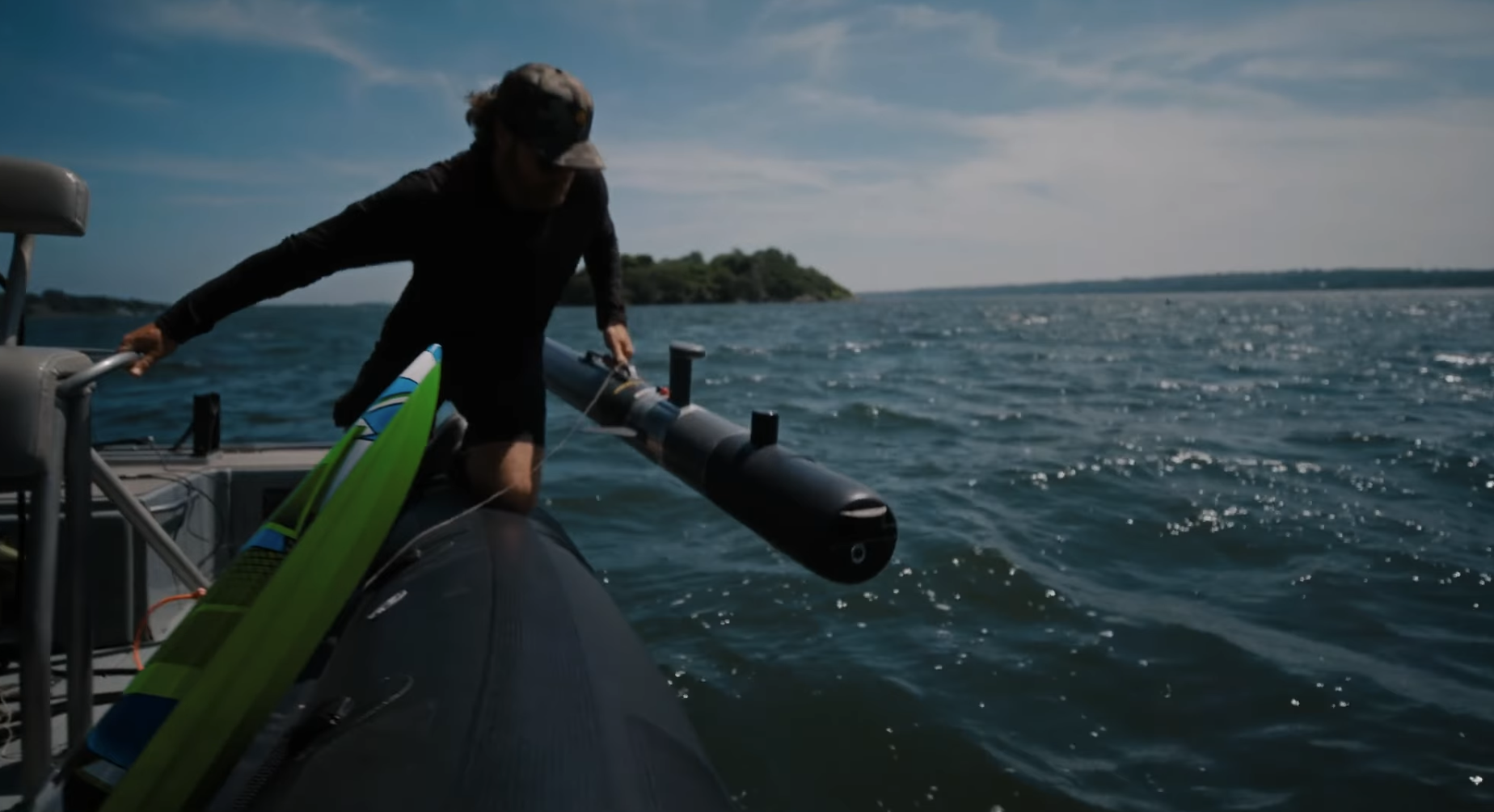
Talking Norse: If you’re a regular reader of Tectonic, you’ll be no stranger to Vatn (Old Norse for “water”). The three-year-old company, which raised a $60M Series A led by BVVC in December, builds a torpedo-like underwater drone called the Skelmir (“trickster”) that comes in two different flavors.
- The Skelmir S6: A 6-inch diameter version that can carry a 10-20lb payload and has a range of 20 nautical miles at up to 20 knots (23 mph).
- The Skelmir S12: A heftier 12-inch diameter AUV that can carry a 250lb payload and has a range of over 200 nautical miles at up to 30 knots (34.5 mph).
SIGURD is built onto the smaller 6-inch Skelmir variant and, according to Vatn, is “capable of tracking, detection, and terminal engagement at an unmatched price point,” at least relative to other pricey mine-hunters on the market.
- That includes General Dynamics’ Kingfish and Knifefish battery-powered AUVs and RTX’s Common Uncrewed Surface Vessel, which tows a floating sonar system to scan the seabed for mines.
One-two punch: Vatn’s SIGURD-flavored Skelmir, handily, offers both detection and mine neutralization through two payloads that can be deployed separately or together as a full package solution:
- The detection payload equips the S6 with a side scan sonar “capable of detecting undersea mines at operational depths of up to 100 meters, with a roughly 6-hour run time and 30 nautical mile operational range,” according to Vatn. The detection and mine-clearing software was built in-house.
- The neutralization variant (read: go boom) uses a forward-looking sensor to “execute terminal guidance on confirmed targets,” with the option of fully autonomous engagement or a human-in-the-loop approach.
- Both variants integrate with Vatn’s C2 software, which runs on the Android Tactical Assault Kit (ATAK) and WinTAK (the Windows TAK equivalent) interfaces operators already use, so “soldiers don’t necessarily [need to be] an expert in this and don’t need a multi-month training course,” Vatn CEO Nelson Mills told Tectonic. “They can train on it for a few days and be confident in its use.”
Small but mighty: Another benefit of SIGURD, compared to other options, is its size and versatility.
“There’s a need in mine countermeasures for lighter, smaller vehicles that can be deployed from anywhere,” Mills said. “You could break this down and potentially even put it in a backpack, carry it to shore, launch it offshore, launch it off a small rib, integrate [it] into USVs of all sizes, or airdrop them from larger quadcopter drones, so it just adds a level of flexibility and ease of use that just doesn’t really exist in the space right now.”
According to Vatn, SIGURD is already in testing with government customers, and in those tests against inert mines, it “has successfully detected and intercepted targets, and the system is expected to be deployable this year.”
- Right off the bat, Mills said Vatn “can [ramp up] to 40 units a month really quickly, and that’s just more production capacity than anyone else that we know [of].”
- SIGURD also conveniently comes on the heels of the Navy and DIU’s launch of the Mine Countermeasure Modernization Prize Challenge in May, which aims to put $10M into solutions that can “neutralize diverse underwater mine threats from a safe standoff distance” and be ready “for operational deployment in under six months.” Mills couldn’t confirm if SIGURD is in the mix, but said it shows “there’s a lot of interest in this right now.”
Sea world: Now, the Navy has a few other mine-hunting options beyond sea drones, including, believe it or not, dolphins. But Mills thinks Vatn still has the edge on the natural world for a few reasons.
“Dolphins are super effective, but the problem is that dolphin factories are having trouble scaling. It’s a very time-intensive process to train them, and they’re very difficult to fly around,” he said. “The advantage of a system like ours is it’s a lot cheaper, you can make a lot more of them, it’s more deployable, so yeah, that’s where I’d say we compete with dolphins.”
Dolphins also don’t come with a neutralization payload. At least we hope not.