If you still had any doubts that Europe was getting serious about defense (and defense tech), well, we’re back with even more evidence to prove you wrong.
Yesterday, Warsaw-based VC Expeditions announced that it’s raised a €197M ($224.5M) Fund II, which it says will “address Europe’s critical capability gaps, as well as strengthen economic and industrial resilience.”
The fund was backed by some pretty major institutional players, including new LPs BAE Systems, the European Investment Fund, and Keysight Technologies. Existing LPs, including the Polish Development Fund (PFR) and the NATO Innovation Fund (NIF), also doubled down.
- Expeditions was one of the two funds (alongside Lakestar) that BAE invested €25M in back in June.
To note: The initial goal was €75M for Fund II. We’d call that majorly oversubscribed.
Old hat: Expeditions has become an extremely serious player in European defense VC since it was founded by Mikolaj Firlej and Stanisław Kastory in Warsaw back in 2021.
- The fund took a bet on European defense early—they were investing primarily in defense and security even before the full-scale Russian invasion of Ukraine in 2022.
- Firlej has been working on autonomy systems since prehistoric times, in defense tech terms. As in, he has a PhD focused on AI-enabled and autonomous weapons systems from Oxford and has been researching the subject since 2015.
- Expeditions’ first fund—launched in 2021—was just €15M ($17.1M). Going from €15M to €197M is a truly wild jump.
Big spenders: Firlej and Kastory took all that autonomy and defense knowledge and put it to pretty good use.
In the last five years, they’ve made early-stage bets on some of the biggest names in European (and international) defense tech, including:
- Dominion Dynamics: The Canadian neoprime founded by former Anduril exec Eliot Pence, building software, sensors, and autonomous systems focused primarily on the Arctic. They just closed a $100M Series A.
- Orqa: The Croatia-founded producer of NDAA-compliant FPV drones. Super active in Ukraine, and expanding quickly in the US and Europe. The company also provided parts for a ton of the drones in Drone Dominance.
- Cambridge Aerospace: The ultra-sneaky low-cost air defense company founded by a former Cambridge and MIT professor and a bunch of British military heavyweights (plus Auctor founder Junaid Hussain). The company has already raised over $100M in funding and is reportedly in talks to raise another $300M-ish at a $3.5B valuation.
- Frankenburg Technologies: The Estonia-based low-cost interceptor company that just raised a €30M Series A (and is reportedly in talks to raise another €100M).
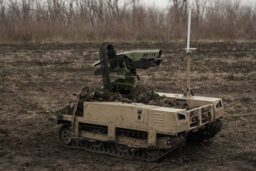
- UForce: The Ukrainian defense tech legend (and conglomerate) behind the Magura USV—which has taken out an estimated 30 percent of Russia’s Black Sea Fleet. The company raised a $50M seed (yes, seed) earlier this year.
- Comand AI: The French planning and C2 company that just teamed up with Saab and Airbus and raised a $32M Series A.
According to Expeditions—citing research by Cambridge Associates—its performance so far puts it among 0.01 percent of venture funds globally.
Blow up: We asked Firlej what he thought was behind the massive (and we mean massive) jump between Fund I and Fund II. He told Tectonic it comes down to a few factors:
- First, there’s been a huge influx of entrepreneurs into defense—including proven founders who’ve been successful in other industries. He gave the example of Florian Fournier, founder of defense AI company Orasio. He previously founded PayFit—an HR and payroll unicorn that has raised hundreds of millions of dollars. Expeditions has become a go-to fund for these proven founders, Firlej said.
- Second, Europe is (finally) realizing that it can no longer rely on the US. “The US is now reorganizing its interests, and is gradually decoupling from Europe, at least in terms of the direct guarantees of security,” he said. “Europeans realize that, and finally are trying to get [their] act together by reindustrializing the continent and addressing some of the critical capability gaps.”
- Plus, institutional investors—say, the European Investment Fund, for example—are finally willing to chuck their money towards straight defense (rather than solely towards dual-use tech or broader resilience). Firlej said that Expeditions personally “managed to revise the internal policies of two institutions, which then led them to invest in Expeditions,” and other defense-focused funds.
Firlej highlighted how very quickly sentiment towards defense investment in Europe is changing. When they started fundraising last year, he said, “large institutional LPs were not willing to invest in pure defense type companies,” and there were only about three defense tech unicorns on the continent.
Now, a year later, by his count, there are 11.
Make it rain: So far, Firlej said that Expeditions has already made about 20 investments totaling €60M ($68.3M) out of Fund II. That gives them a whole lot of leftover cash money to play with.
- The fund plans to invest up to €20M per company, and Firlej said they will definitely double down on some of their Fund I players.
- Investments out of Fund II so far include Orqa, Orasio, Comand AI, and UForce, Firlej said.
Everything is computer: One of the areas that Firlej said he’s keen to dive further into with this new fund is quantum. “We are very interested in the possibility of using quantum computing for the defense industry,” he said.
“Generally, the [usability] of quantum so far is mostly evidenced in navigation in GNSS denied environments. This is the first, most immediate use case, particularly of quantum sensing, but there is so much more.”
- They’ve also invested in Sygaldry, Chad Rigetti’s new company, focused on building a novel quantum computer.
He’s also excited about cyber—especially “unconventional cybersecurity companies.” In case you didn’t get it, that means the ones that do offensive stuff.
Hot take: So, we had to ask: What is Firlej less keen on? He had a spicy take: Drones and counter-drone systems.
“People are building these drones oftentimes with no sophisticated custom AI on board…just building drones for the sake of drones, and they are, I think, coming close to commodity status,” he said.
Same goes for c-UAS. “There are just too many, in my view, companies that are building fairly similar drone-based counter-UAV solutions,” he added.
No kings: Plus, he said, he’s wary of the trend of piling a ton of cash into single companies—he calls this the “king-maker” approach.
“The venture mind developed the idea that we should put as much money as possible into this specific asset, regardless of how that company is performing, because they will be the king-maker,” he said. “They will dominate the whole market, and then they will do acquisitions [and] they will figure it out, because the money itself is the advantage.”
He sees this as massively risky. “The strategy could work, but it’s incredibly dangerous in defense because it separates the performance from funding and it leads to speculation,” he said. “In the defense industry, there’s nothing worse for end users than when you make statements that do not match the reality of their experience with the systems.”
“We’ve already seen numerous examples of the same pattern in the history of venture capital, which…led to the erosion of trust generally in capital markets, because some of these well-funded assets went bankrupt,” he added. “We can’t afford that level of disaster in European defense tech, because what we are doing goes way beyond pure capital markets. We need to reindustrialize, and we need to build proper deterrence against Russia…if we don’t do that, then we face an existential threat.”