Firestorm is, well, on fire.
The San Diego-based 3D-printed drone startup announced today that it’s raised an $82M Series B led by Washington Harbour Partners to scale production of its xCell containerized drone microfactories, “facilitate execution of contracts, and expand into a number of states around the country,” CEO Dan Magy told Tectonic.
- New investors In-Q-Tel, Ondas Capital, Motley Fool Ventures, Litquidity Ventures, and Geodesic also participated in the round alongside repeat backers Lockheed Martin, New Enterprise Associates (NEA), and Booz Allen Ventures.
Looks like Firestorm’s drone printers are turning into money printers.
Fired up: We’ve covered them before, but for a bit of context, Firestorm was founded in 2022 and has since made a name for itself with its 3D-printed drones and mobile manufacturing units (that’s xCell) designed to build them. (Magy’s hair also doesn’t hurt.)
Here’s what they’ve been up to:
- Their flagship drone, the 6.5-foot Tempest, has a range of 400 miles, six hours of endurance, and a ten pound payload capacity. They’ve also developed a 3D-printed quadcopter with Croatian dronemaker Orqa FPV called the Squall.
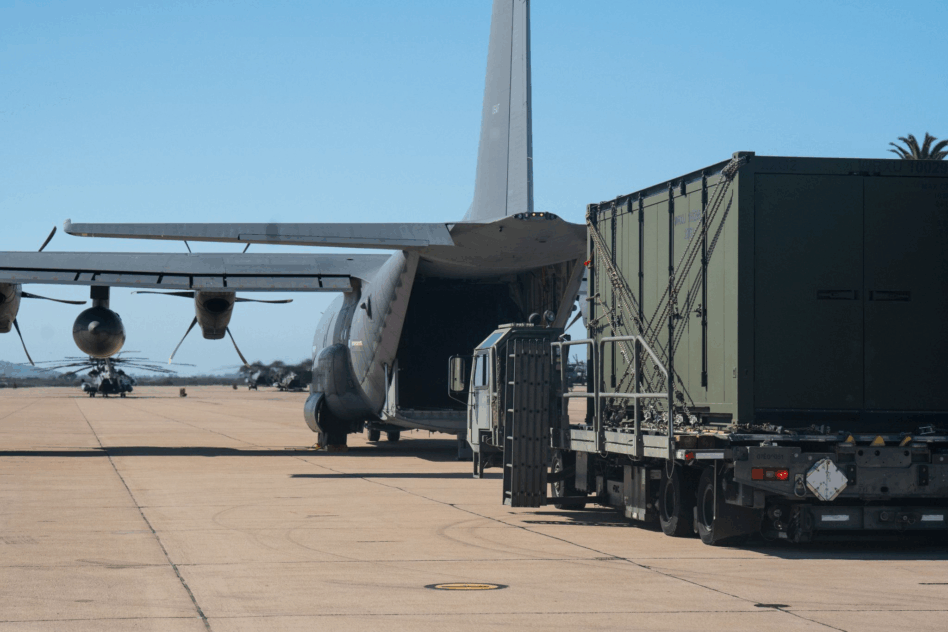
- The drones are cool and all, but xCell is Firestorm’s real difference-maker. The drone-printing micro-factory can work off-grid and be transported on a trailer, airlifted in a C-17 or C-130, sling loaded with a CH-47 Chinook chopper, or moved by sea.
That tech has been a hit with backers and buyers alike:
- Firestorm raised a $12.5M seed round led by Lockheed’s venture arm back in 2024 and a $47M Series A led by NEA last July. Other Series A backers included WHP, Booz Allen, and their old pals at Lockheed, which has pitched in on all of their rounds to date.
- The company was awarded a $100M IDIQ with the Air Force, which Magy said is “like our credit card,” a STRATFI award for their UAS last March, and an $18M ceiling SBIR Phase II for xCell last November.
- Magy also told Tectonic that Firestorm has “another big [contract] in the mix too,” which he couldn’t reveal too much about, but said “it’s very pertinent to the Middle East.”
Cell service: xCell’s increasing popularity and the role frontline manufacturing is starting to play in the modern battlefield was a big reason for the raise.
“Since last July, we’ve continued to win contracts and get traction domestically, and we’re starting to see our first overseas traction as well, but what we see is a broader opportunity beyond just the drones,” Magy said. “Industrial-grade 3D-printing is finally starting to be looked at as a need-to-have across the DoD and overseas—50 to 70 percent of the Ukrainian drones, depending on who you talk to, are 3D-printed. Everyone’s kind of waking up to it.”
“A lot of the folks in the Army just got done doing a whirlwind tour of EUCOM, and they’re like, ‘Holy shit, Ukraine is 3D-printing everything, and we’re not really printing anything,’” he added. “Our long-term, biggest customer is aggressively waking up to the need for distributed, in-the-field manufacturing that’s supported by very strong central manufacturing.”
Drone dollas: That interest also extends to investors.
“The people who have inside knowledge on our company and an understanding of where the market is going are kind of preempting a huge round here,” Magy said. “[Investors] think that the more money we have, the faster we go, the more market share we can win.”
In case you missed that subtle hint, that could mean another big round is on the horizon for Firestorm. According to Axios Pro, the company is in talks to close another $100M in debt and other funding to fuel its overseas expansion and is eying its next round as soon as this year.
Like we said, Firestorm is on fire.